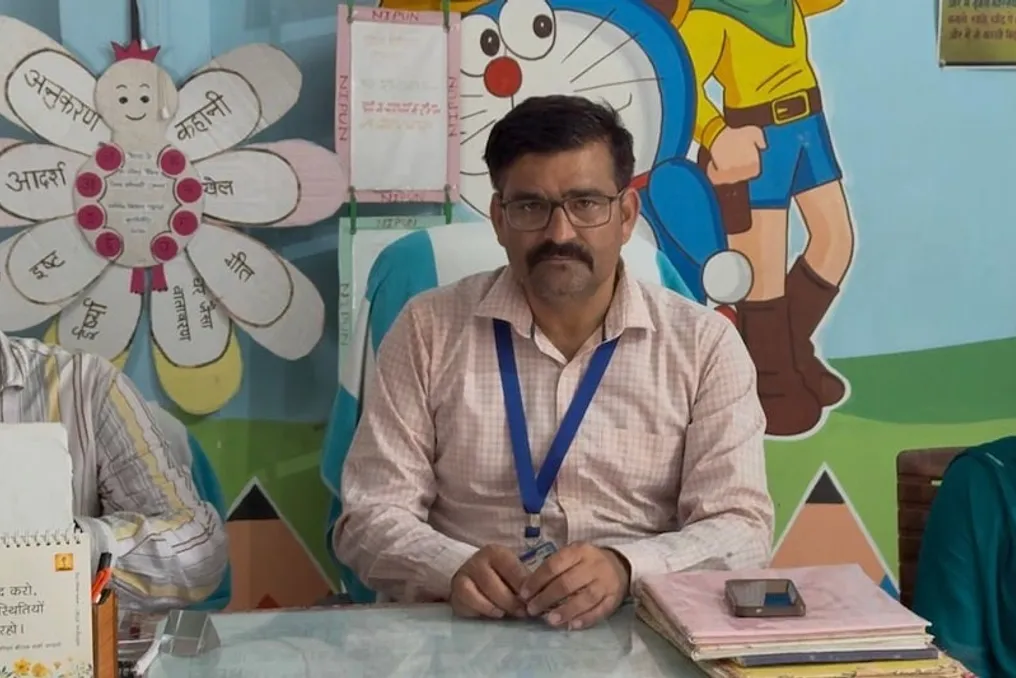
Bridgeshwar Yadav, who initially aimed to serve the country as an IAS or IPS officer, decided to become a teacher after failing the final UPSC selection. Today, his efforts in education have led him to be preparing to receive the State Teacher Award from the Chief Minister of Uttar Pradesh, Yogi Adityanath.
Yadav, a native of Sambal district, transformed a government school not just into a place for learning, but into an educational institution providing children with a favorable and spiritually enriched environment. He began his career in the basic education system, becoming a teacher in 2009 after obtaining a BTC certificate in 2001.
In 2015, Bridgeshwar Yadav took up the position of director at the Comprehensive Primary School in Rasulpur village, located in Sambal district, Ghunnur block. Upon starting his work, he found that although the school's condition was acceptable, the number of enrolled students and their attendance was low. Together with his colleagues, he developed a plan to change the direction and condition of the school.
The director focused primarily on increasing the number of students. He actively engaged with parents, raising awareness about the necessity of regular school attendance for children. Through constant dialogue between teachers and parents, families were made responsible for their children's education. As a result, 425 students are now studying at the school, with the number of girls exceeding that of boys.
Parallel to the increase in enrollment, attention was paid to regularity of attendance. The director and his colleagues explained to parents that simply having a child's name on the list was not enough; their daily presence and participation in classes were important. These measures helped raise attendance to approximately 90%.
To improve the physical environment of the school, the teachers developed a detailed plan. With the support of the community and Corporate Social Responsibility (CSR) funds, various works were carried out. Thanks to CSR support from Narora, a natural science and ICT laboratory was created. The school walls were decorated with messages related to education and upbringing so that children could learn not only from books but also from their surroundings.
Images dedicated to hymns such as 'Vande Mataram' and the national anthem were placed on the school walls, along with posters about the Panch Pran oath, seven principles, and Surya Namaskar. Thoughts of Swami Vivekananda were written, and the mother Saraswati was depicted. These steps completely changed the atmosphere in the school. To make the school child-friendly, drawings were made everywhere that motivate students to read and learn.
Now, teaching in the school is not done only with a traditional blackboard. After the installation of smart screens initiated by the Basic Education Department, teaching using digital technology has begun in some classes. Teachers strive to make teaching more effective by utilizing the ICT laboratory and ICT tools. Alongside improving the quality of education, new experiments are constantly being conducted.
Changes in the school atmosphere have been noticeable in the children's behavior. According to the director, children greet teachers by touching their feet upon entering the school. They then pray before the image of Mother Saraswati, lighting incense sticks, before heading to class. Children are also encouraged to express their opinions and share their problems. Bridgeshwar Yadav emphasizes that the school environment must always be child-centric and friendly to them.
Bridgeshwar Yadav believes that the goal of education is not only to transmit knowledge from books but also to shape worthy citizens connected to the traditions of Indian knowledge. It is with this thought that various activities and experiments have been introduced in the school. His aspiration is for children to master not only education but also values and a sense of responsibility to become good citizens for the country and society in the future.
Speaking about receiving the state award, Bridgeshwar Yadav recalls that he started working in the Basic Education Department in 2009 and became the director of this school in 2015. When he took charge, he noticed the lack of enrollment and low attendance. After consulting with colleagues, he began working to improve the material condition of the school. With community support, many works were carried out, and public support gradually began to grow.
He notes that thanks to the cooperation of all teachers in the school, the ICT laboratories and other ICT tools are being used effectively. He also says that when children see anything around them...
>