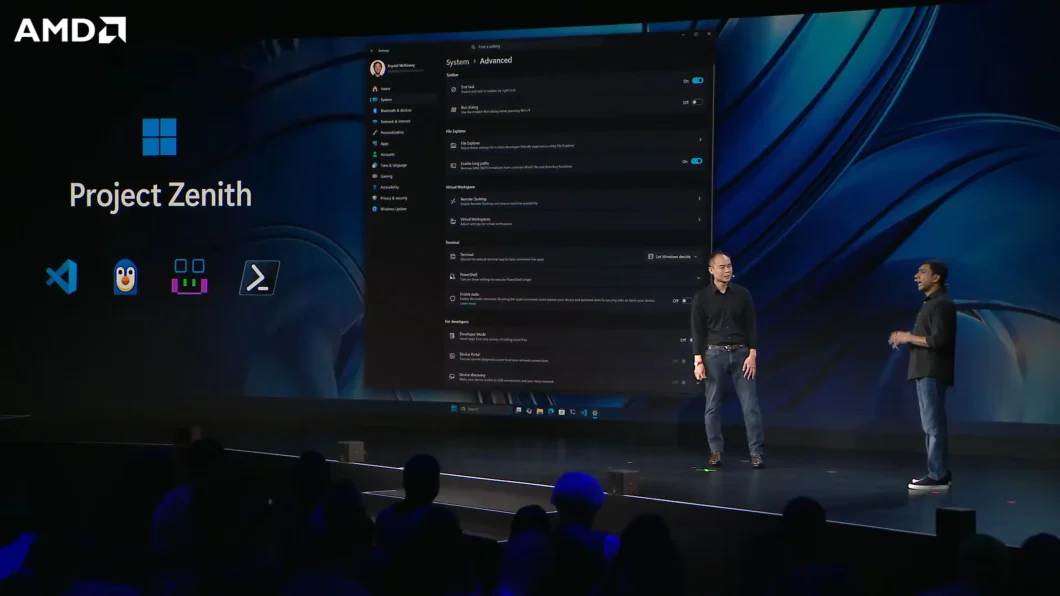
Microsoft introduced Project Zenith, a specialized version of Windows 11 that is pre-configured and designed to be distraction-free. This operating system edition is specifically aimed at developers, with a strong focus on artificial intelligence. The announcement was made this Friday, September 4th, in Berlin, during IFA, in partnership with AMD.
The company's goal is to provide a fully functional programming environment from the moment of first boot, which represents significant time savings in the setup phase. Furthermore, this initiative is centered on cutting-edge hardware capable of processing large language models directly on the computer, eliminating the need for cloud connection.
To build this distinct environment, several adjustments were implemented in the operating system. For example, File Explorer now displays extensions, hidden files, the details pane, and the full path in the title bar by default. To ensure the interface remains focused, Microsoft chose to disable functionalities considered unnecessary, such as account notifications and viewing recent files in the Start Menu.
The computers also come pre-loaded with Windows Terminal and Visual Studio Code pinned to the taskbar. Crucial tools for professionals, including GitHub Copilot, PowerToys, WinAppCLI, and Windows Dev Skills, are installed out of the box.
Another highlight is the enhancement of the Windows Subsystem for Linux (WSL), which promises a more efficient way to develop, run, and interact with Linux workloads without the user having to leave the Windows environment. Additionally, the system's security structure has been strengthened to support the creation of applications based on autonomous agents.
For a device to qualify as a 'Project Zenith PC,' it must meet quite rigorous specifications. The requirements list stipulates a minimum of 64 GB of unified memory, with a bandwidth exceeding 250 GB/s, following the same standard adopted in Apple devices.
AMD used IFA to confirm the first model to integrate this ecosystem: a mini PC equipped with the Ryzen AI Halo chip. Other manufacturers are expected to present similar devices in the coming months.
The combination of this optimized hardware with specialized software has a very clear purpose. According to Logan Iyer, Corporate Vice President of the Windows Platform and Microsoft developer, these specifications allow for the local execution of AI models containing over 30 billion parameters. This native execution capability eliminates token costs, which should result in more accessible and faster projects.