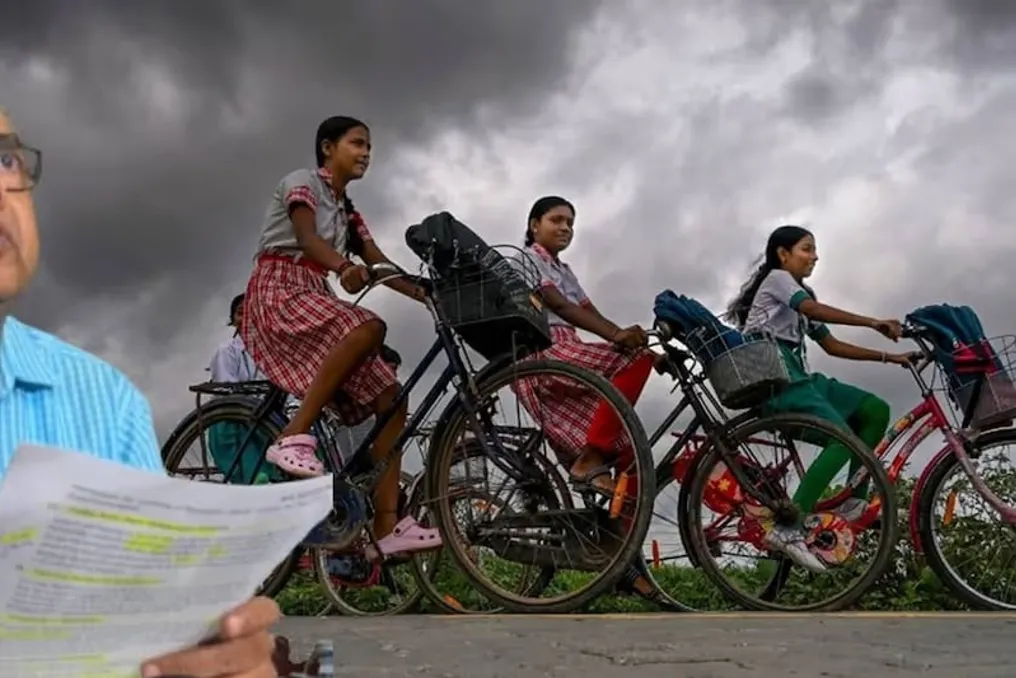
The Health Minister of West Bengal, Sharadwat Mukerji, gave an unusual recommendation to the state's school students: for the next three months, girls should refrain from wearing skirts and instead wear salwar. He also advised boys to attend school in full trousers and shirts.
The Minister noted that girls should wear salwar that cover their legs, and they should not use knee-high stockings because they might stick to the legs due to their thinness. He emphasized that these three months—September, October, and November—are important for health. Furthermore, he strongly recommended that boys wear full trousers and shirts.
Various public opinions arose after the minister's statement. Some argue that wearing leg-covering salwars helps somewhat in protecting against mosquito bites. However, the discussion was not limited to this. Dr. Utpal Banerjee, Secretary of the Association of Medical Services Doctors, stated that the idea of covering the body with clothing to prevent mosquito bites is correct, but it is insufficient to stop dengue cases. He added that sources of mosquitoes must be eliminated, public awareness must be raised, and proper medical infrastructure must be provided to combat dengue.
Banerjee also expressed the opinion that no modern civilized society should allow government control over what a citizen wears, eats, or thinks. Nevertheless, he acknowledged that if it is done for the sake of health, it is necessary to follow it for a certain period, although this is not a final solution to the problem.
Renowned medical expert, Dr. Rudrayat Pal, agreed that the health minister's statement aligns with the medical point of view. He explained that wearing long-sleeved shirts and trousers will reduce the risk of mosquito bites, which in turn reduces the probability of dengue infection. Therefore, he urged parents to take this into account, as well as observe other precautions such as preventing water accumulation and sleeping under a mosquito net.
Manas Barman, Coordinator of Medivijyan for South Bengal, stated that the health minister's recommendations were given with the safety of the students in mind. He believes that the minister's advice on wearing leg-covering clothes is not bad, and noted that the minister spoke not only about girls but also about boys' clothing. Since dengue outbreaks are increasing during this period, he gave similar advice. Barman also stressed that the health minister himself is a doctor, and he should only be criticized after a full understanding of the situation.
During the monsoon season, the dengue situation in West Bengal becomes alarming. As of 2026, more than 4000 dengue cases have been registered in West Bengal, which is approximately 50 percent less than the more than 7600 cases in the same period last year. Currently, there are about 148 active cases in the state, with 7 deaths officially recorded from dengue.
The districts most affected by dengue are Kolkata, Howrah, North 24 Parganas, South 24 Parganas, and Murshidabad. Cases have also been observed in some parts of Chakdah in Nadia and Murshidabad.