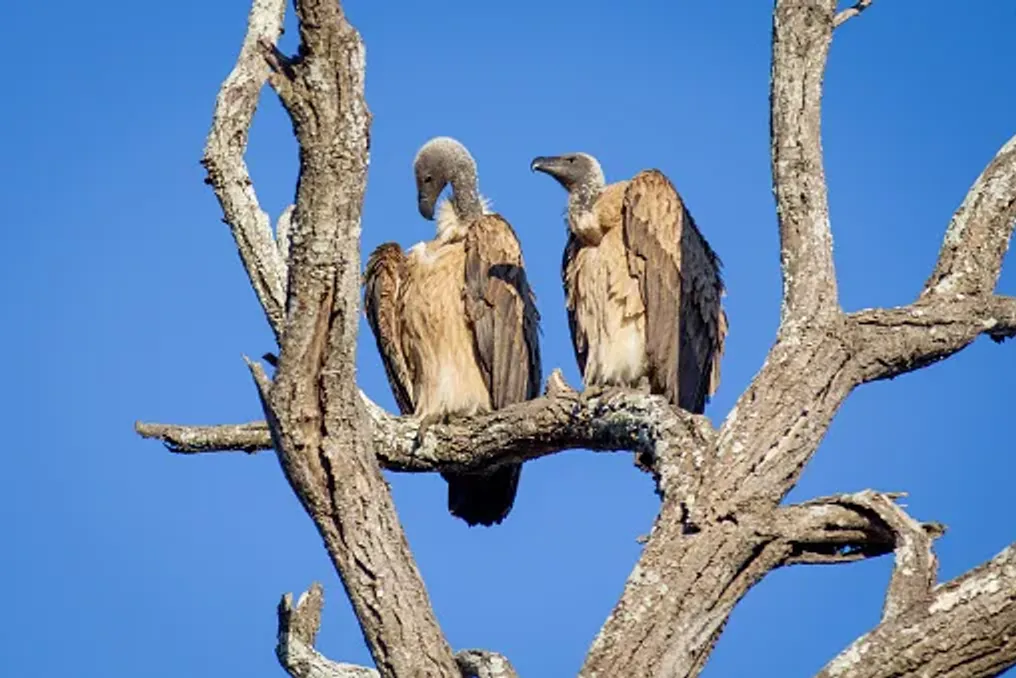
Despite the fact that vultures often have an unfavorable reputation as gloomy birds circling overhead awaiting death, they are among the most outstanding specialists in nature. These highly adapted scavengers can soar for hours with minimal effort, digest carcasses dangerous to many other animals, and locate food over long distances. Some species show care for their young, form long-term partnerships, and at least one species has mastered the unusual talent of tool use.
Nevertheless, these amazing birds are among the most vulnerable groups of birds in the world. Vulture Awareness Day highlights eight facts that can change the perception of these often misunderstood birds. The annual awareness day is held on the first Saturday of September.
One of the most impressive aspects of vulture flight is their manner of movement. Instead of constantly flapping their huge wings, many vultures use rising columns of warm air known as thermals. They circle in these invisible currents, gaining altitude and covering great distances while conserving precious energy. This is especially useful for a scavenger that needs to cover vast territories in search of a carcass.
Some vultures are also among the largest flying birds on Earth. For example, the Andean Condor can have a wingspan of about 3.2 meters and weigh up to 15 kg. For vultures, soaring is not just a spectacle but a vital element of their survival.
Consuming decaying animals involves obvious risks, including exposure to bacteria and other pathogens that can seriously ill many animals. Vultures have developed an exceptional solution: extremely strong stomach acid. The acid in their stomachs can reach a pH level of about 1.5, allowing them to digest carcasses and helping them cope with potentially harmful microorganisms found in dead animals. This adaptation is one reason why vultures are so effective in their ecological role. While other scavengers may leave parts of a carcass, vultures are capable of consuming large volumes of dead animal tissue relatively quickly. Their digestive system effectively allows them to eat food that would be dangerous to many other species.
Vultures should not be portrayed as creatures blindly waiting for the next meal. Many Old World vultures possess exceptionally sharp vision and can scan vast areas, soaring high above the ground in search of signs of a carcass. Their ability to find food in the air is a great advantage in open landscapes where finding a single carcass from the ground can be difficult.
However, not all vultures rely on sight equally. Some New World vultures, including turkey vultures, have an excellent sense of smell and can detect carcasses from significant distances. This means that different vultures have evolved different sensory strategies to solve the same problem—finding dinner in a very large landscape.
Although the word 'vulture' does not evoke associations with devoted motherhood and fatherhood, these birds can be wonderfully attentive parents. Vultures usually form monogamous pairs and choose secluded places such as cliffs, caves, and tall trees for nesting. Both parents typically take turns incubating eggs and helping to raise chicks. Their relatively low reproductive rate makes every chick important. For species already under pressure, the loss of an adult bird can have consequences extending beyond the death of that individual. A bird that could reproduce for years is removed from the population, while creating a replacement generation can take a long time.
Furthermore, vultures are not necessarily solitary creatures, as their sinister reputation might suggest. Many species are very social, gathering around food and using communal roosting sites. Their feeding behavior can also involve the arrival of a large number of birds at a carcass, sometimes creating a spectacular, albeit somewhat chaotic, congregation. They also communicate through body language, visual displays, and vocalizations. Their social life extends to partner relationships: vulture species often form long-term pairs, with some returning to the same nesting sites year after year. Thus, although a group of vultures gathered around a carcass may look ominous, it is actually an example of an efficient social feeding strategy.
Perhaps this is the most important thing to know about vultures. Dead animals are an inevitable part of every ecosystem. If carcasses were simply left to rot where they fell, they could become breeding grounds for pathogens and attract other scavengers. Vultures help rapidly process these remains, recycling nutrients and contributing to ecosystem function. Their powerful digestive systems are particularly valuable because they can consume carcasses containing microorganisms potentially dangerous to other animals. Vulture Awareness Day describes them as the 'cleanup crew of nature,' emphasizing their role in removing dead animal remains and maintaining healthy ecosystems. In other words, vultures perform work that is extremely difficult for humans to replicate.
The Egyptian vulture possesses a trick that resembles a clever primate more than a bird. It can use stones as tools to break open large eggs, including ostrich eggs. The bird picks up a suitable stone with its beak and repeatedly throws or strikes the egg until the shell cracks, allowing it access to the contents. This behavior is one of the best-known examples of tool use among birds.
Egyptian vultures are interesting for another reason: some populations undertake massive migrations, traveling thousands of kilometers between breeding and wintering grounds. BirdLife International notes that some can travel up to 640 km a day during migration.
So, the next time you see a vulture quietly perched on a branch, do not assume nothing is happening. Despite all their remarkable adaptations, vultures are in trouble. Vulture Awareness Day estimates that about 70% of vulture species are threatened, making vultures one of the most vulnerable groups of birds. Major threats include poisoning, illegal hunting, habitat loss, electrocution, and collisions with energy infrastructure.
South Africa is particularly important for vulture conservation, as several species face serious threats. For instance, the Lappet-faced vulture is currently classified as vulnerable. BirdLife South Africa identifies threats including poisoning, collisions with power lines and wind turbines, electrocution, loss of foraging habitat, and unsustainable harvesting. Since 1996, over 1900 individual Lappet-faced vultures have been recorded colliding with or being struck by electrical infrastructure, although not every incident is fatal.
Other South African vultures face even greater pressure. Current Red List information from BirdLife South Africa lists species such as the White-backed, Hooded, and White-headed vultures as being at very high risk of extinction. Poisoning is particularly devastating because vultures often feed in large groups. Consequently, one poisoned carcass can kill many birds. BirdLife South Africa has also documented lead poisoning in South African vulture populations, including a link between lead fragments in fragmented animal carcasses and poisoning.
Vultures are not glamorous like big cats, elephants, or wild dogs. They do not have the reputation of mighty predators. But this is what makes them fascinating. They are soaring experts, highly specialized scavengers, devoted parents, and vital members of healthy ecosystems. Their seemingly unpleasant diet has given them adaptations possessed by few other animals, while their disappearance could have consequences far beyond the loss of a single bird species. On Vulture Awareness Day, the next time you see a vulture circling over the landscape, look a little longer. You might be observing one of nature's most underrated specialists at work.
}))