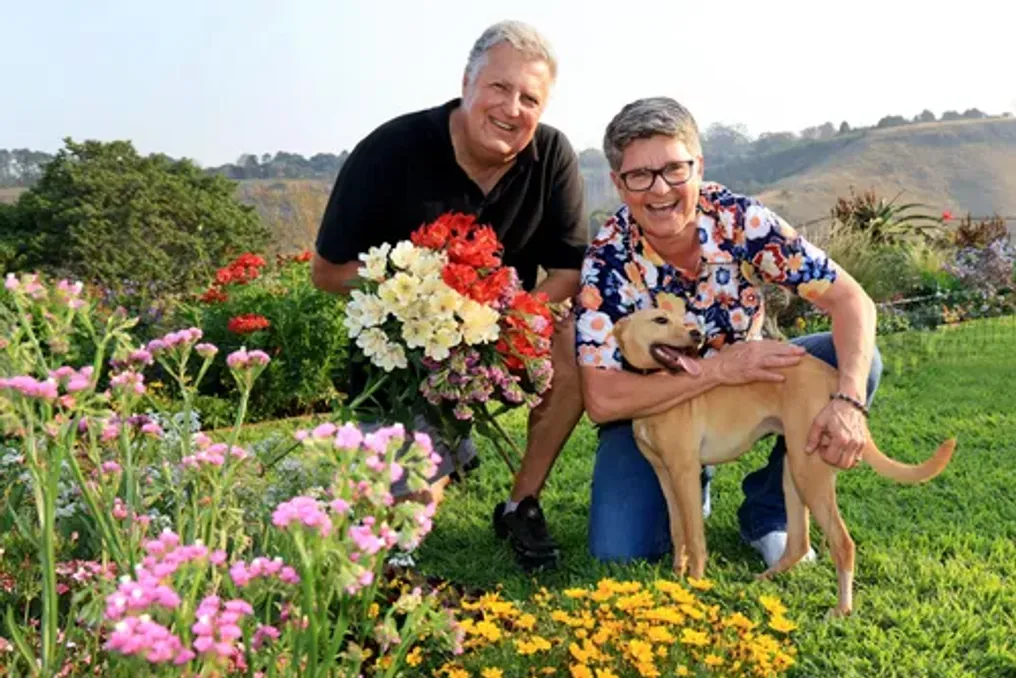
Ahead of the Spring Show Lifestyle & Garden event, organizer Brad Raat visited Tani Wisser's garden to learn what makes a spring garden perfect. During her visit to the magnificent Wisser garden in Assagay, she shared numerous tips.
Wisser emphasized that she does not follow traditional gardening approaches, asserting that the garden belongs to the owner, and the owner sets the rules.
Her passion for gardening stems from her childhood in the small coastal town of Umzingo. She recalls that her family was very traditional: her mother worked at Standard Bank, and her father was a builder working at Illovo Sugar. During family celebrations, they often traveled with plants. Her father grew roses and vegetables, while her mother loved orchids and anthuriums, making gardening a legacy and a memory for her.
In the small town where there were no shopping malls, they engaged in gardening. Everything her father grew was sold to help the family. All three children were interested in this activity; the middle brother, who passed away, was probably the best gardener, the older brother loves roses, and Tani herself prefers everything beautiful, symmetrical, and orderly.
She says she simply wants to grow plants because it is her quiet and sacred place where no one judges. There, she can do whatever she wants, invent her own rules, and listen to what the plant says to learn how to care for it properly.
Wisser believes that in spring, the garden should be in full bloom. The main work during this time is deadheading to stop seed production, as all the plant's energy is directed towards this. Removing faded buds tricks the plant into focusing on maintaining its appearance and creating new flowers and seeds.
She also advises using fertilizers if available. Following the instructions on the packaging is enough to ensure the plants have a long life. Similar to diets that work when rules are followed, gardening requires adherence to specific methods.
Spring is the ideal time to prepare the lawn for summer by providing it with good nutrition. She recommends starting with something like 232 or Atlantic Bioganic, and after about four weeks, using Turbo Grass or 713 to give it a bright green color. It is important not to rush and to encourage root development, as without a good root structure, the desired green color cannot be achieved.
Roses require special care and feeding separate from other flowers. Wisser describes it as: 'Roses are on N2, and other flowers are on N1.' She warns that roses located at the top of the highway are an ideal environment for fungal diseases, so she recommends organic sprays and uses orange oil extract, which has powerful antifungal and insecticidal properties.
Another hobby is using homemade compost around young plants as mulch. This protects the soil, nourishes it, prevents weed growth, and regulates temperature. Even on very hot days, the ground remains moist.
Wisser also enjoys planting vegetables among flowers. For example, instead of planting a tree for shade, she might plant a lemon tree, but then lemons will grow. She mentions the beautiful Violet of Provence artichoke, which, due to moths, is planted in a large plastic pot and buried in the ground. She grows it not for the artichokes, but for the flowers and bees, noting that there are no rules prohibiting this.
Succulents hold a special place in Wisser's heart; she cultivates them in five tunnels in the back garden. Her love for succulents is linked to the rhythm and architecture of these plants. They follow a certain pattern, which calms her, especially considering her ADHD. She notes that there is mathematics in every succulent, which is admirable in itself.
She demonstrates a collection of Aeoniums from the Canary Islands, saying that these plants are 'God-made' and eliminate all noise. There is no Wi-Fi or internet there; you have to talk to the plant, listen, and observe carefully because it won't send an email about needing water.