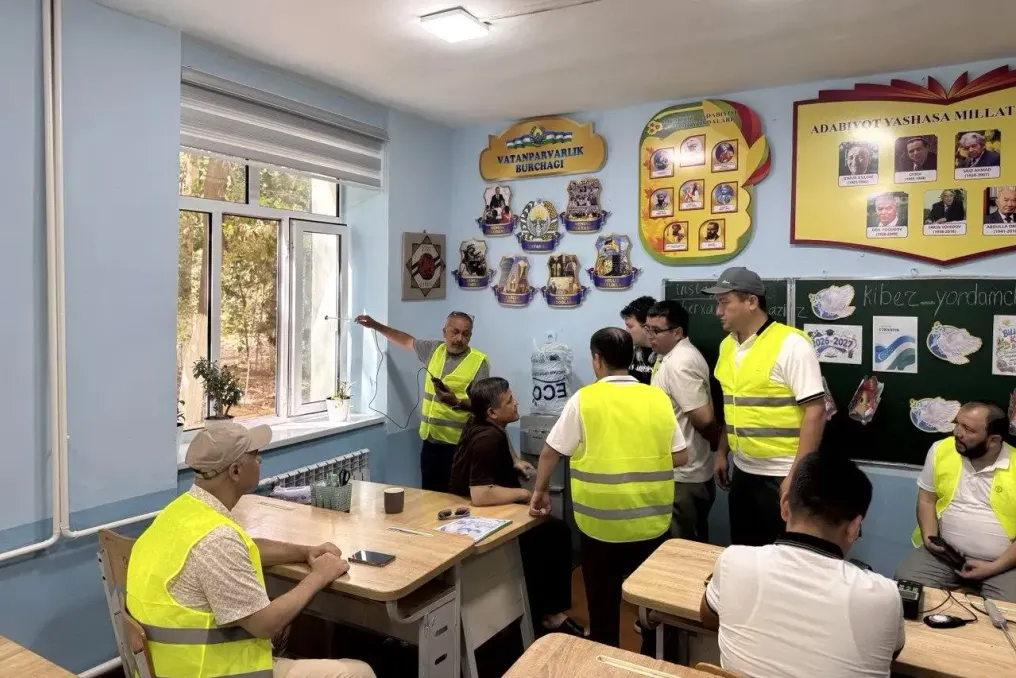
The United Nations Development Programme (UNDP) and the National Agency for Energy Efficiency in Uzbekistan conducted a series of two-day training courses on energy auditing. These trainings were organized for Energy Service Company (ESCO) projects and took place from August 13 to August 28, 2026.
Eighty specialists participated in the training from cities such as Tashkent, Samarkand, Fergana, and Karshi. Participants included energy auditors, private sector representatives interested in working under the ESCO model, and employees of state institutions.
This initiative is part of the project 'Energy Audit – Unlocking the Potential of Public Building Energy Efficiency' and is implemented within the broader Public-Private Financing for Development (PPFD) program with financial support from the Ministry of Finance of the Slovak Republic.
The main focus of the training was on developing practical skills necessary for preparing energy efficiency improvement projects for public infrastructure, including schools, hospitals, kindergartens, and other government buildings. Reducing energy consumption in such facilities helps lower costs and improve conditions for users.
In ESCO projects, a high-quality energy audit is essential for determining the baseline energy consumption, identifying potential efficiency measures, and assessing potential savings. The data obtained is also used to establish performance indicators and subsequently evaluate achieved results.
Shokhzahon Islamov, a representative of the National Agency for Energy Efficiency, emphasized that for the successful development of the ESCO market, it is critically important that all participants have confidence in the reliability and transparency of energy savings assessments. He noted that developing the practical skills of private energy auditors will help strengthen trust among state structures, ESCO companies, and potential investors.
The first day of training was dedicated to studying the legal and technical foundations of conducting energy audits in both Uzbekistan and the European Union. Participants familiarized themselves with different types of audits and their application at various stages of ESCO projects, including Walk-Through Audits and Investment Grade Audits.
Special attention was paid to determining the baseline energy consumption and adjusting data according to weather conditions and building operational characteristics. Furthermore, participants reviewed measurement and verification methods in accordance with the International Performance Measurement and Verification Protocol (IPMVP).
The second day focused on practical work. Groups of participants worked on selected public facilities in each region. They established the baseline energy consumption, adapted indicators to climatic conditions, calculated potential savings, and selected methods for verifying achieved results.
Muhaiyo Latipova, an energy auditor from Fergana, noted the practical value of the training, pointing out that specialists worked with real building data and independently performed calculations for ESCO projects. The materials and calculation templates provided during the training can be used by participants in their future work to assess energy efficiency measures and justify expected and actual energy savings.
According to UNDP international expert Yura Klukan, the development of the ESCO market in Uzbekistan requires not only a regulatory framework and access to financing but also the presence of specialists capable of preparing technically sound and high-quality projects. The training program combined international approaches with practical assignments adapted to the country's conditions.
UNDP added that as the ESCO market grows in Uzbekistan, the demand for specialists capable of conducting high-quality energy efficiency assessments and verifying the results of implemented projects will increase.