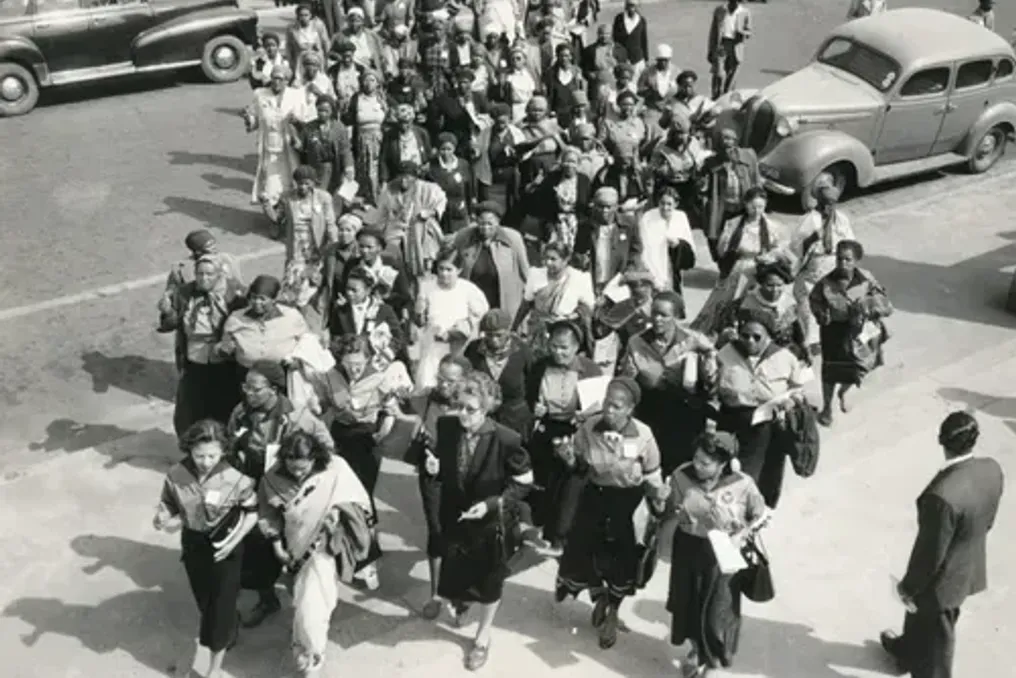
The recent appropriation of the history of the 1956 Women's March by the international whisky brand Glenlivet has sparked strong criticism, serving as a reminder of the ongoing fight for women's rights and recognition.
Public reaction to the use of the image of the 1956 Women's March, which involved over 20,000 women in an anti-protest against passes at Union Buildings on August 9th of that year, continued to intensify. Families of the affected activists have approached Glenlivet demanding answers.
This resonance arose after the promotion of Glenlivet Women’s Month, in which actress Dineo Lange moved through rooms decorated with portraits of key figures such as Winnie Madikizela-Mandela, Lillian Ngoyi, and Sophie Williams-De Bruyn, provoking a huge wave of criticism in South African society.
In a joint statement with the Lillian Ngoyi Foundation and the Sophie and Henry De Bruyn Heritage Foundation, the families of the struggle heroes stated, just as 70 years ago: 'We, the families, speak with deep sadness and disappointment regarding the recent Glenlivet advertising campaign. This campaign inappropriately used the history, images, and sacred legacy of the women of the 1956 Women's March, as well as the voice of Winnie Madikizela-Mandela, to promote and sell whisky. We condemn this commercial exploitation.'
Families Condemn Glenlivet Campaign
The campaign, which was removed, appeared during the celebration of the 70th anniversary of the 1956 Women's March, and it was accused of trivializing and misusing the democratic ideals that women fought for during apartheid.
Although the advertisement aimed to celebrate the contribution of women to the struggle, it ironically used the slogan 'Wathint' abafazi, wathint' imbokodo,' which is a battle cry of resilience. However, the execution left many feeling that it was an insult to the history and dignity of those who participated in the march, where over 20,000 women bravely stood up against the repressive regime of their time.
In social media, South Africans expressed outrage over the alleged exploitation of women's struggle in connection with alcohol, raising questions about the appropriateness of such a combination, especially against the backdrop of ongoing issues with alcohol abuse and rising gender-based violence in the country. The African National Congress (ANC), along with the living descendants of the march heroes, also sharply condemned the campaign in a statement released this week.
In response to the negative reaction from the families of women such as Lillian Ngoyi and the Sophie and Henry De Bruyn Heritage Foundation, they demanded accountability from Glenlivet and its parent companies. By putting forward their claims, they accused the whisky brand of improperly using the images and heritage of their relatives to promote alcohol.
ANC and Families Demand Accountability
ANC representative Malengi Bengu-Motsiri stated: 'It is deeply disturbing to see The Glenlivet using Mama Winnie Madikizela-Mandela, Mama Lillian Ngoyi, Mama Sophie De Bruyn, and the historical Women's March to sell alcohol. Their legacy and sacrifices are not marketing tools. The advertisement must be withdrawn, and an apology must be issued.'
One of the surviving participants of the 1956 Women's March, Sophie Williams-De Bruyn, publicly expressed her concern over the appropriation of her legacy. She noted: 'I am upset that the brand never asked for permission to use my image or legacy, and I am saddened to see the 1956 Women's March associated with alcohol.' Williams-De Bruyn emphasized the deeper implications of turning historical hardships into a commodity.
'I cannot accept that history, preserved for decades, can simply be ripped out of context and turned into a corporate asset at the whim of a brand,' she said.
In light of the public criticism, Glenlivet published an apology on social media, stating: 'Glenlivet unequivocally apologizes for the recent influencer post that referenced the legacy of the 1956 Women's March.' The brand initiated an internal investigation to understand how the publication was conceived and approved, acknowledging the damage caused and confirming that the controversial post had been removed.
Similarly, Lange publicly apologized for her role in the advertisement, acknowledging her actions and the consequences she faced. She stated: 'I am sorry that I caused harm. I understand the seriousness of this mistake and will be more careful in the future.'