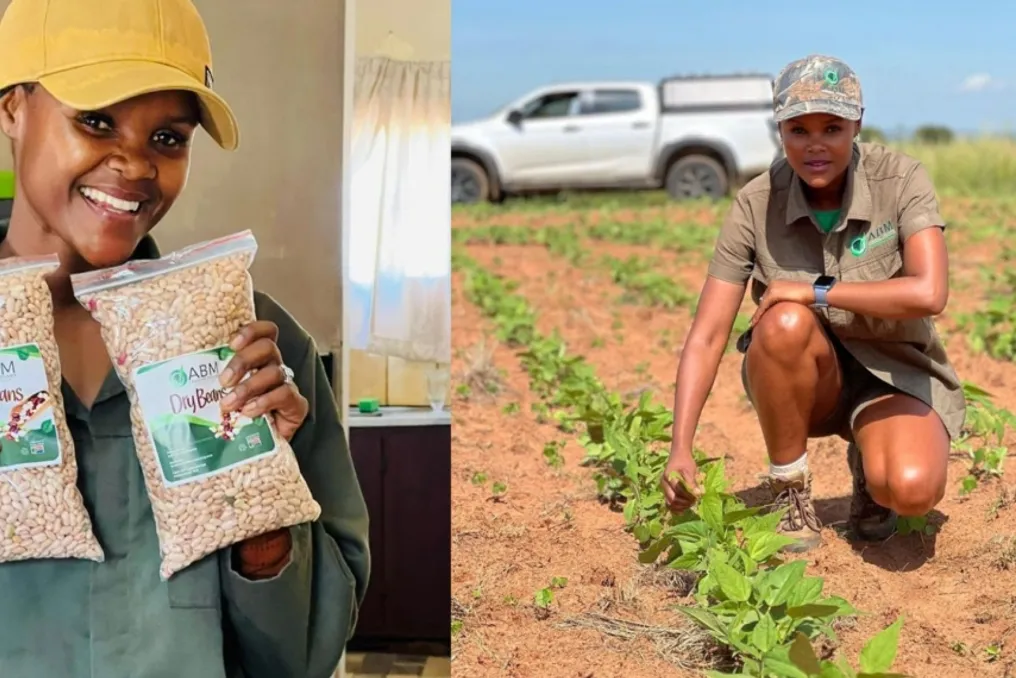
Although Zaza Letsholo was close to a career as a flight attendant, her passion for agriculture remained deep. Today, she is developing the legacy left by her late father, not only in farming but also in understanding the principles of building a business from scratch.
Leveraging experience gained in various fields—from hospitality to medical sales and finally to car sales—Letsholo applies her skills at ABM Farming Dreams. On this farm, located in KwaMhlanga, Mpumalanga, she produces grains and fresh produce.
While agriculture was part of Letsholo's childhood, she initially saw her future in other areas. Her career took her through hospitality, medical sales, and automotive sales. However, while working in sales, the pull of the family land grew stronger.
After her father's death in 2009, she began to wonder why she had access to such a large piece of land that went unused. She stated: 'I wanted to use what I learned and build something of my own.'
In 2013, she registered ABM Farming Dreams, named after her father Amos Boy Malangu, but active farming only began several years later. In 2021, while still working as a sales manager, she decided to transition to this venture with her younger brother Sifiso, planning to leave her job for farming.
However, the same week they made this decision, her brother was shot. Letsholo emphasized: 'I had to continue. I couldn't just give up on what we started.'
Since starting her journey in agriculture, Letsholo has continuously improved her skills through practical training and development programs. In 2022, she attended workshops with the FarmTogether cooperatives, and a year later, she completed courses in business planning and grain processing.
In 2025, she completed the 12-month Basali Development Program and entered the top 10 of a business presentation competition. Another year later, she participated in an acceleration program for women in agribusiness.
When she started, Letsholo told Food For Mzansi that she had an idea and a vision, but lacked startup capital and equipment. She has access to approximately 1,100 hectares of land in KwaMhlanga through the Department of Agriculture. Nevertheless, due to the necessary resources and capital, she cannot yet cultivate all this land.
Currently, she utilizes about 120 hectares, with 115 hectares outsourced to United Seeds, and the remaining five hectares are used for growing her own vegetables. Additionally, part of the land is used for grazing six head of livestock. Her products include soybeans, sugar beans, mustard, green onions, cabbage, carrots, and beetroot.
Letsholo notes that her sales experience helped her market her products and find outlets. Her customers include the local community, Fruit Stop, Afgri, and Beanex, as well as the Thembisile Hani farmers' market.
She believes that working in sales effectively prepared her for entrepreneurship. Attending seminars, exhibitions, and other agricultural events also boosted her confidence and expanded her knowledge of farming. Exchanging ideas with other industry specialists gave her valuable experience for her own venture.
Nevertheless, capital expenditure and resources remain a significant challenge. 'Resources and capital hold me back. You can have access to a huge area, but if there is no money to work with it, it becomes difficult,' she says.
Water supply was another difficulty that required seeking assistance from various authorities. In 2024, the Nkangala District Municipality helped her install a dam and irrigation system.
Furthermore, as part of the Basali Development Program, Letsholo received R60,000, which she used to purchase a greenhouse and increase vegetable production.
Letsholo aims to transform ABM Farming Dreams into a sustainable commercial agricultural and processing enterprise, equipped with its own machinery, irrigation systems, cold storage, and eventually grain silos. Part of this plan involves increasing the value of the harvested crops: she plans to package dried beans, pickle beetroot, and dry herbs, as well as find ways to utilize vegetables that might otherwise go to waste.
The farm could also become a place where youth and women can gain practical skills in agriculture—from soil preparation and planting to harvesting, packaging, and adding value. Letsholo does not want to farm just for herself; she strives to create jobs, especially for women and youth, and open opportunities for other farmers.
Her long-term goal is to create a business that will endure after her. Letsholo sees in this land not just a farm, but potential for the next generation.