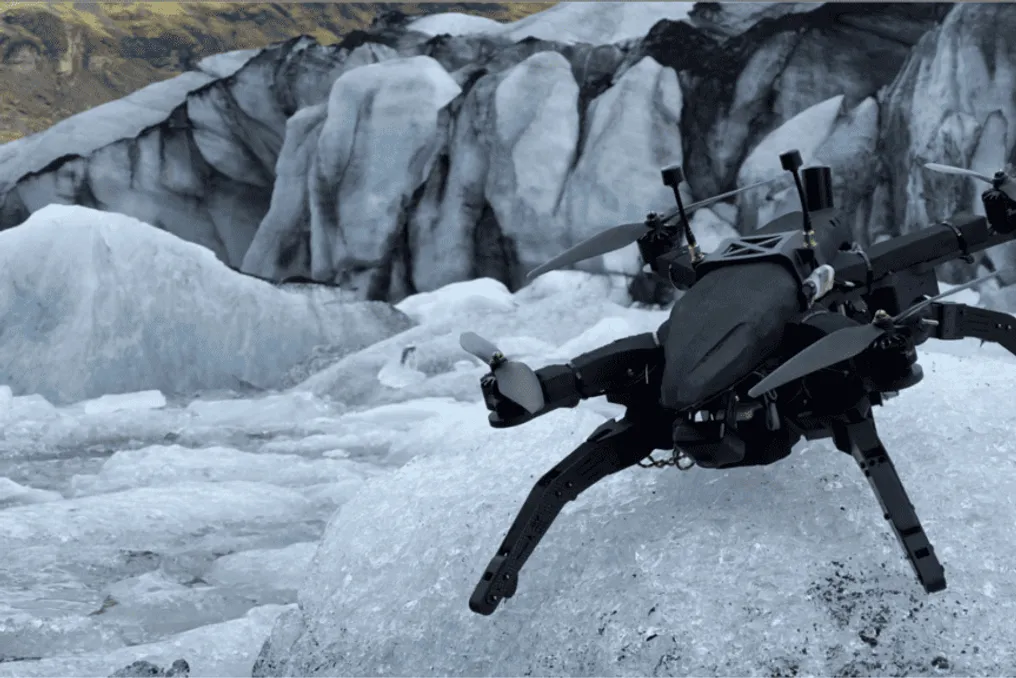
A drone equipped with small 'claws,' developed by researchers from Sherbrooke University in Canada, has been able to land and secure itself on slippery and inclined surfaces. This device, named Ice Dart, was created for landings in locations where finding a safe landing spot is extremely difficult. Information about this technology was published in the middle of the year in the publication IEEE Xplore.
Tests on Icelandic Ice
The technology underwent testing on icebergs and a glacier in southeastern Iceland. During the experiments, the drone successfully landed on surfaces with an incline of up to 58 degrees and in winds up to 30 km/h, demonstrating a one hundred percent success rate.
Ice Dart is equipped with four cross-positioned legs and a suspension system that softens the landing process. The primary fixation function is performed by special elements on the legs—two small retractable spikes of different sizes called microspikes. Upon contact with the surface during landing, these spikes grip the ice, helping to hold Ice Dart.
The mechanism was inspired by cat claws. The researchers' idea was to activate the spikes during landing regardless of the drone's orientation or the characteristics of the surface. The spikes on each leg are of different sizes, allowing the drone to adapt to inclined surfaces: the largest is used when more effort is required to hold the equipment, and the smallest where the pressure is lower.
Ice Dart weighs 2.65 kg and has a carbon fiber structure. During tests on the Fjallsjökull glacier in Iceland, the drone reached speeds of up to 10 km/h. Experiments were conducted at temperatures ranging from 0 °C to 10 °C and in strong winds.
Future Prospects for the Technology
For scientists, the ability to land instead of flying continuously could change how drones are used in field conditions. On the ground, the equipment consumes significantly less energy, which allows for longer observation periods. In the case of icebergs, this will allow Ice Dart to remain in place for days or months, providing more detailed monitoring than quick flights.
Furthermore, this technology can complement existing iceberg detection methods used by satellites and ships. According to the article, the drone could potentially be used in icy formations that are difficult to track by other means.
The developers plan further improvements to Ice Dart. Future goals include ensuring autonomous selection of a suitable landing spot and developing an emergency takeoff system.