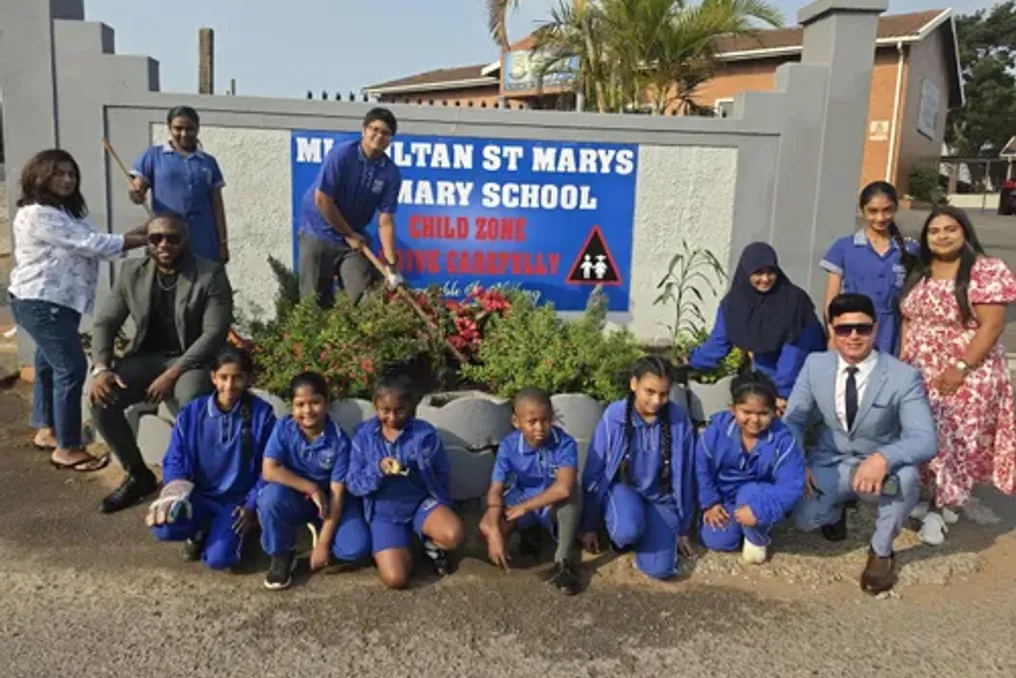
St Mary’s Primary School promotes greening and environmental care initiatives
Read more
IOL
iol.co.za

St Mary’s Primary School promotes greening and environmental care initiatives

Students and teachers at M.L. Sultan St Mary’s Primary School in Merebank observed Tree Day, emphasizing the importance of tree conservation and environmental care.

Recently, M.L. Sultan St Mary’s Primary School in Merebank marked National Tree Day, educating students that caring for trees is critically important for environmental sustainability and societal well-being. This initiative aligns with a broader national movement to green up South African settlements.

South Africa observes National Tree Week every year during the first week of September. This weekly campaign, conducted by the Department of Forestry, Fisheries and the Environment (DFFE) as the national forestry custodian, calls on all South African citizens, local government partners, non-governmental organizations, and the private sector to plant indigenous tree species as a practical step in environmental management.

Since September is also Heritage Month, the national campaign highlights historical South African 'champion trees,' including the Sophiatown Oak in Gauteng and the massive Sagoe Baobab in Limpopo, which form an integral part of the country's natural heritage.

It is important to note that the national greening strategy focuses on historically underserved towns, settlements, and informal areas that were previously systematically excluded from urban planning, parks, and street tree distribution. National Tree Week provides local communities with an opportunity to correct this imbalance through comprehensive planting, care, and management of local vegetation.

At the local level, St Mary’s Primary has integrated this national mandate into its curriculum, explaining to students of all grades that trees provide oxygen, shade, and food, support wildlife, prevent soil erosion, and contribute to a healthier environment.

For the school itself, this event is viewed not merely as an occasion to plant a sapling, but as a platform for fostering ecological awareness from an early age and encouraging students to become responsible stewards of their surroundings. Beyond academic achievements, the school urges students to realize that daily actions can yield tangible results.

The students themselves shared their views on the value of this initiative. Grade 7B student, Christian Dasappa, stated: 'Tree Day is important because trees give us oxygen and help keep our environment clean. I think we should take care of trees because they are important for both people and animals.'

Grade 4C student, Langelihle Mvelase, described the week as a special event because it demonstrates direct benefits to their local area. She said: 'Trees give us shade and make our school and community beautiful. We should always take care of them.'

For younger students, the connection between trees, fresh air, and local ecosystems was equally clear. Grade 2B student, Nehali Nayker, noted: 'I like Tree Day because we learn about trees and how they help us. Trees give us fresh air and homes for birds. We must water them and not harm them.'

The message from St Mary’s reflects the national call: environmental protection is not solely the responsibility of adults or government agencies, but a lesson that begins with a child planting, watering, or protecting a tree in their neighborhood.

Grade 5A student, Sameeha Bashir, added that the event showed how individual actions benefit the entire community. She said: 'Tree Day teaches us that we must care for nature. Planting and caring for trees can make our environment greener and healthier for everyone.'

Similar stories

Two options for a two-minute speech for Teacher's Day 2026 are offered
Read more
www.aajtak.in

Two options for a two-minute speech for Teacher's Day 2026 are offered

In connection with Teacher's Day, which is celebrated on September 5th, special morning assemblies will be organized in all schools across the country. For many students, it is a dream to give a wonderful speech during this assembly. If you are preparing a speech for tomorrow and don't know where to start, this ready-made speech of about two minutes might be useful.

Idea #1 for a speech at the assembly in honor of Teacher's Day

Addressing the principal, respected teachers, and dear classmates, the speaker congratulates everyone on Teacher's Day. He notes that a teacher is one who dispels the darkness of ignorance and ignites the light of knowledge by showing the right path.

The main theme is related to the fact that September 5th is the birthday of the former president, great scientist, and philosopher Dr. Sarvapalli Radhakrishnan. Teacher's Day is observed annually in his memory. It is said that books provide knowledge, but it is teachers who teach how to use that knowledge correctly. When students make mistakes, teachers may scold them, but behind this criticism is always care for the student's well-being. In the current digital age, obtaining knowledge is easy, but only a teacher can explain the difference between good and evil. Behind every small success are countless nights of effort and guidance from our teachers. In conclusion, the speaker expresses unwavering gratitude to all their teachers for shaping their lives and turning them into better people, paying them the deepest tribute.

Idea #2 for a speech at the assembly in honor of Teacher's Day

Greeting the principal, teachers, and classmates, the speaker raises the question: has the role of the teacher changed in the era of Artificial Intelligence (AI) and Google? Today, any information is available with one click, but the question arises: can a machine replace a teacher? Although AI can provide facts and answers, it cannot teach the difference between good and evil. Google provides information, but teachers give us 'morality' and 'knowledge'. When we fail, no algorithm boosts our morale; our teachers do this by comforting us and saying, 'It's okay, try again.' AI is just a tool, but the teacher is the guide who teaches how to use that tool correctly. Teachers teach not just to pass exams, but to achieve success in life's challenges. Therefore, in this digital age, no technology will replace the teachers who shape our lives. The speaker thanks all mentors from the bottom of their heart.

Idea #3 for a speech at the assembly in honor of Teacher's Day

Addressing mentors and friends, the speaker congratulates everyone on Teacher's Day. A famous phrase is cited: 'A teacher is a lamp that burns by itself, illuminating others.' In the era of ChatGPT, YouTube, and AI, when the answer to any question is on the screen, the question arises: can technology replace a teacher? The answer is categorical: no. AI can provide information, but only a teacher can provide understanding. Machines operate on code, whereas a teacher's guidance is filled with experience, tenderness, and sensitivity. Technology tells us what to think, but teachers teach us how to think. They help us recognize our dreams, turn weaknesses into strengths, and become good people—this is magic that only our mentors can perform. Even in this AI era, the place of the teacher remains supreme and unchanged. The speaker expresses deep respect to all teachers.

Namita teaches working children in Delhi park, helping them gain education and develop
Read more
www.aajtak.in

Namita teaches working children in Delhi park, helping them gain education and develop

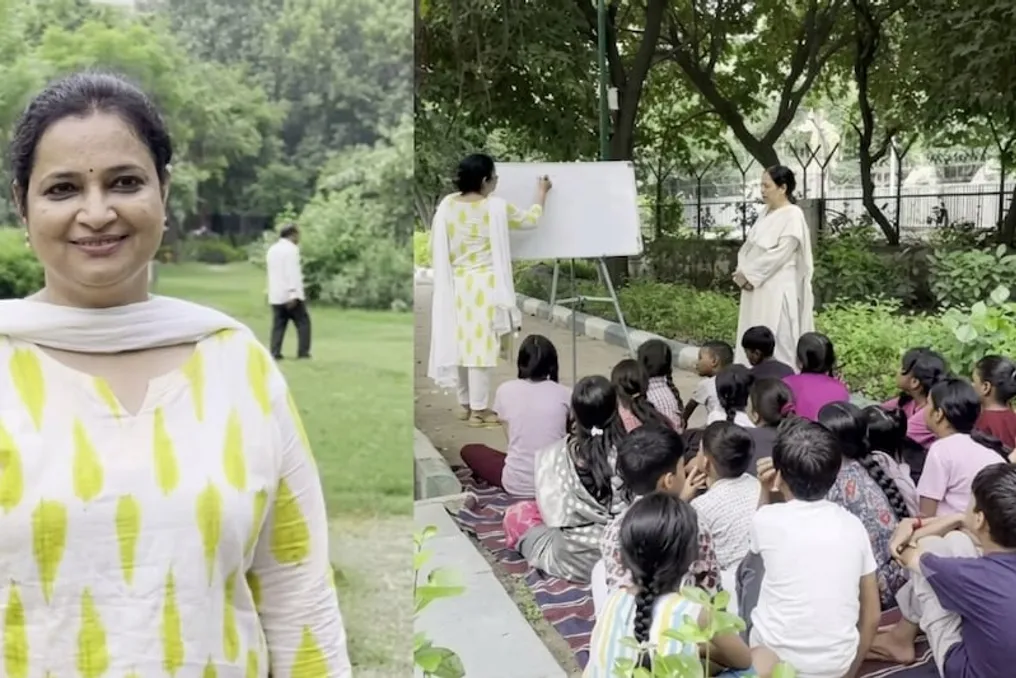
For 13 years, a kind of school has been operating in Delhi Park for children whose parents work in construction, as rickshaw drivers, or as casual laborers. When Namita Choudhary started her activities in Balaji Park in Dwarka, she only had five students. Today, thanks to this initiative, over 200 children have joined the classes. Furthermore, through adult literacy campaigns and empowerment efforts, she has managed to help more than 100 women.

The learning space does not feature luxurious classrooms; however, it hosts not only lessons but also drawing classes, conversational English classes, and other activities that help children unlock their talents beyond textbooks.

Namita's journey began with a very simple question: how to use her time to improve the lives of others? Namita shares that she is satisfied with the thought that before she dies, she could bring a smile to at least one person and provide an education to at least one child.

Her beliefs were also shaped by her past experience working in an orphanage. After moving to Delhi, she strongly felt the desire to dedicate her time to meaningful work.

Initially, the classes focused on migrant children living near construction sites. As information about this initiative spread, families from the surrounding areas began bringing their children.

Namita notes that it soon became clear to her team that these children required not only academic knowledge but also much more support. Some children lagged in their studies due to a lack of suitable environment, while many possessed remarkable abilities in drawing, dancing, or communication, needing only a little development.

Based on this realization, the scope of activities was expanded. Namita recounts that they had dancing children who had never been formally taught to dance; they simply asked them to practice correctly, and they revealed their talent to them.

Special attention is paid to learning English, especially for children who study in government schools in Hindi and are shy about public speaking.

The most noticeable and positive effect of this entire initiative is seen among former students. According to Namita, thanks to this movement, over 100 children have received higher education. Many of them now hold good positions or are preparing for a career. One former student works as an administrator at J.P. Pant Hospital, and another trained as a teacher and became an educator. Other children work in private schools and in the travel industry. The most wonderful thing is that some of these children have returned to the same park.

Komal first came here as a third-grade student. Her father works as a rickshaw driver, and her mother is a domestic helper. Komal used to say that due to home restrictions and shyness, she avoided even interacting with anyone. Today, the same Komal teaches English to young children in the same park.

Komal says: 'I was shy to talk to anyone, but today I have learned both to speak and to teach children.' For Namita, this is the greatest victory: children who once asked for help are now reaching out to others themselves.

She emphasizes: 'This process must not stop. People will change, but the efforts to bring education to these settlements and communities must continue.' In this city of Delhi, full of companies, schools, and tall buildings, this small park serves as an excellent medium to give children the opportunity to learn, dream, and open doors for themselves and others.

Popular