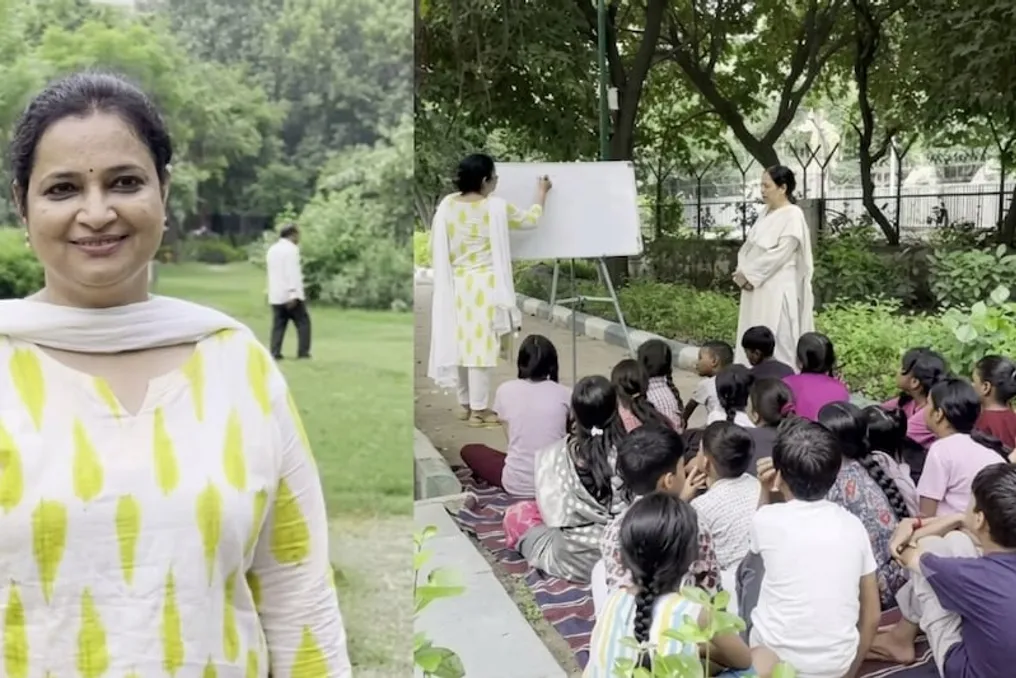
For 13 years, a kind of school has been operating in Delhi Park for children whose parents work in construction, as rickshaw drivers, or as casual laborers. When Namita Choudhary started her activities in Balaji Park in Dwarka, she only had five students. Today, thanks to this initiative, over 200 children have joined the classes. Furthermore, through adult literacy campaigns and empowerment efforts, she has managed to help more than 100 women.
The learning space does not feature luxurious classrooms; however, it hosts not only lessons but also drawing classes, conversational English classes, and other activities that help children unlock their talents beyond textbooks.
Namita's journey began with a very simple question: how to use her time to improve the lives of others? Namita shares that she is satisfied with the thought that before she dies, she could bring a smile to at least one person and provide an education to at least one child.
Her beliefs were also shaped by her past experience working in an orphanage. After moving to Delhi, she strongly felt the desire to dedicate her time to meaningful work.
Initially, the classes focused on migrant children living near construction sites. As information about this initiative spread, families from the surrounding areas began bringing their children.
Namita notes that it soon became clear to her team that these children required not only academic knowledge but also much more support. Some children lagged in their studies due to a lack of suitable environment, while many possessed remarkable abilities in drawing, dancing, or communication, needing only a little development.
Based on this realization, the scope of activities was expanded. Namita recounts that they had dancing children who had never been formally taught to dance; they simply asked them to practice correctly, and they revealed their talent to them.
Special attention is paid to learning English, especially for children who study in government schools in Hindi and are shy about public speaking.
The most noticeable and positive effect of this entire initiative is seen among former students. According to Namita, thanks to this movement, over 100 children have received higher education. Many of them now hold good positions or are preparing for a career. One former student works as an administrator at J.P. Pant Hospital, and another trained as a teacher and became an educator. Other children work in private schools and in the travel industry. The most wonderful thing is that some of these children have returned to the same park.
Komal first came here as a third-grade student. Her father works as a rickshaw driver, and her mother is a domestic helper. Komal used to say that due to home restrictions and shyness, she avoided even interacting with anyone. Today, the same Komal teaches English to young children in the same park.
Komal says: 'I was shy to talk to anyone, but today I have learned both to speak and to teach children.' For Namita, this is the greatest victory: children who once asked for help are now reaching out to others themselves.
She emphasizes: 'This process must not stop. People will change, but the efforts to bring education to these settlements and communities must continue.' In this city of Delhi, full of companies, schools, and tall buildings, this small park serves as an excellent medium to give children the opportunity to learn, dream, and open doors for themselves and others.