The agricultural sector in Gauteng must strengthen partnerships, implement innovations, and create more efficient market access channels to fully unlock the potential of farmers in the province. This was one of the key themes at the annual AgriCulture Gauteng Congress in Pretoria on Wednesday, where representatives from agribusiness, government, and farmers themselves gathered to discuss the future of the sector under the theme 'Developing Gauteng Together.'
AgriSA President Willem de Savonnes Vrugt emphasized that unity is crucial for ensuring agriculture has a significant and long-term impact on farmer-related policies. He used the analogy of a rope woven from thousands of fibers, asserting that the strength of organized agriculture lies not in a single organization or individual, but in the collective contribution of farmers, commodity organizations, and industry associations.
De Savonnes Vrugt highlighted the importance of data-driven decision-making, noting that reliable information can help organized agriculture influence decisions regarding electricity tariffs, infrastructure, and market access. He also pointed out that the contribution of the agricultural sector extends beyond primary production, as the entire value chain plays a significant role in South Africa's economy and employment.
Meanwhile, Dr. Dalen Louw, CEO of AgriCulture Gauteng, stated that the province should not underestimate its agricultural potential simply because it is highly urbanized. With a population exceeding 15 million people and being one of the continent's largest centers for consumers, businesses, and infrastructure, Gauteng provides farmers with a substantial market right at their doorstep. 'We are farming within a huge market,' she said.
Louw called for increased investment in precision and regenerative agriculture, arguing that the future of farming is determined not by the acreage a producer owns, but by how efficiently the existing land is utilized. She added that small and emerging farmers in Gauteng, many operating on relatively small plots, can succeed if they find profitable niches, professionally aggregate production, and view farming as a business.
The MEC for Economic Development, Agriculture and Rural Development of Gauteng, Vuyiswa Ramkopa, stated that agriculture must be recognized as a central driver of economic growth. She congratulated the sector on its resilience, noting that despite general economic difficulties, agriculture has shown strong growth. However, Ramkopa warned that South Africa's ability to produce enough food does not guarantee that this food will be accessible to all households.
She reported that the Gauteng 'Zero Hunger' Programme aims to address household hunger and strengthen the links between agricultural production and local communities. A priority is the sustainable development and commercialization of smallholder and subsistence farming activities. The province has between 6,000 and 8,000 emerging and small-scale farmers, and subsistence and communal farming covers about 250,000 households. The province is increasingly focusing on aggregation, incubation, and guaranteed markets to help farmers transition to sustainable businesses.
Ramkopa also rejected the idea of dividing South African agriculture into 'two agricultural sectors,' insisting that farmers should be supported according to their stage of development, providing appropriate pathways for sustainable business growth.
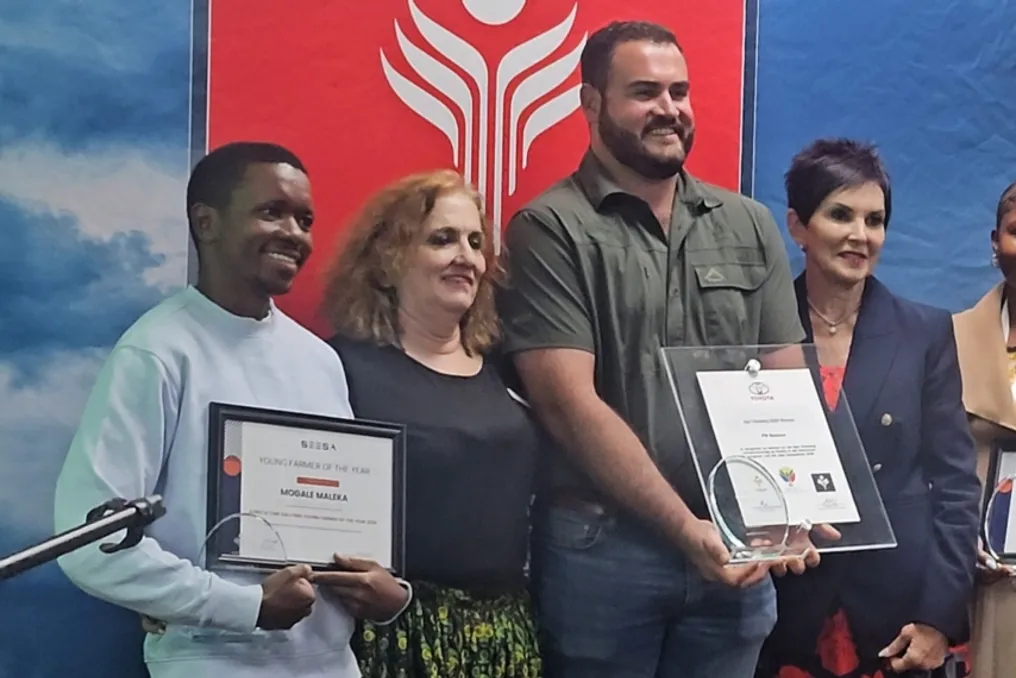
Ramkopa also highlighted Gauteng's success in responding to Foot-and-Mouth Disease (FMD), reporting that active cases have decreased by 60%, from 308 registered cases to 132. The province vaccinated over 542,000 animals, reaching 77% of the provincial livestock population. The Congress also recognized Gauteng's agricultural talent during the provincial 'Young Farmer of the Year' award ceremony by Toyota Agri SA. Petrus Nicolaas Basson was named Young Farmer of Gauteng of the Year, Mogale Maleka was the first prize winner, and Lesego Mohube was the second prize winner. Under the Urban Farming Programme 2026, Palese Seko won the top prize, and Zandile Humalo and Ruben Lawrence were the first and second prize winners, respectively.