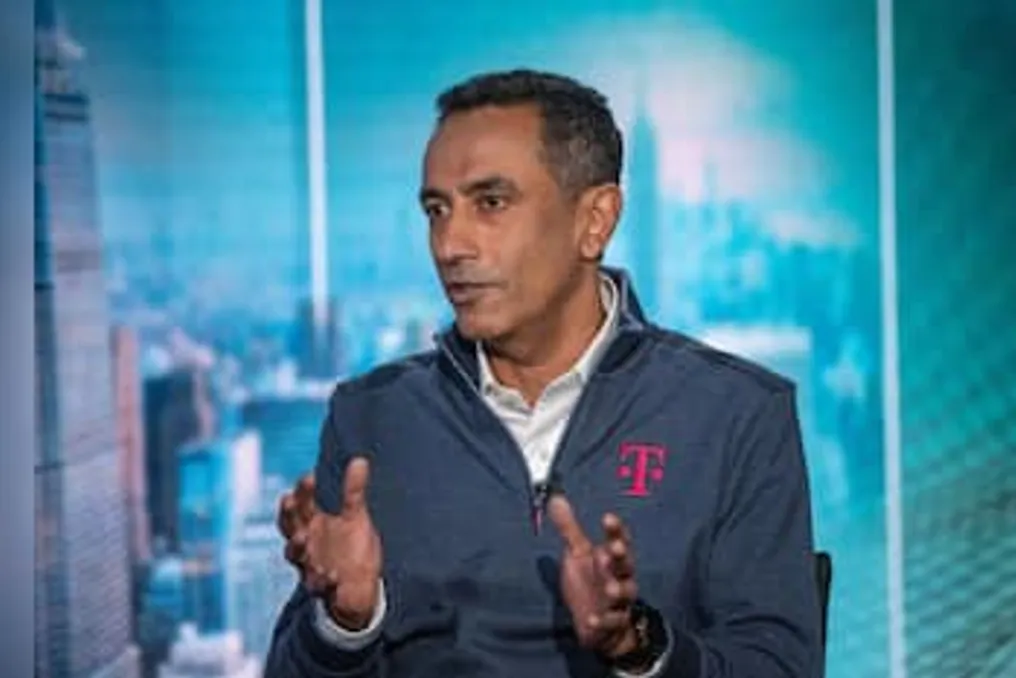
As the one-year anniversary of his appointment as head of T-Mobile US Inc. approaches, Srini Gopalan is banking on growth in areas such as home internet and artificial intelligence to support the company's declining stock price.
The second-largest wireless carrier in the US has seen its shares drop by 25 percent since September last year, when Gopalan took over the role from Mike Sievert on November 1. Second-quarter results, published in July, disappointed investors, showing revenue decline below expectations and a 13 percent year-over-year drop in subscriber growth, despite T-Mobile traditionally dominating this category.
While shares of Verizon Communications Inc. rose by 16 percent over the same period, and AT&T Inc. fell by 10 percent, T-Mobile's shares remained relatively flat on Thursday, reaching $188.02 in New York.
Gopalan, however, is looking beyond short-term metrics. In an interview, he stated that the market's reaction to any quarter depends on numerous factors, and he does not intend to manage the company based on daily or quarterly stock prices. He emphasized that creating shareholder value is the company's central mission, but the approach to this must be more thoughtful and long-term.
This long-term view includes changes in leadership. The company announced on Thursday that CFO Peter Oswaldick will retire next year. Jessica Ull, former CFO of Shell Plc., will join the company in mid-September and will work with Oswaldick during a transition period until February 2027. Gopalan noted that Ull's experience suits T-Mobile, as both companies have extensive retail networks and complex infrastructure portfolios.
His vision involves using T-Mobile's network infrastructure for AI needs. According to Gopalan, when AI moves beyond chatbots to physical applications like automated factories and drone home delivery, 'none of this is possible without the wireless network connecting them.' He sees such applications fitting perfectly with T-Mobile's ambitions to expand its business offerings in enterprise connectivity, which are becoming increasingly wireless-centric.
The company is also working to increase its home internet business, which, Gopalan noted, has grown from zero to nearly 10 million home customers over four years. It views 60 million cable company customers as the next target for T-Mobile as it expands its fiber optic and fixed wireless access offerings, utilizing excess 5G capacity.
The Bellevue, Washington-based company is already striving to improve conditions for existing wireless subscribers by offering bonuses and incentives, including updating its popular loyalty program and additional phone financing options. Furthermore, it is entering the advertising and financial services markets, launching initiatives such as a co-branded credit card with Capital One Financial Corp.
Some of these offerings have received mixed reactions. The partnership with SpaceX's Starlink service provides customers with access to satellite coverage that can fill gaps in T-Mobile's terrestrial network, especially in very remote areas. However, most customers are unwilling to pay $10 per month for this added service. Gopalan believes that over time, this will not become a decisive competitive advantage but rather an expected part of standard cellular service.
Gopalan declined to comment on reports of a potential merger with T-Mobile's parent company, Deutsche Telekom AG. Bloomberg reported that Elliott Investment Management acquired a significant stake in Deutsche Telekom and advised the German firm to abandon plans for a potential merger with its American subsidiary. Gopalan stressed that the change in T-Mobile's CFO is unrelated to recent changes in Deutsche Telekom's senior management.