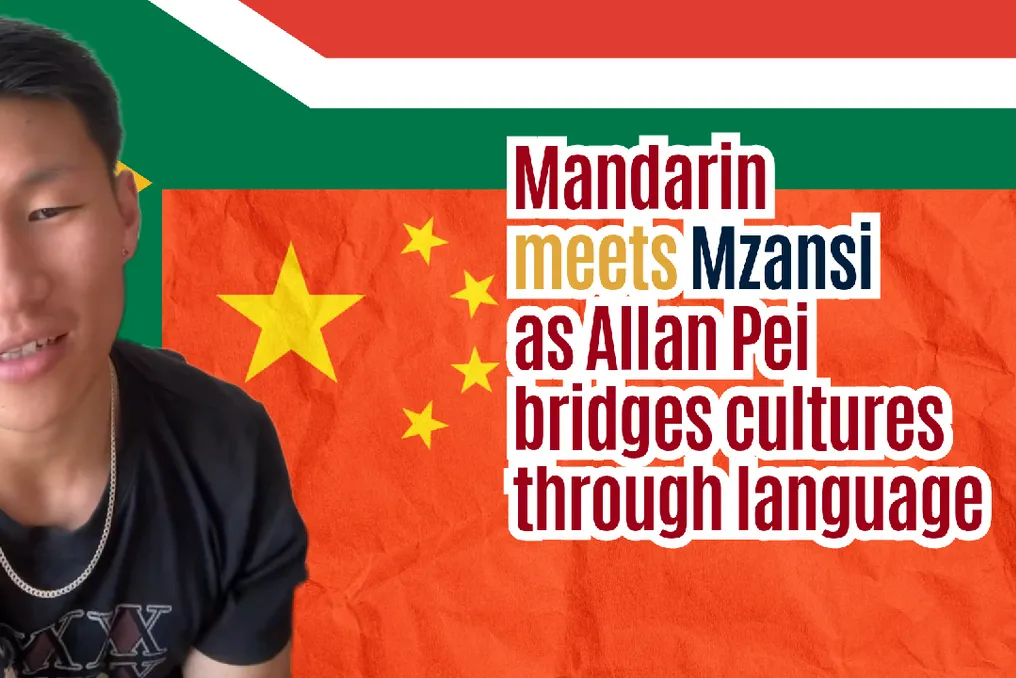
For many residents of South Africa, Allan Pei has made Mandarin Chinese less foreign and more familiar for daily communication. This content creator, known online as Allan Sensei, gained a rapidly growing audience at the age of 29 by using a simple method: he teaches Chinese phrases by applying them in the context of South African languages and familiar everyday situations.
He is proficient in four languages—English, Afrikaans, isiXhosa, and Mandarin—and also incorporates the Shanghai dialect into his repertoire. Allan was born in South Africa to Chinese parents from Shanghai, and his childhood was split between the small town of Kraddock in the Eastern Cape province and a home shaped by Chinese language and traditions.
He recalls that because his parents are immigrants who maintain strong Chinese traditions, they did not initially speak English, communicating only in Chinese while trying to adapt to interacting with local people. Unlike them, Allan could communicate with everyone from an early age due to his environment.
For Allan, ordinary childhood moments, such as playing with other children, visiting their homes, and attending parties, became his classroom. He notes that at the time, he did not realize he was mixing cultures. When he went out, he had to speak different languages and think differently while interacting with white, Coloured, and Black children. However, as soon as he returned home, everything switched to Chinese, while homework was done in English.
He viewed himself as someone adapting to two cultures and learning from both sides. His ability to adapt, ask questions, and build connections defined his approach to language learning. He believes that the lack of a common language does not mean an unwillingness to spend time together; rather, it facilitates contact and language acquisition.
Years later, these everyday experiences formed the basis of his online persona. Before creating content, Allan studied law and worked in corporate business and hospitality sectors. Nevertheless, the idea of doing something online always attracted him, and he found his niche after encountering the same life interactions: people would ask him about his background and how he learned languages.
He decided to create content that would be understandable to South Africans while reflecting his Chinese heritage. This idea arose from constant questions he received about languages, such as: 'Can you teach me Chinese? How do I say this in Chinese?' Thus, he connected his two worlds through content creation. What surprised him most was not the attention, but the positive community that formed around him.
For Allan, this community symbolizes something more than just social media; it speaks to the relationship between China and South Africa and the role language can play in deepening these ties. He asserts that language acts as a bridge between these two cultures, allowing trust to be built and questions to be answered.
Through his videos, he strives to show people that they need to look beyond stereotypes and recognize shared humanity. Although he admits that the two cultures may seem very different, he believes they are actually quite similar. Moreover, Allan's videos even reached China when a colleague from South Africa teaching in China requested permission to use one of his clips to provide students with a brief but informative lesson in isiXhosa.
He tries to visit his family in Shanghai once a year but is grateful for the opportunity to continue feeling his Chinese heritage at home, whether through food or simply talking with relatives. Despite his popularity, Allan still considers himself a student. Chinese remains the most challenging language for him due to the need to be aware of tonal changes and all technical nuances. His advice to those trying to learn a new language is to practice with people, allow mistakes, and keep moving forward. He urges: 'Don't be too hard on yourself. Enjoy the process.'