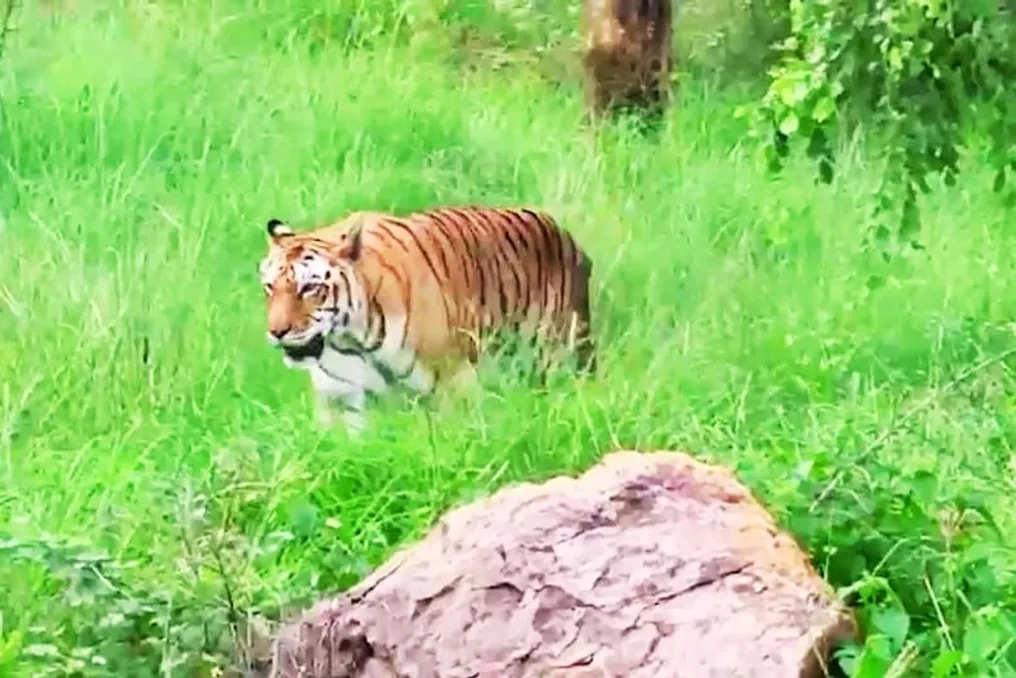
Most baginas become old at the age of 16–18, however, the bagina named Mahak from Kota demonstrates exceptional vitality, reaching the age of 22 and approaching 23.
Unlike the general trend, Mahak continues to move actively in her enclosure, play in the water, and calmly eat when food is available. Although age is beginning to take its toll, causing some difficulty when getting up, her health condition remains so good that forest department employees cite her as an example. This is why Mahak is recognized as the oldest living bagina in the country.
Her story began on August 28, 2004, at the Jaipur Zoo. At that time, she was born one of four cubs born by the bagina Chanda: Rudra, Gauri, Ramba, and Mahak. Over time, their paths diverged: Rudra went to the Jodhpur Zoo, Gauri to the Vanah Vihar Sanctuary in Bhopal, and Ramba was sent to the Nahargarh Biological Park. Mahak's journey led her from Jaipur to Kota.
Mahak was first transported from Jaipur to the Kota Zoo in March 2012. Then, in 2019, she was sent to the Nahargarh Biological Park in Jaipur for breeding purposes, where she was with a tiger named Nahar. However, on March 1, 2023, Mahak returned to the Abeda Biological Park in Kota with Nahar. Unfortunately, attempts at breeding between Mahak and Nahar were unsuccessful, and Mahak could not become a mother. About two years ago, Nahar passed away, and now Mahak is alone.
In zoos, the average age of tigers is usually around 16–18 years, and in the wild, the average lifespan is even lower. Thus, reaching 22 years is an outstanding event. Mahak surpasses the average age of baginas in zoos by about four years, and in the wild—by about seven years. However, her uniqueness lies not only in her age but also in maintaining excellent health at 22 years old.
Despite her age, Mahak's physical indicators remain high. According to forest department representatives, although age has left no absolute trace, she sometimes requires more effort to get up compared to the past. To prevent weakening, her calcium dosage has been increased. That is, Mahak is not entirely as 'young' as a young bagina, but her physical condition for 22 years is considered exceptional.
Forest department employees suggest that several factors may be behind Mahak's long life. One of them is high-quality and balanced nutrition, another is regular medical check-ups, and also a clean and safe habitat. The role of genetics cannot be ruled out. Since all tigers in the zoos are provided with food and treatment, but not all reach 22 years, Mahak's case is likely the result of a combination of her luck, genetic makeup, and excellent care.
Nutrition plays an important role in Mahak's longevity. According to Dr. Trilok Gurjer, a veterinarian from the Abeda Biological Park, Mahak receives about 8 kilograms of chicken and paste meat daily. Additionally, she is regularly given multivitamins, calcium, and iron. The diet is tailored to her age. Hygiene is extremely important for older animals; Mahak's shelter is regularly sprayed with medicine. Care methods are also adjusted depending on the change of season, as immunity decreases with age.