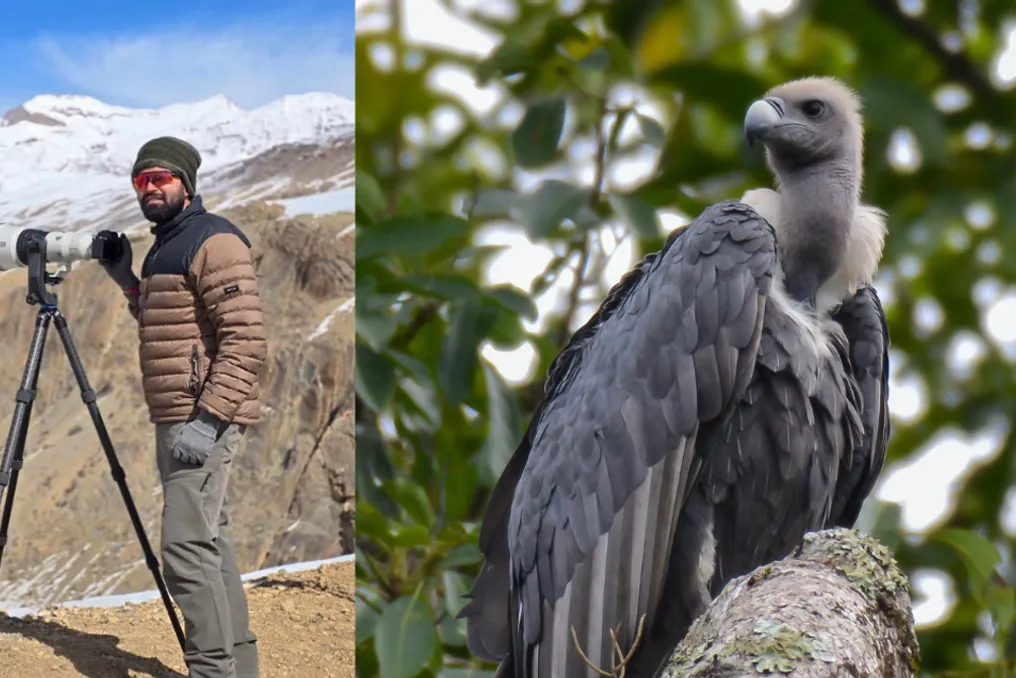
Ishan Patak, who previously served as a doctor in the Air Force, has now dedicated himself to wildlife photography to capture India's rarest vultures. He recalls the moments preceding the vultures' arrival at a carcass, when there was initially a short pause over the remains before movement began: wings slicing through the dry air, hooked beaks tearing flesh, and the birds gathering around the carcass with astonishing precision.
Standing in the rural area of Jaisalmer, surrounded by dust and decay, Ishan observed the largest congregation of vultures he had ever seen. He noted that this was likely a sight many would never see again, having documented over 100 vultures from four different species gathered around a single carcass.
For this photographer, vultures do not carry any sinister sign or horror. They are among nature's most vital workers: they clean up landscapes, prevent diseases, and serve as indicators of ecological health. This conviction has driven him to travel through the forests, deserts, plains, and mountains of India, documenting species that are disappearing from the skies.
Out of the 23 vulture species found worldwide, nine species inhabit or migrate to India, making the country home to the highest diversity of vulture species globally. Ishan managed to photograph all these nine species found across India.
Before starting his professional career in photography, Ishan had experience in medicine and military service. He earned a medical degree in China, then completed an MD in public health in Karnataka, and worked as an assistant professor in Kerala before joining the Indian Air Force as a medical specialist. In 2024, he retired as a squadron commander after five years of service and decided to dedicate himself fully to wildlife photography.
More than a decade and a half of his professional life were tied to hospitals, lecture halls, and military discipline. However, the forests have always been close to Ishan. As a child, he loved visiting national parks, which provided him a respite from routine, and over time, these visits became regular. The more he traveled, the more attentively he noticed the small details of wildlife: how animals move, how birds behave, and what role each species plays. These trips gradually changed his view of wildlife and, ultimately, the direction of his life.
Today, Ishan, aged 37, works as a staff wildlife photographer, documenting species and ecosystems under pressure. Among all the birds and animals he has photographed, vultures have made the strongest impression on him. Viewing carcasses through the lens of a physician, rather than just a photographer, Ishan began to see what most people overlook. He notes: 'If these birds weren't here, this carcass would remain for days, attracting stray dogs and increasing the risk of disease.' He continues: 'People see something disgusting, but I see one of nature's most effective public health workers.' This shift in worldview has stayed with him.
Since then, he has sought out vultures across India, striving to document these birds outside the fear, myths, and stigma that long defined their image. He succeeded in photographing all nine species of vultures inhabiting or migrating to India.
Documenting Ecological Moments Before Their Disappearance
Over the years, Ishan's equipment has evolved alongside his work. He started shooting wildlife using a Nikon setup with a 200–500 mm lens, later upgrading to a 600 mm f/4 lens, which allowed him to capture feeding behavior and close interactions in greater detail. But for him, the camera is just a tool; what matters are the moments it preserves. He reflects: 'These are moments that people may never see again.'
In Ishan's photographs, vultures are no longer shadows of death circling overhead. They have become birds performing a job that no one else can: they clean up what we leave behind, stop the spread of disease, and remind us that losing these birds would mean losing one of nature's most crucial defense mechanisms.
Among the pictures Ishan has taken over the years, one shot defines his work: a Cinereous Vulture feeding on the open heart of a mongoose in the desert landscape of Rajasthan. His photos are not intended to romanticize wildlife; instead, they make viewers contemplate the role of death in sustaining ecosystems. For Ishan, photographing vultures is about capturing the raw mechanisms of survival, such as feeding behavior and carcass ecology.
He explains that 'so much is involved in vulture feeding,' describing how intensely the birds focus around carcasses. This concentration often allowed him to photograph them from unusually close distances, especially in open rural areas. His images also challenge the common misconception about vultures: these birds are among the most effective ecosystem protectors. When a carcass is left exposed, vultures are often the first to take on the difficult task of cleaning it before it can rot for days, attract more scavengers, or become a source of disease for nearby forests, villages, and animals.
Despite their importance, vulture populations in India have experienced one of the sharpest declines in wildlife recorded anywhere in the world. An assessment by the Wildlife Institute of India showed that nesting occurs in only 120 out of 425 historical vulture nesting sites, demonstrating a sharp reduction in their former range. The primary cause of this decline was diclofenac—a painkiller widely used for livestock. While it helped animals manage pain, even trace amounts could kill them when vultures fed on treated animal carcasses. This single drug decimated huge numbers of several vulture species.
For Ishan, the vulture crisis became real through the places he visited. He saw it in mountain villages where carcasses used to attract birds from the sky. He saw it in desert fields where feeding grounds were still showing what India was losing. He saw it again in forests where spotting a vulture became much rarer than it should be.
One such trip took him to Kibber in Himachal Pradesh. In the high-altitude landscape of Kibber, Ishan photographed a Bearded Vulture, also known as Lammergeier, soaring over the cold desert skies. The Bearded Vulture is the only known vertebrate whose diet consists mainly of bones and bone marrow, making up 70–90 percent of its diet. It is the only living bird species specialized in eating bones. When a bone is too large to swallow, the Bearded Vulture carries it in flight at an altitude of 50–150 m above the ground and drops it onto rocks below. This breaks the bone into smaller pieces and exposes the nutritious bone marrow. It can fly with bones up to 10 cm in diameter and weighing over 4 kg, almost equal to its own weight. After dropping large bones, the Bearded Vulture spirals or glides down to inspect them and may repeat the action if the bone is not broken enough. This acquired skill requires extensive practice in young birds and can take up to seven years to master. Its old name, ossifrage, meaning 'bone breaker', comes from this habit. Unlike most vultures, the Bearded Vulture does not have a bald head. Its cream-colored forehead contrasts with a black stripe through the eyes and nose area, and the beard under its chin forms a black beard, giving rise to its English name. Although still relatively widespread in the northern Himalayas, threats from poisoned carcasses, reduced food availability, and habitat disruption continue to grow in fragile mountain ecosystems.
Every winter season, the deserts of Jaisalmer become a refuge for migratory vultures arriving from Central Asia and Europe. Here, Ishan documented the Cinereous Vulture, one of the heaviest flying birds in the world. Large, dark, and often seen alone, the Cinereous Vulture faces dangers during its long migrations. Poisoned carcasses, power lines, and shrinking safe feeding areas complicate the survival of this migratory bird.
Jaisalmer has also been the site of some of Ishan's most poignant photographs. Among them is the endangered Egyptian Vulture, smaller than most of its relatives but very intelligent and adaptable. Known for its white plumage and yellow facial skin, this bird feeds around villages, bushes, and carcass sites. For Ishan, photographing the Cinereous Vulture feeding on a mongoose carcass reflected both the brutality and the necessity of scavenging in the wild.
Another migratory species Ishan photographed in Rajasthan is the Eurasian Griffon Vulture. These social scavengers descend in groups around carcasses, using their broad wings to cover vast distances across arid terrain. Although global populations are more stable than some Indian vulture species, migratory populations still face threats from poisoned feeding sites and collisions with power lines.
In the Kaziranga landscape of Assam, Ishan photographed one of India's most vulnerable scavengers—the critically endangered White-rumped Vulture. This species, once common across the Gangetic plain, suffered a catastrophic population decline following diclofenac contamination. Characterized by a slender beak and elongated neck, the bird now survives in fragmented areas near riverine forests and grasslands. This makes landscapes like Kaziranga particularly important, as they are among the few places where the species still has a chance of survival for conservation organizations.
For Ishan, photographing this bird here held a deeper meaning. Every frame became a reminder of the role vultures still play in maintaining forest cleanliness, controlling diseases, and balancing ecosystems across northern India.
In Nagarhola National Park, Ishan photographed the White-backed Vulture, once one of the most common scavengers in the country. This species, recognizable by a distinct white patch near its rump, experienced a population collapse of over 95 percent in the 1990s. According to the Vulture Conservation Foundation, this decline wiped out a species once considered the most numerous large predator in the world, altering local ecosystems. Conservation efforts have helped some populations recover, but the species remains threatened by harmful veterinary drugs, contaminated carcasses, and habitat loss. For Ishan, the decline of this bird is one of the starkest reminders of how quickly ecological collapse can occur when a single toxic factor enters the food chain.
In Dudhwa National Park, Ishan photographed the Red-headed Vulture, also known as the Asian Imperial Vulture, a solitary scavenger marked by deep black plumage and a bare crimson head. Once widespread across the Indian subcontinent, this species is now endangered. Due to fewer safe feeding sites, habitat reduction, and poisoning risks, the Red-headed Vulture struggles to survive. However, in the forest, its role remains indispensable: it removes the dead, maintains landscape cleanliness, and helps wildlife remain in balance.