When Mohammed Al Remaiti was thirteen years old, his hunting trips involved deep immersion into the desert with his grandfather and uncle. They would take everything necessary for sleeping, cooking, and surviving far from roads and services.
At that time, rabbits were abundant, whereas finding houbara bustards and gazelles was more difficult. The lessons he learned related not only to the hunt itself but also to patience and respect for the desert.
Decades later, Al Remaiti, who now holds the position of events manager at the Abu Dhabi Falconry Club, continues falconry, although the experience surrounding this tradition has undergone radical changes.
Al Remaiti recalls his early impressions, saying: 'When you go hunting, you must remember that you are going to an area where all the infrastructure you are used to is absent.' He adds that in such conditions, one learns patience and how to interact with nature, while the person bears responsibility for it, leaving no trash and not damaging the natural landscape.
Some of Al Remaiti's earliest memories of hunting take him far beyond the organized events available today. He remembers trips with his grandfather into the Empty Quarter, where they could cover hundreds of kilometers without encountering anyone else. Modern conveniences were absent there.
'You sleep on the ground, under the open sky,' he described this experience, talking about sitting around a campfire far from mobile phones and the comforts of modern life. The only means of transport was a vehicle; everything else had to be carried with them.
For Al Remaiti, there was no reason to fear in such an isolated environment. He explains: 'For us Bedouins, nothing scared us because we are of nature, and nature is a part of us.' The reward was the opportunity itself to experience this and go hunting.
He remembers that there were many rabbits in the wild back then, while finding houbara and gazelles was harder. His hunting experience over time included rabbits, houbara, and gazelles, alongside falconry and other traditional activities.
When asked about preparing for today's hunt, the list he mentions still sounds very traditional: food, kitchen equipment, bedding, clothing, coffee and tea, falcon feed, and bird tracking gear. He also takes a radio for communication with companions.
However, the process itself has become significantly more accessible. Instead of traveling for weeks into remote desert areas, hunters today can use managed reserves and other organized sites that allow them to practice this tradition closer to home.
Al Remaiti considers this one of the most significant changes. He notes that 'today the government supports reserves and captive-bred animals.' The development of reserves allows families to engage in this activity closer to their residence without disrupting children's work or studies. He emphasizes that one can practice this sport near home or in the vicinity without interfering with children's work or studies, and then return.
However, greater accessibility does not mean a complete abandonment of the traditional experience, says Al Remaiti. For those who wish it, hunting can still mean stepping away from modern life and spending time in the desert. He describes the appeal of this as an opportunity to feel nature in its traditional form, rather than just turning the activity into a modern recreational outing.
For him, the responsibility associated with venturing into the desert has always been part of the lesson. A hunter must not leave trash or damage the landscape. This principle is now integrated into a much more formalized system of environmental rules regulating hunting in Abu Dhabi.
Today, the rules regarding hunting are much stricter than when Al Remaiti first accompanied his grandfather. In Abu Dhabi's open natural areas, traditional falconry is regulated by permits and restrictions regarding the location and time of the hunt, as well as what can be taken.
Hunters are required to avoid protected areas, roads, residential areas, and other restricted locations, while ensuring they do not disturb wildlife or damage vegetation.
Al Remaiti believes that the growth of managed hunting reserves has helped make this tradition both safer and more accessible. He asserts that 'the state does not miss opportunities to support this sport,' pointing to organized competitions, hunting reserves, captive breeding, and other forms of support.
For him, such support means that today hunters have few reasons to risk traveling to places where they should not hunt.
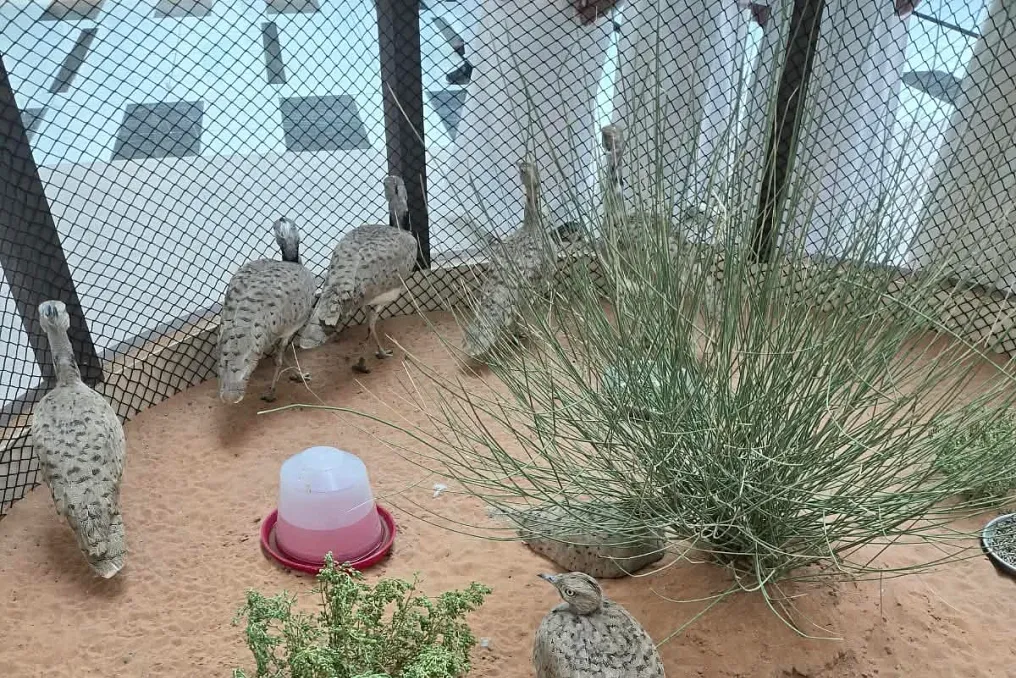
The transformation of hunting is also closely linked to nature conservation. Houbara has long been a central figure in falconry, but protecting its populations required a serious shift towards captive breeding and release programs. Ali Al Shamsi, project manager at the International Houbara Conservation Fund, reported that the organization annually produces about 90,000–100,000 houbara, releasing the birds into their natural habitats in the UAE and abroad.
According to Al Shamsi, the UAE's efforts to conserve houbara began in 1977 when the late Sheikh Zayed launched the project, and the National Bird Research Centre was established later in Suwaiq in 1989 to study, breed, and release houbara.
For Al Remaiti, nature conservation and the continuation of falconry are not competing ideas, but increasingly intertwined concepts. The experience inherited from his grandfather was about understanding the desert and living with it, not just extracting resources from it. Today, the same philosophy coexists with licenses, protected areas, managed reserves, and captive breeding programs.
The equipment may have changed, the journey may have become shorter, and the rules may have become stricter. But the reason why Al Remaiti continues to hunt is rooted in the same experience he gained in childhood. He still prepares provisions, cares for his falcon, and goes into the desert. The difference is that today's hunter is surrounded by more infrastructure and bears a much greater responsibility for understanding the rules governing the land and wildlife.
For someone who started at the age of thirteen, following his grandfather into one of the world's most remote deserts, this may be the biggest evolution: the tradition has changed for survival.