Modern enterprises face unprecedented pressure requiring the adoption and adaptation of technologies. Beyond mastering artificial intelligence, companies must answer a fundamental question: how to work with AI tools without losing human analytical sharpness?
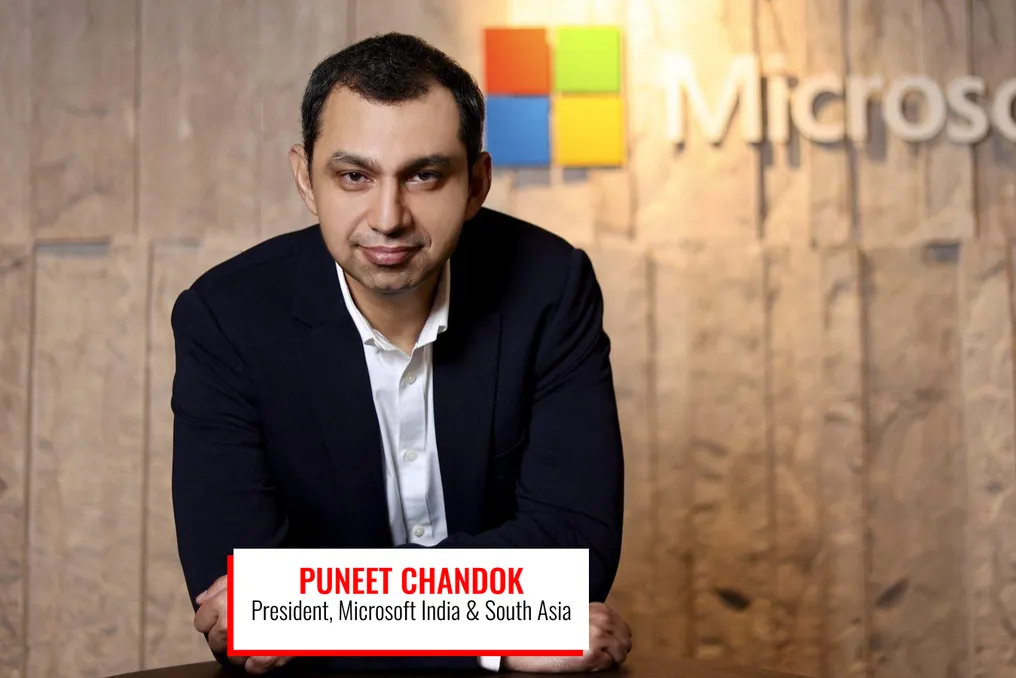
Punith Chandok, President of Microsoft India & South Asia, asserts that the key lies in achieving balance. He believes that the modern workforce is entering a new era defined by the concept of the 'human and AI barbell.' At one end of this barbell are the technical capabilities of AI, and at the other are unique human qualities that become increasingly valuable as AI develops.
Chandok emphasizes the necessity of maintaining equilibrium between practical skills in using AI and human aspects such as judgment, understanding the essence of things, curiosity, emotional component, and empathy.
The good news is that India is successfully responding to this new paradigm and leading in shaping the future of work. According to a Microsoft study, 32% of AI users in India are 'frontier professionals.' These specialists combine agentic automation with strong human judgment, which is double the global average and the highest among studied markets.
During an event presenting the Microsoft Work Trend Index 2026 results in Bengaluru, Chandok presented a clear action plan for navigating the future of work.
Punith Chandok's View
He shares his view that thanks to Copilot, he is honing his analysis and reasoning skills. This happens because he has become bolder in asking questions. Unlike communicating with colleagues or professors, where one might hesitate due to the interlocutor's reaction, with Copilot, one can discuss absolutely anything. Active interaction and challenging the tool sharpens the mind. For instance, one morning session was entirely planned by Copilot. After requesting an analysis of a report, a debate ensued, and he objected when the tool missed a certain perspective. He calls this a kind of 'guardian angel' that prevents foolish actions and enhances his potential.
However, he insists on maintaining balance, comparing it to a barbell: he improves his AI skills but does not forget about judgment, understanding, curiosity, emotions, and empathy. He notes that one cannot simply communicate with machines; one must interact and collaborate with people to preserve these indispensable traits. Thus, Copilot enhances his level of reasoning, rather than diminishing it.
Chandok believes that the younger generation has a significant advantage as AI natives, as they are free from the 'baggage' carried by previous generations. First and foremost, they need to master AI skills, as they have become a basic requirement for entering the industry. This implies the ability to responsibly create and manage agents while developing human competencies such as empathy and the ability to grasp the essence.
Furthermore, he advises young professionals to prepare for a dynamic career with a portfolio. Their career path will be long but not static. Instead of a slow climb up the traditional corporate ladder, they can make leaps. They do not need to go through the initial phase of routine work that he and others did.
He also notes that the world is becoming more tolerant. It is liberating for a 17-year-old to realize that they can pursue ten different things in life instead of making one lifelong decision right now. Consequently, the approach to university recruitment has shifted from assessing diplomas to checking practical results. His first question to a candidate is: 'What have you released in the last 90 days?' Here, not only the volume of released products matters, as anyone can create a useless application in hours; taste, judgment, and filter are assessed. He asks young engineers how many versions they created and discarded before releasing them, which reveals their filter and how they use AI to achieve their goals.
Three Changes in Corporate Models
Chandok points out that both Microsoft and its clients are undergoing three transformations that are changing business operating models. Firstly, there is an increased focus on Return on Investment (ROI). AI ambitions must be clear: without a path to ROI, projects should be avoided just for hobby purposes. This is a requirement demanded by all clients and boards of directors, and it is the healthiest topic for discussion.
Secondly, there is a rethinking of work for a new era where human and token capital work together. One cannot simply put a 'band-aid' on an old, broken process and expect a miracle; this will not happen. Workflows must be redesigned around tokens that function around the clock, without ego, breaks, or sleep. This is being implemented on a large scale: Air India restored customer service to handle 13 million requests with 97% accuracy, while partners like Adani Group, Axis Bank, Infosys, and TCS are implementing Copilots ubiquitously.
Thirdly, there is training of leaders and employees to transform them into frontier professionals. Chandok emphasizes that middle and senior management must first have direct access to the tools. AI cannot be learned theoretically; one cannot learn just by sitting in a room watching videos. It requires practical interaction, similar to contact sports. Therefore, companies ensure that all employees have Copilots, as this is currently the most powerful AI interface.
After enabling the tools, training must be scaled. The goal is to train 20 million people in India, including 2 million teachers who are crucial amplifiers in the world's largest education system. Culturally, a structural change is necessary. He advises CEOs that at least one-third of their staff should consist of frontier professionals, and eight out of ten employees should be performing new tasks they could not perform a year ago.
According to the Microsoft Work Trend Index, two metrics are critical. Firstly, 44% of managers in India agree with the AI mission, indicating a gap in communication between leadership commitment and on-the-ground work. Secondly, 25% of employees feel that experiments are rewarded sooner than results. It is necessary to ensure widespread design-based experimentation, while people feel rewarded regardless of the final outcome. Shifting these two parameters is a priority.
The 'Intelligence Plus Trust' Approach
Microsoft uses the concept of 'intelligence plus trust,' which serves as an excellent template for any AI startup. Firstly, intelligence is not just renting a cutting-edge model. It is the ability to adapt models to your organization's specific context. Without this, even the most powerful model remains a brilliant stranger, unaware of your company's work standards. Startups must possess the ability to contextualize the intelligence they create and adapt models to their own conditions.
Secondly, trust is a prerequisite. Enterprises want to see a reliable ally in a partner and ask the question: will you act in a safe, controlled, and trustworthy manner? If such a promise cannot be made, they have no right to participate in the process. The company actively collaborates and co-develops solutions with AI-oriented startups to bridge this gap. Using its 20,000 engineers in India and its B2B distribution mechanism, it helps startups provide safe and contextualized AI to traditional enterprises.
The company's broader goal is to transform recognized digital public infrastructure into AI public infrastructure for citizen-scale services. The core idea is simple: is it possible to uplift a billion Indians with AI, not just a few people with tools?