In 1951, Acharya Vinoba Bhave initiated the Bhudan movement, which he called Bhudan Yagya. The goal of this movement was to free vast tracts of land from seizure by landlords and provide housing for the needy. Although this task was not easy, Sant Vinoba relied on only one idea.
He asserted: 'All land belongs to Gopal; where is the obstacle? The obstacle is where it is in the heart.' That is, all this land belongs to Shri Krishna (Gopal), and everyone has the right to live on it equally. They are all His people.
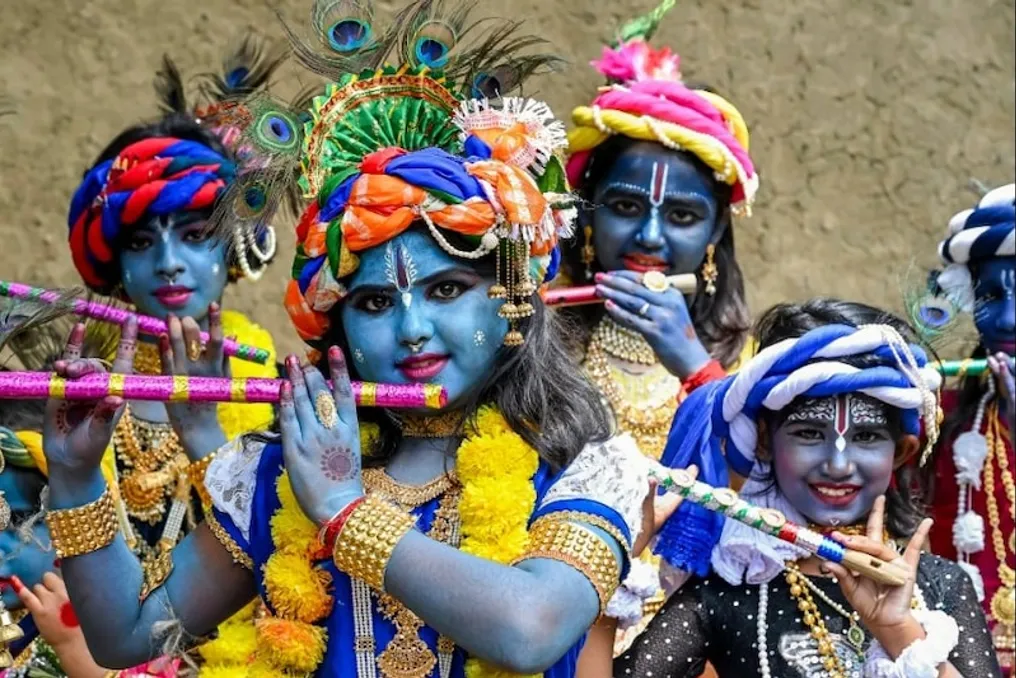
When we look at the image of Lord Krishna—adorned with a peacock feather, dressed in pitambara, playing the flute, with a mischievous expression on his face and a charming smile on his lips—we forget the boundaries of any country, region, or city where the land beneath our feet lies. Only the memory of Krishna remains.
As the eighth son of Devaki and Vasudeva, He begins as Makhanor in Nandgaon, as Gopal in Gokul, as Bank Bihari in Vrindavan, as Govardhanari in Natdwara, and then reaches Dwarka, becoming Dwarkadhish, the king. This means that Krishna is one, and the essence of His stories is singular, yet different corners of India adapted the image of Krishna according to their local traditions.
The natural origin of the journey of Krishna's changing forms stems from Braj. Although His stories are contained in various Puranas, a detailed description of His life, from birth to the entirety of His existence, is presented in the Shrimad Bhagavatam, where it is called 'Lila.'
Regarding the miraculous childhood stories, the narrative of Krishna surpasses that of Shri Rama. After Krishna's birth, a series of miracles begins: opening the prison doors, killing Putana, subduing Kaliya Naga, lifting the mountain, killing the demons sent by Kansa in a playful manner, and then killing Kansa himself at a young age. It is these stories that have cemented Krishna's deepest place in the Indian consciousness, and their geography is mainly associated with Braj.
In Chapter 21 of the Bhagavatam, Krishna's flute and the cowherds enchanted by it are described. This Braj sentiment later manifested most vividly in the image of Krishna not as an emperor of an empire, but as a simple Gopalaka, a cowherd. He is the simple beloved of Radha and Kanhaiya for the residents of Braj. This atmosphere is vividly expressed in the famous Bank Bihari temple in Vrindavan.
Although the history of the Bank Bihari temple dates back to the 16th century, there is a belief that the saint and musician Swami Haridas was devoted to Bank Bihari, and after being moved by his raga-singing, Shri Radha and Krishna appeared to him as a couple. This image was later established in the form of a murti.
'Bank' is associated with His tribhangi posture, while 'Bihari' refers to one who wanders. The appeal of Krishna here lies in the fact that the distance between the devotee and God is erased, and both seem madly and anxiously obsessed with each other. This is the specialty of Braj worship of Krishna.
Similarly, Srinathji Maharaj from Natdwara in Rajasthan also belongs to the Braj tradition, but His form is connected to the story of accepting Govardhana. Srinathjis are revered by everyone from nobility to merchants and sardars. During the Mughal rule in the 17th century, this idol was moved from Braj to a safer location. According to the history of the Natdwara temple, Srinathji left Govardhana in 1670 and were installed in Mewar in 1672, becoming Srinathji of Natdwara.
The modern practice of worshipping Laddu Gopal, seen everywhere, resembles the 'Pushtimarg Seva' tradition of Srinathji. The essence is that Krishna is worshipped simultaneously as a child who is cherished and as God. In the Pushtimarg 'Seva' tradition, Krishna (Srinathji) awakens as a living child, is adorned, fed, and given rest.
During the service of eight times (Ashtayam Seva), the Lord's clothing, food, and feelings change from Mangala to sleep. The Natdwara tradition calls Srinathji Govardhanath and not only worships Him in childhood form but also cares for Him like a child. Thus, the young Krishna, Govardhanari from Braj, became Srinathji in Rajasthan, and around Him developed a whole world of painting, music, clothing, food, and Haveli culture.
Now, moving from the western edge of India, another famous name of Krishna appears in this journey story—'Ranchodrai'. The story says that when Krishna felt he was unnecessarily involved in the conflict with Jarasandha and Kalyavan, He decided to withdraw. As a result, Krishna did not give a direct answer to Kalyavan's challenge and began to flee. Thus, Kalyavan fell into Krishna's politics and was burned in the rage of Maharaja Muchukunda.
Meanwhile, to protect the Yadavas from Jarasandha's invasions, Krishna founded a new city on the seashore—Dwarka, and became Dwarkadhish. Thus, His path from stealing the mahana, the Lila, accepting Govardhana, killing Kansa ends in Dwarka, and Krishna becomes the ruler of Dwarka.