Choosing a Bluetooth headset in 2026 requires more than just comparing prices. Crucial factors such as Active Noise Cancellation (ANC), battery life, wireless transmission quality, water resistance, and compatibility with various devices can influence the decision, depending on the consumer's usage profile. For this reason, Tecnoblog compiled a list of the ten best wireless headphones, detailing their features, advantages, and disadvantages.
Sony WH-1000XM6
The Sony WH-1000XM6 is an over-ear headphone that stands out for its focus on acoustic isolation through Active Noise Cancellation (ANC). It incorporates 30mm drivers and operates with Bluetooth 5.3, offering support for SBC, AAC, LDAC, and LC3 codecs. Thanks to its adaptive ANC and dedicated processing, noise reduction dynamically adjusts to the surrounding environment.
With Sony's digital processing and its drivers, this model aims to reproduce all frequency ranges with studio-level fidelity. The LDAC codec enables higher quality audio transmission on compatible devices, and support for LC3 prepares the device for low-energy audio functionalities of Bluetooth LE Audio. The battery of this headphone lasts up to 30 hours with active noise cancellation and 40 hours when the feature is turned off. Weighing about 254g, it can also be connected by cable, although it does not have an IP rating for dust and water protection.
JBL Live 780NC
The JBL Live 780NC is another over-ear headphone equipped with 40mm drivers, six microphones, and an adaptive noise cancellation system. This model uses Bluetooth 6.0 and features multipoint connectivity, which can be managed via the JBL Headphones app, offering various operating modes.
The 40mm drivers promise good sound projection, while the six microphones assist the system in identifying and mitigating external noises, and are also used during calls. Adaptive cancellation regulates the noise reduction level according to the scenario, making it ideal for environments such as public transport, offices, or home use. JBL reports that the autonomy can reach 50 hours with ANC on and an impressive 80 hours with the feature disabled. Weighing 260g, it also offers wired and multipoint connection, which is particularly advantageous for those who need to switch between a mobile phone and computer throughout the day.
AirPods Pro 3
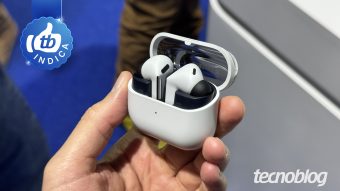
The AirPods Pro 3 are in-ear headphones featuring ANC, Ambient Mode, and Adaptive Audio. They use Apple's H2 chip and include advanced features such as Spatial Audio with dynamic head tracking, heart rate monitoring during exercise, and hearing accessibility options.
This chip centralizes much of the audio processing and noise cancellation, allowing the AirPods to adjust playback and sound suppression in real time. The battery lasts up to eight hours with ANC activated, and the charging case complements this with up to 24 hours under the same conditions. When Spatial Audio and dynamic head tracking are enabled, the autonomy can reach 7.5 hours. Furthermore, both the earbuds and the case have an IP57 rating, ensuring resistance against dust and water.
Galaxy Buds 4 Pro
The Galaxy Buds 4 Pro represents Samsung's flagship model among in-ear headphones. It comes equipped with ANC, 360 audio, Bluetooth 6.1, LE Audio, and support for AAC, SBC, and Samsung Seamless Codec. With an IP57 rating, these headphones are resistant to dust and water, and each unit weighs approximately 5.1g.
The combination of ANC with the in-ear design helps reduce external sounds even before sound processing. However, the advanced audio and connectivity features are maximized when the headphones are used with Galaxy line devices. Battery life reaches six hours with ANC on and 26 hours with the case. Without noise cancellation, the autonomy can reach seven hours in the earbuds and 30 hours with the case.
Huawei FreeBuds Pro 5
The Huawei FreeBuds Pro 5 is an in-ear headphone that employs two driver systems: a dual-magnet ultralinear and a microplanar diaphragm. While the ultralinear primarily focuses on mid and low frequencies, the microplanar handles the highs. This architecture results in consistent bass and greater detail in the treble.
The model supports Bluetooth 6 and allows simultaneous connection to two compatible devices. It also offers high-resolution codecs such as LDAC and L2HC, the latter being more integrated with Huawei devices. Autonomy varies depending on the codec and ANC usage: with AAC, it is up to six hours with ANC on and nine hours without it; with LDAC or L2HC, the duration is up to five hours with ANC and eight hours without cancellation. With the case, the battery can reach 25 hours with ANC active.
The Soundcore P40i is an in-ear headphone that features adaptive ANC, Bluetooth, and an app for equalization adjustments and audio features. It has a low-latency mode optimized for gaming and multipoint connection, as well as an IPX5 certification, which guarantees protection against water jets. Its 11mm drivers are considered large for this format, contributing to a more pronounced impact on the bass. The adaptive noise cancellation automatically adjusts the ambient sound, and the six microphones capture voice for call processing. Playback on the headphones reaches 12 hours, and with the case, it can reach up to 60 hours, depending on usage conditions. The case also serves as a smartphone stand, adding a practical function, although it makes the case larger.
Meanwhile, the Soundcore Q20i is an entry-level over-ear headphone that uses 40mm dynamic drivers and hybrid active noise cancellation. The system employs internal and external microphones to reduce ambient noise and allows simultaneous connection to two devices. The drivers promise to improve sound presentation with greater emphasis on bass, and the equalizer available in the app allows users to customize the sound according to their preference. This model's battery reaches 40 hours with ANC on and 60 hours with the feature off. Being a more basic model, its focus lies on essential elements: ANC, battery, and Bluetooth 5.0 connectivity.