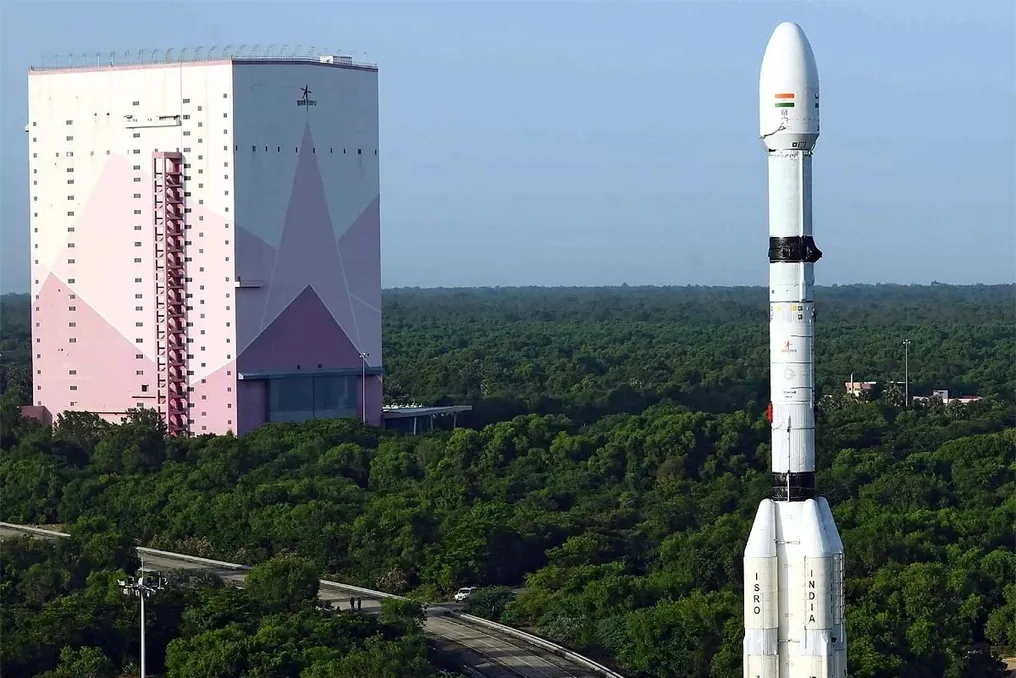
The Indian GSLV-F17 rocket was launched on September 4th at 2:55 AM from Sriharikota, successfully placing the EOS-05 satellite into orbit. The launch took place from the second launch pad of the Satish Dhawan Space Centre, located in Sriharikota, Andhra Pradesh. GSLV-F17 is the nineteenth flight of India's GSLV rocket. In this mission, EOS-05 was delivered to a special Sub-GTO transfer orbit.
EOS-05 is an Earth remote sensing satellite that will collect images and related information about the planet from space. The GSLV-F17 is used to put this satellite into orbit and functions in three stages. A distinctive feature of this rocket is the simultaneous operation of various systems, including a solid fuel engine, four liquid boosters, and a cryogenic engine.
The GSLV rocket has a height of about 51.7 meters and a mass of about 420 tons during flight. It consists of three stages: the lowest is the first stage, above it is the second, and at the very top is the cryogenic stage. Each stage performs its function, sequentially propelling the rocket forward during the flight.
The first stage, known as GS1, is equipped with a large solid propellant engine S139. It uses solid fuel based on HTPB and can operate for about 100 seconds, providing thrust up to 4800 kilonewtons. Four side boosters L40 are attached to it, which can be considered additional engines mounted on the sides of the rocket. Each of these boosters has its own engine and can operate for approximately 140 seconds, assisting the rocket in the initial phase of flight.
After the first stage completes its operation, GS2, or the second stage, comes into action. This stage operates on liquid fuel using UH25 and N2O4. It functions for about 150 seconds and is capable of generating thrust up to 846 kilonewtons. The task of the second stage is to give the rocket the necessary altitude and speed to direct the satellite to the designated orbit.
The third stage of the GSLV is the upper cryogenic section (CUS), equipped with the cryogenic engine CE-7.5. It operates on liquid oxygen and liquid hydrogen, which are maintained at very low temperatures. This engine provides thrust up to 75 kilonewtons and can operate for approximately 814 seconds. It is critically important that this cryogenic stage was developed in India. Since January 2014, the cryogenic stage has been used in domestically developed GSLV missions.
The EOS-05 satellite is placed inside the payload fairing at the very top of the rocket, which serves as its protective casing. This casing protects the satellite from external influences and air pressure while passing through the atmosphere. For GSLV-F17, a composite payload with a diameter of 4 meters was used. The term 'nose' refers to the front part, which has a rounded and slightly pointed shape.
In this mission, GSLV-F17 will deliver EOS-05 to a Sub-GTO (Sub-Geosynchronous Transfer Orbit). After this, the satellite will independently reach its final orbit through further maneuvers. The role of all three stages of the rocket is different: the first stage and four boosters provide the initial impulse, the second stage continues the rocket's movement, and the third cryogenic stage gives EOS-05 the necessary speed.