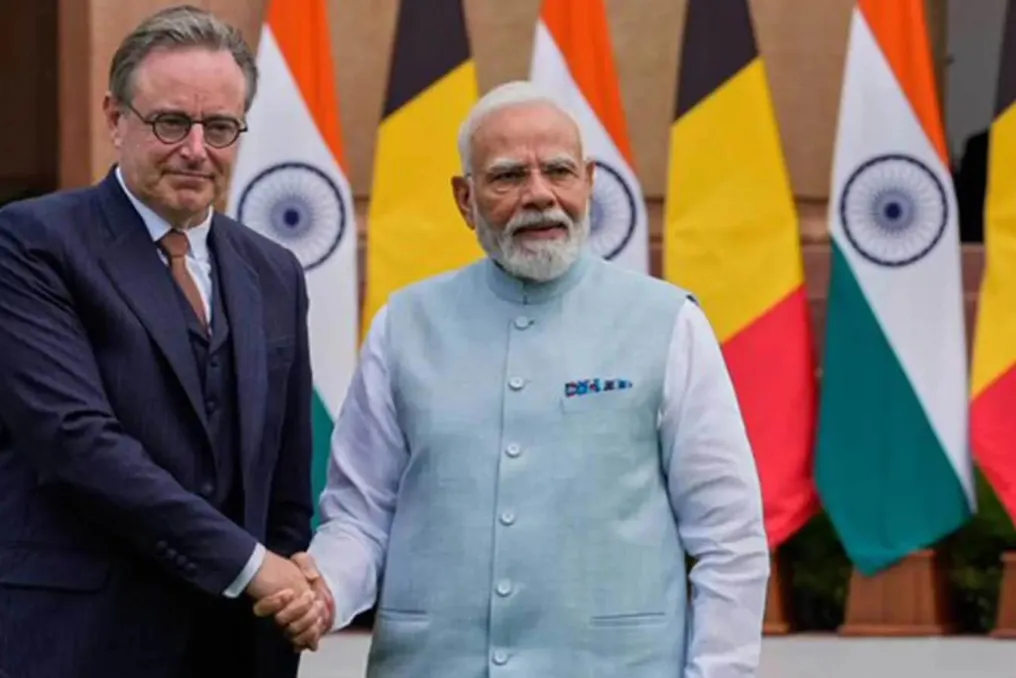
India and Belgium deepen defense and energy ties with aim to double trade turnover
Read more
The times of India
timesofindia.indiatimes.com

India and Belgium deepen defense and energy ties with aim to double trade turnover

India and Belgium have signed agreements aimed at strengthening defense cooperation and clean energy collaboration, and they also agreed to double bilateral trade within five years. These arrangements were reached during meetings between Indian Prime Minister Modi and his Belgian counterpart Bart De Wever, who became the first Belgian Prime Minister to visit India in nearly two decades, according to Sachin Parashar.

Following the talks, Modi presented India's growth of 7.8% in the last quarter as an opportunity for the entire world. In a joint statement with De Wever, Modi noted that global conflicts are causing serious disruptions, disrupting food, fuel, and raw material supply chains, and creating uncertainty across various sectors.

Modi stated: 'Today, the story of India's growth is becoming a source of confidence and new opportunities for the whole world.' Prime Minister Narendra Modi also announced a mechanism to accelerate investment between the two nations.

Belgium has contributed to attracting $4.2 billion in Foreign Direct Investment (FDI) into India from April 2000 to December 2025, making it the eighteenth largest source of FDI in India. De Wever's visit led to 10 key outcomes: five Memorandums of Understanding (MoUs), including two focused on developing domestic defense production, co-design, and joint development, as well as five other announcements, including the appointment of a military attaché at the Indian embassy in Brussels.

Regarding the potential extradition of fugitive Mehul Choksi, currently imprisoned in Belgium, Foreign Ministry Secretary Sibi George noted that law enforcement cooperation was a 'significant topic of discussion and an important aspect of relations with Belgium.' He added that 'all issues of concern and interest are discussed at all levels of our interaction... India remains committed to ensuring the return of fugitives to the country to serve their sentences.'

Modi emphasized that relations with Belgium have expanded beyond traditional sectors. The Prime Minister stated: 'Defense and security cooperation is a key pillar of our relationship. Today, we agreed to enhance military exchange and training cooperation between the two countries.' He continued that agreements between governments and defense industries will open up opportunities for joint development and production in the defense sector. Furthermore, intelligence sharing and agency cooperation to combat crime will be strengthened.

The Prime Minister noted that unprecedented cooperation, including the recently concluded Free Trade Agreement (FTA) between India and the EU—the two largest democratic blocs in the world—will serve as an impetus for global stability, development, and common prosperity.

The leaders also discussed Ukraine and West Asia, stressing their support for the rule of law, dialogue, and diplomacy. In a joint statement, they highlighted the importance of ensuring the security of sea lanes and maintaining safe and unimpeded maritime navigation.

Modi added: 'Whether it is Ukraine or West Asia, we support all efforts aimed at the swift cessation of conflicts and the restoration of peace.'

The leaders called for closer partnership in semiconductor technologies to create resilient and advanced technological ecosystems in both countries, noting that Belgium's expertise in this area complements India's scale.

Both leaders agreed to conclude an agreement on migration and mobility soon to facilitate talent movement. Belgium also expressed solidarity with India in the fight against terrorism. De Wever condemned the attack on civilians in Pahalgam in April 2025. The statement said that both leaders stressed their commitment to a comprehensive/global approach to combating terrorism and affirmed that terrorism in any form, manifestation, and anywhere can never be justified, calling for its perpetrators to be held accountable under the law.

Furthermore, the leaders focused on clean energy, critical minerals, and resilient supply chains. The Prime Minister stated: 'The MoU on renewable energy signed today will give momentum to our sustainable development cooperation. Regarding critical minerals, we decided to strengthen ties in processing and recycling.'

Similar stories

India and Belgium sign agreements to expand bilateral cooperation in several areas
Read more
timesofindia.indiatimes.com

India and Belgium sign agreements to expand bilateral cooperation in several areas

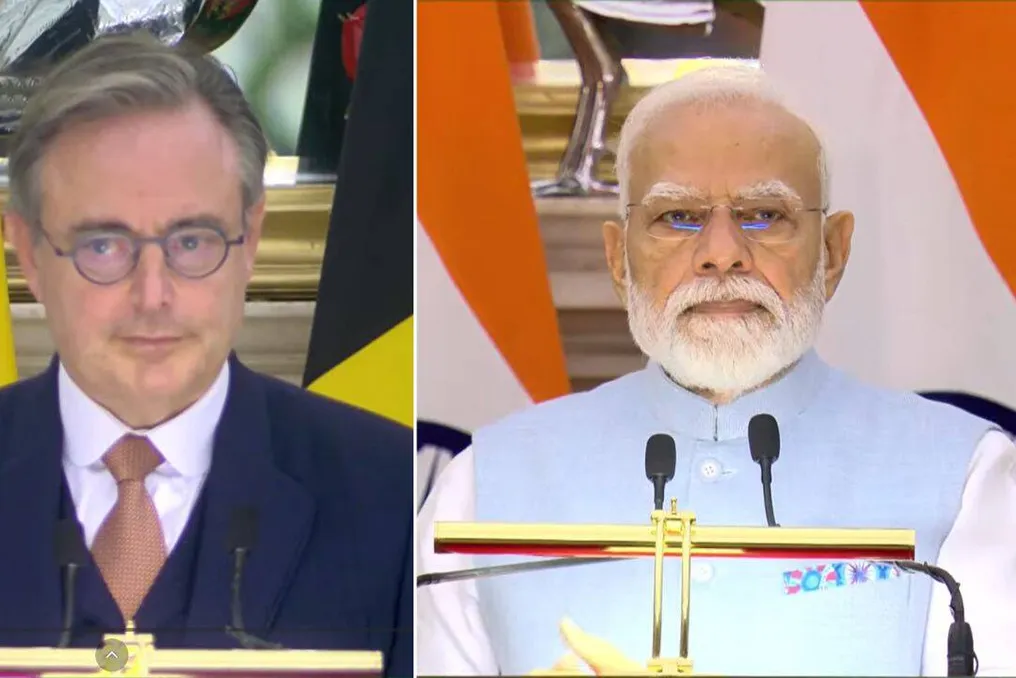
In New Delhi, India and Belgium signed a series of memoranda and agreements on Thursday aimed at deepening bilateral interaction in the fields of renewable energy, defense, trade, investment, maritime affairs, critical minerals, semiconductors, and research. These agreements were concluded during meetings between Indian Prime Minister Narendra Modi and Belgian Prime Minister Bart De Wever in New Delhi.

The agreements were exchanged at Hyderabad House in the presence of both leaders, as both sides seek to transform long-standing relations between India and Belgium into a broader strategic and economic partnership.

Prime Minister Modi stated that the countries agreed to strengthen cooperation in several new areas, including startups, enhancing maritime capabilities, universities, and scientific research. Furthermore, they are working on an Agreement on Migration and Mobility Partnership to facilitate talent movement.

Modi emphasized that an agreement was reached today to strengthen ties between startups and enhance maritime competence. He also noted that an Agreement on Migration and Mobility Partnership will be signed soon. The Prime Minister added that both countries share the principles of the rule of law, dialogue, and diplomacy, having discussed regional and global events.

An agreement on renewable energy was highlighted, which will give a new impetus to bilateral cooperation on sustainable development issues. The parties also decided to intensify joint work on the recycling and processing of critical minerals.

The Prime Minister also stressed defense cooperation as a key pillar of the relationship. An increase in military exchanges and joint exercises was agreed upon. Agreements concluded between governments and defense industries will open up new opportunities for joint development and production of defense equipment. Additionally, the parties intend to strengthen intelligence sharing and cooperation in combating crime.

Modi mentioned that India and Belgium are working on modern defense equipment, citing the Zorawar tank as an example. In the field of clean energy, the renewable energy agreement will strengthen sustainability, while the planned integration of the Belgian Institute IMEC with India's semiconductor ecosystem will combine Belgian expertise with India's scale.

In the context of economic ties, following the signing of the Indo-European Trade Agreement earlier this year, Modi reported that India and Belgium have taken steps to realize the potential of this agreement. An 'Accelerated Investment Mechanism' has been established in India for Belgian companies, and the Indo-Belgian Business Forum will become a regular event. The goal of these measures is to double bilateral trade within the next five years.

During De Wever's visit, which is the first visit by a Belgian Prime Minister to India in two decades, geopolitical issues were also discussed. Modi emphasized that both countries support peace-building efforts, whether in Ukraine or West Asia, and share a common commitment to eradicating terrorism.

Against the backdrop of global uncertainty affecting supply chains, Modi noted that the Indian economy remains dynamic, demonstrating growth of 7.8% in the last quarter.

De Wever's visit, which began on September 2 and lasted until September 4, was accompanied by the Belgian Minister of Defence and Foreign Trade, Theo Franken. Earlier on Thursday, Franken held a meeting with Indian Defence Minister Rajnath Singh and the Belgian Minister, where the expansion of defense cooperation was discussed. Singh welcomed greater interaction with the defense companies of both countries.

Franken called for deeper cooperation with India, highlighting its technological capabilities, and noted that Belgium needs partners like India for future projects. He also referred to Belgium's economic mission in March 2025, which contributed to the development of bilateral ties.

US-China Medical Cooperation Leads to Global Treatment Standards
Read more
cgtn.com

US-China Medical Cooperation Leads to Global Treatment Standards

Discussions on trans-Pacific cooperation and mutual benefit were the central theme of the CGTN panel discussion at the annual AABIP meeting in Denver. Experts from both countries shared their views on joint work.

Professor Sun Jiayuan from Shanghai Lung Hospital presented an example of using shape-sensing robotic bronchoscopy (ssRAB), invented in the US and implemented in China in 2021. His team collaborated with American specialists to treat Chinese patients: the US provided device innovations, while China contributed a large number of clinical cases and rapid clinical adaptation.

By December 2025, specialists from 13 hospitals in Asia, Europe, and North America gathered 18 experts to develop the world's first international consensus on the use of ssRAB for diagnosing peripheral lung lesions. All 38 recommendations were unanimously approved.

Dr. Sonali Sethi, President of the American Association of Bronchology and Interventional Pulmonology (AABIP), noted that lung cancer issues are similar in China and the US. She also highly praised the CT-based lung screening system in China, which promotes early disease diagnosis.

Discussing technological advancements, Dr. Sethi emphasized that the emergence of navigational robotic platforms allows doctors to reach smaller and peripheral lesions, detect cancer earlier, and transition patients from late stages (III/IV) to Stage I or II, where chances of recovery are significantly higher.

Furthermore, she pointed to the importance of integrating imaging with robotics. Mobile cone-beam computed tomography systems combined with tomosynthesis and artificial intelligence algorithms now provide real-time intraoperative visualization with low radiation doses, increasing accuracy and reducing costs.

Professor George Chen from the Department of Pulmonology at UCSD (University of California San Diego) noted that Chinese companies are utilizing the acquired clinical technologies and lessons to improve them, and there is potential for the reverse transfer of innovations from China to Europe and the US for the benefit of local patients.

Professor Chen added that this dynamic mutual enrichment of technologies and healthcare models is a future direction and will contribute to improving the quality of care provided by doctors to patients.

Professor Hou Gan from the Sino-Japanese Friendship Hospital highlighted the necessity of staff training. He proposed creating a faculty training program between the US and China, stating that trans-Pacific cooperation is valuable for evaluating new methods and disseminating them globally, ultimately benefiting more patients.

Founded in 1992, AABIP provides participants with the opportunity to present research, network with colleagues, and develop joint projects. The event also serves as a platform for exchanging the latest advances in research and clinical practice to improve patient care.

Popular