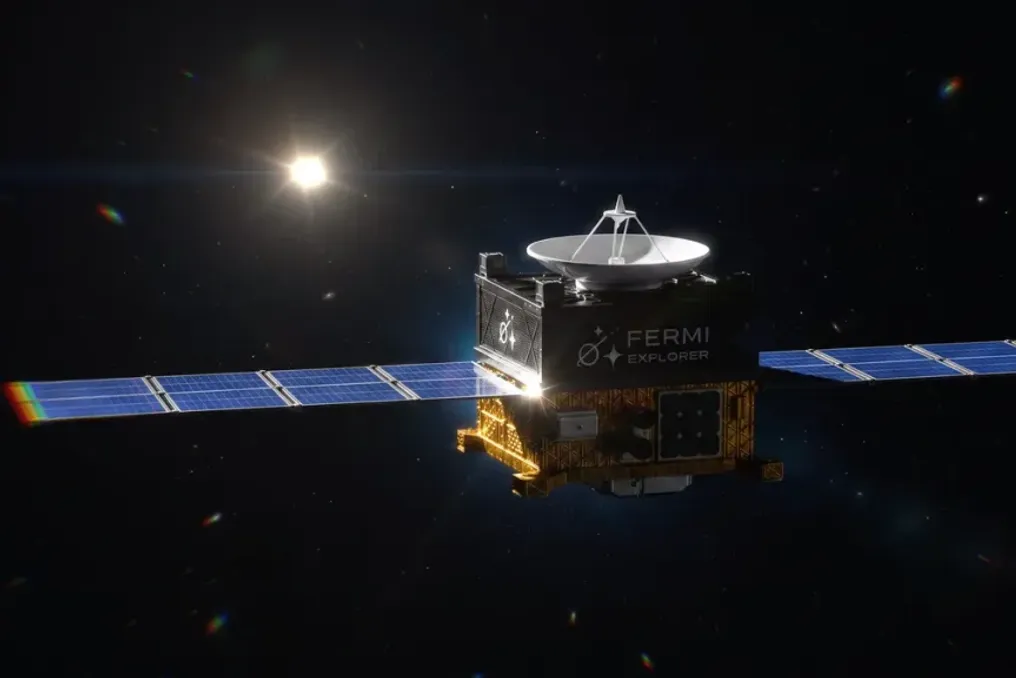
A small spacecraft could be launched toward Alpha Centauri, the closest star system to the Sun, on a journey that would take about 80 thousand years. The proposal, named Fermi Explorer, intends to use existing technologies to demonstrate the possibility of an interstellar mission, even a very slow one, without relying on futuristic propulsion systems or billion-dollar investments.
This idea was presented on Tuesday (1) by mathematician and physicist from the UK, Philip Johnston, and other entrepreneurs. The group plans to raise $15 million (about 76.6 million Brazilian reais) to build a probe with a payload of only 1 kg and attempt to launch it in 2029. Instead of aiming for a fast arrival, the project is betting on a low-cost strategy for placing the spacecraft on a path to another star.
Discussion of Mission Goals
In an interview with Olhar Digital, Roberto Dias da Costa, Associate Professor at the Department of Astronomy at IAG-USP and director of CienTec, explained that the mission's goal is not an isolated star like our Sun. He clarified that Alpha Centauri is a triple system consisting of two stars very similar to the Sun, named Alpha Centauri A and Alpha Centauri B, and one red dwarf known as Proxima Centauri, which is significantly smaller.
According to the astronomer, the two larger stars are separated by 23 astronomical units (AU), equivalent to the distance between the Sun and the planet Uranus, and are located 4.36 light-years from Earth. The third star orbits this pair at a much greater distance, being the closest to our planet. 'Proxima is significantly farther from the pair, currently about 12 thousand AU away from them, and is located 4.24 light-years from us, making it slightly closer.'
Despite being our nearest stellar neighbor, the distance is so vast that a conventional ship would take thousands of years to cover the journey. Fermi Explorer will travel at a speed of approximately 25 km/s, which is enough to escape the Solar System but too little compared to the distances between stars. As a result, the journey will take about 79,800 years.
This means that if the mission is launched in 2029 and completes its route, arrival will occur around 81,829! None of the project participants will be alive to see the result. In fact, thousands of generations will pass between launch and arrival. Thus, the spacecraft will function as a kind of technological capsule sent into such a distant future that the modern world will be unrecognizable.
Acceleration Mechanism
The challenge begins long before the probe leaves the Solar System. Fermi Explorer will first be launched into a low Earth orbit, likely as part of a joint launch mission. Then, a long series of maneuvers around the Sun will begin. Instead of simply directing the craft toward Alpha Centauri, the developers intend to use the star itself as part of the mechanism to accelerate the probe.
For over ten years, the probe will execute carefully calculated orbits, gradually approaching the Sun. The point of closest approach may reach 0.42 astronomical units, or about 62.9 million kilometers, which is slightly less than half the average distance between the Earth and the Sun. In this region, solar radiation is much more intense, allowing panels to generate more energy to power an electric propulsion system.
The team plans to combine these close passes of the Sun with the so-called Oberth effect, a phenomenon that allows for better utilization of engine thrust when the spacecraft is moving at high speed. Multiple such maneuvers, called 'perihelion boosting,' will gradually increase the probe's speed until it can finally leave the Solar System.
However, according to Costa, the strategy adopted by the private group does not represent a major aerospace breakthrough. 'They say it is a technology test, but I believe it will only serve as a check of the 'elastic band effect,' which involves placing the probe in an orbit that allows it to pass close to a very massive body, in this case the Sun, and thus gain speed. But this is in no way new; many probes have already used this technique.'
According to an 81-page technical assessment prepared with the help of artificial intelligence, this solar acceleration process could take about 12 years. After this, Fermi Explorer will continue moving almost purely by inertia toward Alpha Centauri. A speed of about 25 km/s will be sufficient to start the journey, but not to make it fast. Most of the 80 thousand years will be spent in deep interstellar space.
The mission is not intended to carry people or even a large number of scientific instruments. The priority is to test whether a very small spacecraft can undertake such a journey using relatively simple components. Nevertheless, without active propulsion after the initial phase, the astronomer from IAG-USP emphasizes the problem of trajectory accuracy. 'Since this hypothetical probe has no directional control and will move only by inertia, I believe it is impossible to 'accurately target' one of the three stars in the system.'
After the initial stages, communication will become an issue. Direct contact will last about 18 months, while reflectors will help ground telescopes track the craft for some time. However, once it crosses Jupiter's region, Fermi Explorer will become increasingly difficult to detect, silently advancing for tens of thousands of years. There will be no team waiting for arrival, and there will be no rescue mission. The probe's fate will be to continue its trajectory until reaching the Alpha Centauri system.
Additional Remarks
Signal loss at such an early stage is one of the most criticized aspects by experts. 'If they themselves say they will lose the ability to track the probe when it is about the distance of Jupiter, then anything beyond that will just be speculation. Note that Voyager 1 and 2 were launched in 1977 and are still operating! They are now more than 150 times farther from the Sun than Earth! Jupiter is only 5 times farther from the Sun than us,' analyzes Costa.
As unlikely as it may seem, the 80,000-year journey has a purpose that goes beyond simply reaching another star. Johnston links the project to the Fermi paradox, which questions why, despite the vast number of existing stars and planets, we have yet to find convincing evidence of other civilizations. One possible reason is that interstellar travel is too complex for any form of life.
Fermi Explorer would be a way to test exactly this hypothesis. If a technological civilization can send a small spacecraft to another star using relatively modest resources, even if it takes tens of thousands of years to arrive, one of the potential obstacles of the paradox weakens. The mission would also leave a message for the extremely distant future: humanity was able, at least, to attempt to cross the space between stars.
The project is still far from guaranteed realization. The team needs to secure funding, build the spacecraft, find a suitable launch, and execute a complex sequence of maneuvers. Even if all these stages are completed, the mission will remain a bet with an almost incomprehensible timeframe.