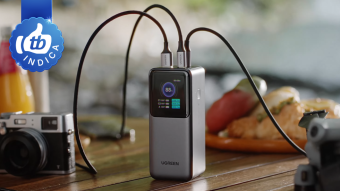
Selecting the ideal power bank requires careful evaluation of available charging specifications and the budget allocated for its purchase. Models with higher prices generally offer greater capacity and superior power, ideal for fast charging. On the other hand, portable chargers with lower power tend to have more accessible costs, although they may prolong the time needed to charge devices.
In this article, Tecnoblog presents ten recommended power bank options, detailing the advantages and limitations of products from the brands Ugreen, Anker, i2GO, Samsung, Geonav, Baseus, and Basike.
UGreen Nexode Pro (5525B)
The UGreen Nexode Pro (5525B) is the most powerful model on the list, suitable for recharging more robust equipment, such as laptops. It features a capacity of 25,000 mAh and a total output power of 200 W, supporting USB Power Delivery (PD) 3.1. This charger has three ports: USB-C 1 (140 W), USB-C 2 (100 W), and USB-A (22.5 W). Even when powering three devices simultaneously, it maintains a maximum power of 140 W through the main USB-C port.
The power bank itself takes approximately two hours to recharge with its maximum power of 65 W. Furthermore, it incorporates an TFT screen to display metrics and a ThermalGuard system that monitors temperature variations in real time.
Anker MagGo (A1654)
The Anker MagGo (A1654) is a 10,000 mAh power bank focused on phone charging, especially iPhones. It uses the Qi2 standard to allow wireless charging, but the magnetic alignment and maximum power of 15 W only apply to certain iPhone models (iPhone 12 or later). It has a single USB-C port with a 27 W output, a lower level, but useful for devices that do not support wireless charging. This same port supports a maximum input power of 20 W for recharging the power bank itself, which weighs 250 g. Other features include thermal monitoring and a side screen for data tracking.
i2GO
The i2GO power bank, with 20,000 mAh, offers a good energy reserve. However, it is better suited for charging phones, headphones, or tablets with lower demands, as its maximum output power is only 20 W. The two USB-A ports provide 18 W of output each, while the USB-C port with PD reaches up to 20 W, allowing up to three devices to be charged simultaneously. The device's input power (412 g) is 18 W, resulting in a total recharge time between 8 and 10 hours.
Samsung Battery Pack
The Samsung Battery Pack has 20,000 mAh and a maximum output power of 45 W. Its specifications suggest it is sufficient for charging phones and tablets but is limited for laptops; it is recommended to turn off the laptop or activate power saving mode during charging. It has three USB-C ports, but the 45 W power is only achieved when using one port and a device compatible with Super Fast Charging 2.0 and PD 3.0/PPS. In situations of simultaneous charging of three devices, the power drops to 30 W. The maximum input power of the power bank is 25 W. Although it does not have a monitoring screen, four LEDs indicate the battery level, and the device weighs 402 g.
Geonav Magnetic
The 10,000 mAh Geonav magnetic power bank is an advantageous alternative for iPhone charging, thanks to its MagSafe compatibility, optimizing induction charging efficiency. The maximum inductive charging power is 15 W. Wired charging is also possible using the USB-C port (PD 20 W) or USB-A (QC 18 W). In multiple charges, the 15 W of power is distributed according to the connected devices. The maximum input power is 18 W, which may imply a considerable waiting time to charge the power bank.
Baseus PicoGo Magnetic
The Baseus PicoGo Magnetic, also with 10,000 mAh, is another model focused on smartphones and headphones. Although it supports wired charging, it is not recommended for more demanding devices due to its lower capacity and power levels. Qi2 magnetic charging offers up to 15 W. The USB-C port allows charging devices via cable with a maximum output power of 27 W. This same USB-C port also receives power to charge the power bank with up to 20 W. An AI chip assists in thermal monitoring, and LEDs show the battery level.
Basike Power Bank
The Basike Power Bank offers 20,000 mAh and a maximum output power of 45 W. It is capable of charging headphones, phones, tablets, and even laptops, as long as the power demand does not exceed 45 W. The USB-C input provides up to 45 W, but the integrated USB-C cable (bidirectional) is limited to 30 W. There is also a USB-A port that delivers up to 22.5 W. A small display on top indicates the battery level, and this 325 g power bank takes about three hours to recharge at 30 W.
Anker Nano Power Bank
The Anker Nano Power Bank is the least powerful charger on the list, mainly due to its reduced size. It offers 5,000 mAh of capacity and includes a compact USB-C connector that plugs into smartphone ports without taking up much space. The integrated connector provides 22.5 W of output, as does the side USB-C port for wired charging. When used simultaneously, the power drops to 18 W. Weighing only 100 g, this portable battery supports charges of up to 18 W and is compatible with pass-through, allowing other devices to be recharged while it is being charged.
Geonav 20,000 mAh
This 20,000 mAh Geonav model is a portable charger with good capacity, but its restricted output power makes it more suitable for smartphones and headphones. It has three outputs: two USB-A (up to 18 W) and one USB-C (up to 20 W). When all ports are used together, the power drops to only 10 W. Weighing 350 g, it supports pass-through mode but requires about 7 hours to recharge its battery (with up to 18 W power).
i2GO Plus
The i2GO Plus is a basic power bank, ideal for those who need a daily extra charge. It offers 10,000 mAh capacity, but its output power is limited to only 10.5 W. The device has two USB-C outputs and one USB-A port, each providing 10.5 W. SmartCharge technology automatically adjusts the output current, allowing up to three devices to be charged simultaneously while maintaining maximum performance. The package includes a USB-C cable for recharging the power bank (222 g), which takes approximately 5 hours to charge at a maximum power of 10 W.
When deciding which power bank to purchase, it is essential to consider both technical specifications and the available budget. Important aspects to analyze include:
The 20,000 mAh Geonav and Basike 20,000 mAh models with 45 W are good choices for air travel, as they are relatively light and compact, while keeping the capacity below the 100 Wh limit. However, it is important to note that airlines such as Gol, Latam, and Azul prohibit the use of these power banks during the flight. It is permitted to carry up to two portable chargers (each 100 Wh) in carry-on baggage, but they cannot be used or recharged during the journey.
Power banks with 20,000 mAh or more provide an excellent level of autonomy, usually supplying two to three recharges for most current smartphones. Meanwhile, 10,000 mAh chargers offer a reasonable capacity but are often limited to a single charge cycle due to the inherent energy loss in the charging process.
The Basike Power Bank of 20,000 mAh is highlighted as the most economical option on the list, currently priced in the range of R$ 200. This device combines a compact design, good capacity, and fast charging up to 45 W.