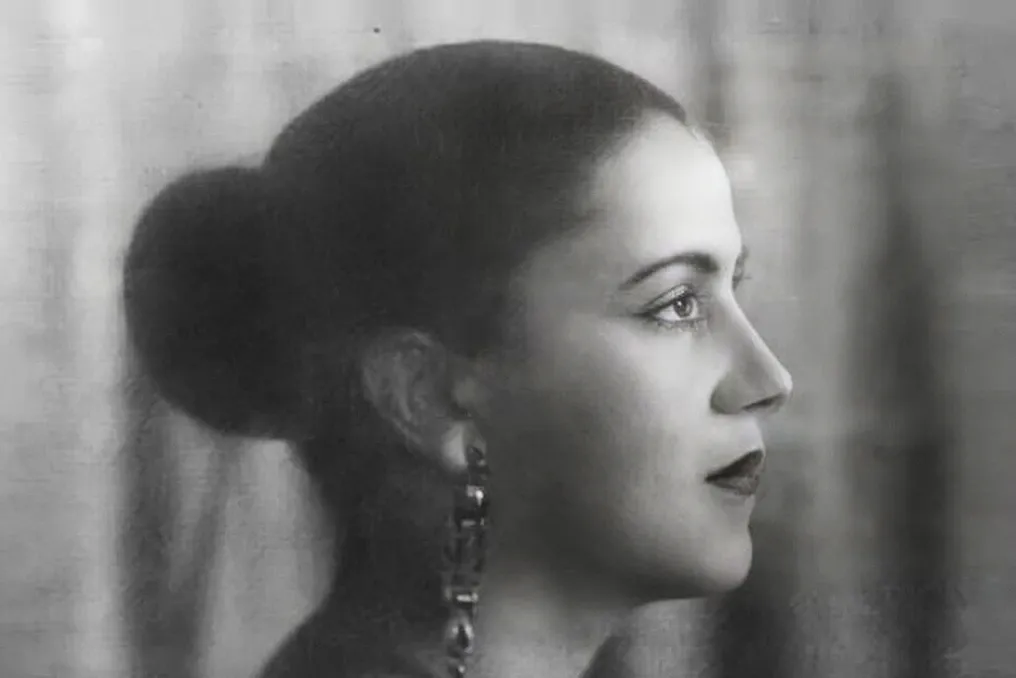
Tarsila do Amaral, one of the most prominent figures in Brazilian art, would have turned 140 on a Tuesday. Her art, characterized by the vibrant use of colors, simplified geometric shapes, and the representation of genuinely Brazilian themes, established her as a pillar of the modernist movement, which aimed to break away from austere and monochromatic European aesthetics.
Tarsila was born into a privileged environment, being the daughter of Paulista landowners who were involved in cultivating and exporting coffee in Capivari, in the interior of São Paulo. Despite her affluent background, she received encouragement to study and undertook extensive travels through Europe, where she attended private art institutions, such as the Académie Julian in Paris.
Initially, her artistic production strongly reflected the European academic influence of her training. Her first painting, titled Sacred Heart of Jesus (1904, Barcelona), showed little affinity with the artist she would later become.
The turning point in her trajectory occurred in 1922. After a brief return to São Paulo shortly after the Modern Art Week, Tarsila was introduced to Oswald de Andrade, Mário de Andrade, and Menotti Del Picchia by her friend Anita Malfatti, whom she had known since 1917. This group later became known as 'The Group of 5.'
Upon returning to Paris, this time to study with Cubist artists like Albert Gleizes and Fernand Léger, Tarsila incorporated the colors, shapes, and themes of Brazil into her work. In a correspondence from April 1923, sent to her family, she expressed her desire to become a painter of her homeland, declaring: 'I feel increasingly Brazilian; I want to be the painter of my land. I want, in art, to be the caipirinha of São Bernardo, playing with bush dolls, as in the last painting I am doing. Don't think that this Brazilian trend in art is looked down upon here [in Paris]. On the contrary. What is wanted here is for everyone to bring contributions from their own country.'
Subsequently, Tarsila remained in Brazil, dedicating herself to rescuing the cultural roots of the country. One milestone of this period is Abaporu (1928), her most famous work, which was a birthday gift for her then-husband, Oswald de Andrade.
Upon seeing the canvas for the first time on January 11 of that year, Oswald considered the work extraordinary, stating: 'This painting is exceptional.' He and the poet Raul Bopp (1898-1984) immediately began analyzing the painting, interpreting the enigmatic figure as an anthropophagic man, someone who would absorb, digest, and renew culture.
Tarsila, who had not yet named the work, consulted her Tupi-Guarani dictionary and translated the terms 'aba' and 'poru', meaning 'man who eats', giving rise to the name Abaporu. This name was crucial, inspiring Oswald to create the Anthropophagic Manifesto in 1928.
However, Tarsilinha do Amaral, the artist's grandniece and guardian of her legacy, presents a different perspective on the creation of the painting, suggesting that Abaporu might be a self-portrait of Tarsila. She related in a conversation with Bial in 2019 that the artist was facing a mirror, in a seated position, with her hand on her head and her foot bare, possibly nude.
Another comparative detail lies in the feet: relatives believe that Tarsila had a second big toe larger than the hallux, as depicted in Abaporu. Despite Oswald's excitement upon receiving the painting, the artist allegedly did not reveal that it was a self-portrait.
In 1929, Tarsila requested the return of Abaporu after her separation from Oswald. However, due to subsequent movements, the work is no longer in Brazilian possession, and is accessible at the Latin American Art Museum of Buenos Aires, in Argentina.
The economic crisis of 1929 severely impacted Tarsila's family, who owned farms in the interior of São Paulo. The subsequent financial difficulty sparked an interest in political issues within her. To finance a trip to the Soviet Union in 1931, the artist sold part of her personal collection.
In Moscow, Tarsila exhibited her works at the State Museum of Modern Western Art and came close to communist ideologies, being influenced by the workers' cause. Upon returning to Brazil, however, her sympathy for communism led to political persecution. During the dictatorship of Getúlio Vargas, she was detained for approximately one month in 1932, on suspicion of involvement in activities linked to the Soviet Union and subversion, which distanced her from partisan engagement in the following years.
This transformation of values also manifested in her art. Still marked by the experience in the Soviet Union and sensitive to the workers' cause, Tarsila began, in the 1930s, what is known as the social phase of her work. Abandoning the tropical and dreamlike color of the anthropophagic phase, she began to portray urban themes and the daily life of the working class, lending a more political bias to the depiction of Brazil.
The most notable paintings from this phase include Workers (Operários, 1933) and Second Class (Segunda Classe, 1933), which are currently part of the Artistic-Cultural Collection of the Government Palaces of the State of São Paulo.
Like many Brazilians, Tarsila enjoyed cachaça with lime, which earned her the affectionate nickname 'caipirinha' among modernists, attributed to her strong accent. This is one of several theories about the origin of the drink's name.
One narrative suggests that the drink gained popularity during the Modern Art Week, and Tarsila supposedly coined the term 'caipirinha' to designate the event's official beverage. Additionally, while residing in Paris, the painter received bottles of cachaça from Brazil and prepared the drink for her foreign friends, such as Pablo Picasso.
Although Abaporu is her most famous piece, it is not Tarsila's most expensive painting. That title belongs to the work 'A Caipirinha' (1923), a Cubist self-portrait that refers to the artist's childhood in the interior of São Paulo. In December 2020, this canvas was auctioned for R$ 57.5 million, establishing itself as the most expensive artwork ever sold at a public auction in the country. It is currently part of a Brazilian collector's private collection.