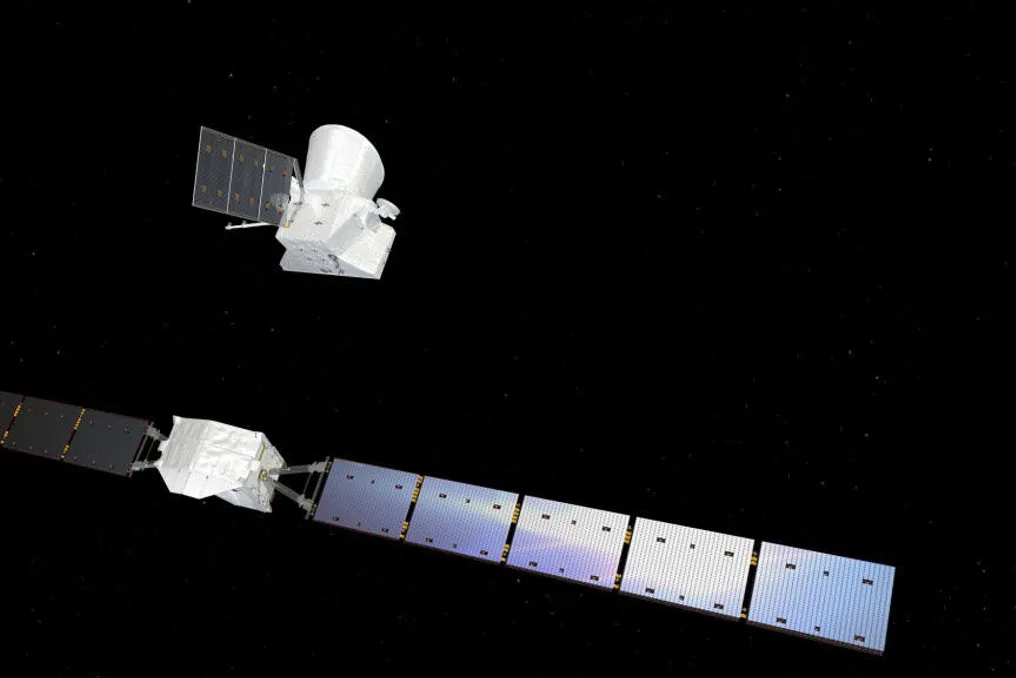
The BepiColombo mission reached a crucial stage of its journey to Mercury on Thursday (the 3rd). After nearly eight years traveling through the inner solar system, the Mercury Transfer Module (MTM) was successfully separated from the main spacecraft at a distance of over 200 million kilometers from Earth.
The European Space Agency (ESA) confirmed the separation at 10:52 Brazilian time, after antennas from the Estrack network located in Cebreros (Spain) and Malargüe (Argentina) received a signal from the mission. Telemetry showed that the systems are functioning normally, and the ESA orbiter's solar panels, MPO, are charging the batteries.
This operation is part of the BepiColombo arrival phase. The mission is being implemented by ESA in collaboration with the Japan Aerospace Exploration Agency (JAXA) and is intended to deliver two scientific spacecraft to Mercury.
Mission Components
The first two orbiters to operate around Mercury simultaneously will be the Mercury Planetary Orbiter (MPO) from ESA and the Mercury Magnetospheric Orbiter (Mio) from JAXA.
Before final confirmation, the team detected a preliminary Doppler signal corresponding to the planned MTM separation sequence at 9:41 Brazilian time. This signal reflects the change in radio frequency between Earth and the spacecraft caused by the change in the spacecraft's velocity.
Full confirmation depended on receiving a signal from MPO, which was expected around 10:53 Brazilian time. Although the separation was expected around 9:00 Brazilian time, the team continued to await confirmation via communication with the spacecraft.
After the separation of MTM, both scientific orbiters head towards the Mercury orbital insertion phase. The mission plans for the entire spacecraft to enter the planet's orbit on November 21, 2026. Subsequently, MPO and Mio are scheduled to separate between December 9 and 10, 2026. Until then, MPO will provide power to the entire complex.
The scientific phase of the mission is slated for April 2027. ESA emphasized that the separation this Thursday required meticulous planning, navigation, and precise commands, as the operation took place at a distance of over 200 million kilometers from Earth, precluding real-time intervention.