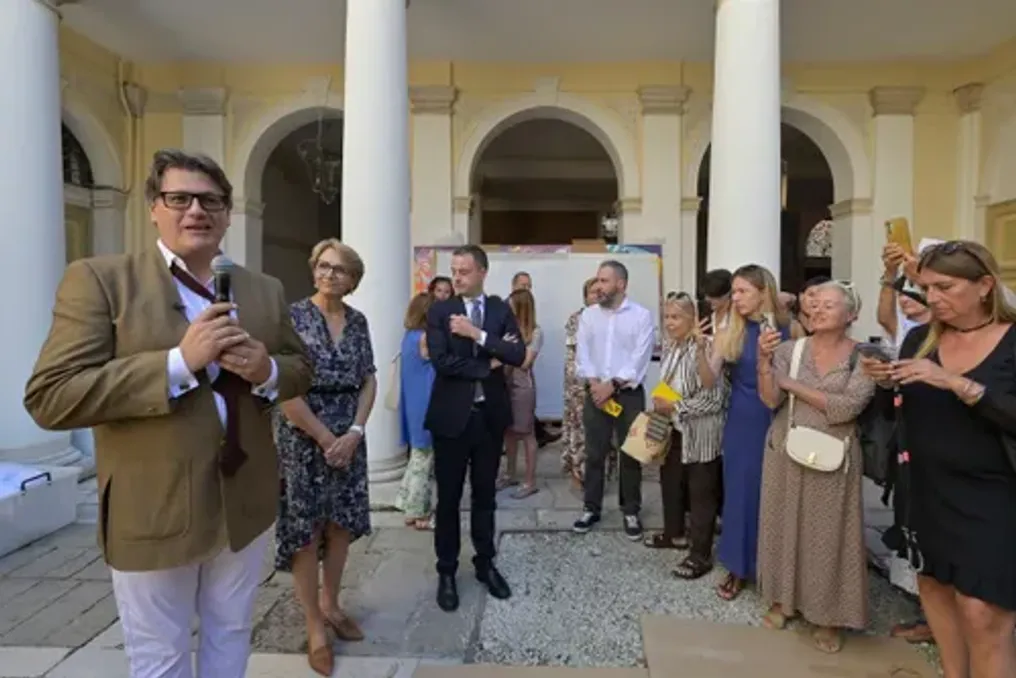
A Venetian palazzo, the former residence of the designer, will be transformed into a new museum showcasing hundreds of iconic works from late Pierre Cardin, celebrating his innovative vision of future fashion. The museum opening is scheduled for September 13th.
The opening ceremony will be marked by a costume party to be held on Thursday evening at Cardin's Venetian home, Palazzo Bragadin, where he lived for almost 40 years.
Cardin, the French couturier who was born in Italy and passed away in December 2020 at the age of 98, was a key figure in 1960s fashion. His space-age unisex designs sparked a wave of youth culture, spreading from Parisian boulevards to Carnaby Street in London.
His reputation as a modernist, fitting the spirit of the decade, was cemented by knit mini-dresses with bright geometric patterns, unexpected cutouts, and a preference for synthetic fabrics. Cardin acquired his palazzo in Venice in 1981, using it as a sanctuary to restore creative inspiration.
Designer's Vision and Legacy
Cardin's relative, Rodrigo Basilicatí-Cardin, CEO of the brand, noted that the approximately 1000 square meter space with high ceilings is ideal for exhibiting at least one hundred outfits. Today, Cardin is largely known for his pioneering business strategy of licensing his name onto thousands of products, from bedsheets to answering machines, which brought him wealth but somewhat diminished the luster of his once prestigious brand.
The museum aims to remind visitors of the couturier's innovative design sense, who worked under Elsa Schiaparelli and Christian Dior in Paris before launching his own line in 1950. In 1959, Cardin attempted to democratize fashion by releasing ready-to-wear clothing—a concept that shocked the time and led to temporary exclusion from the French haute couture board, though it was quickly copied by competitors.
About 130 outfits spanning the period from 1951 to 2018 are displayed in the palazzo's luxurious halls. Among them are a 1971 emerald green knit tunic with a belt and dramatic side cutouts, as well as a 1991 black velvet evening dress adorned with a giant taffeta rose on the hips. Also featured are a 1963 silver mini-dress with a honeycomb pattern and a neck bow, and a 1993 dress in pumpkin and black colors with dramatic folds cascading from the bodice.
Basilicatí-Cardin emphasized that for his uncle, the body was secondary to what it supported—the sculpture of clothing. He asserted that Cardin's entire life was built on structures, and all his pieces are architectural, not purely fluid, considering his dresses to be sculptures. Nevertheless, Cardin remained a minimalist, striving for his dress to be recognizable from afar, using few ideas—a maximum of two, preferably different in shape and color, and nothing more.
Unexpected Turn of Fate
The costume party on Thursday commemorates the 75th anniversary of a legendary ball held in a neighboring palazzo that helped launch Cardin's career. This ball, titled the 'Ball of the Century,' was organized in 1951 by art collector Charles de Besteuguy and gathered society celebrities, including Orson Welles, Aga Khan III, and photographer Cecil Beaton.
Immediately after Cardin left Dior, the great couturier tasked his former assistant with creating about 30 costumes for an upcoming ball in Venice, for which he lacked time. This incident became a turning point that contributed to the young designer's reputation. His nephew recounted that he only had six workers and seamstresses at the time, but he managed to create these 30 costumes, including outfits for Salvador Dalí and his friends.
René Taponne, 79, who began working with Pierre Cardin at the age of 14, managed the final details for the museum opening. Taponne told AFP that she misses him, stating that he shaped her and built her entire life. Over more than 60 years of work in the company, Taponne performed numerous duties: sewing, working in sales, and helping organize fashion shows. She noted that Cardin demanded a lot, but in return, gave a great deal.