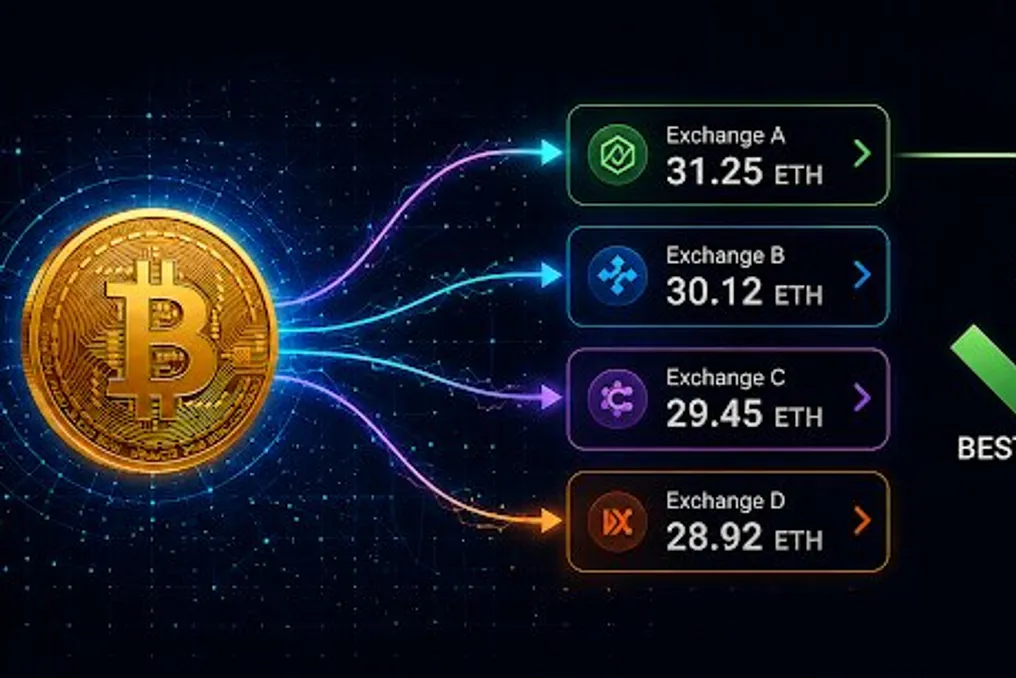
How to compare cryptocurrency exchange rates to avoid overpaying during swaps
Read more
Ventureburn
ventureburn.com

How to compare cryptocurrency exchange rates to avoid overpaying during swaps

When performing the same crypto swap on different platforms, a user may receive a noticeably different amount of the target asset, even if the same amount and cryptocurrency pair are entered. This occurs because the crypto swap quote includes not only the market price of the two assets but also a number of conditions that determine the possibility of executing the transaction.

These conditions include available liquidity, spread, network costs, routing, transaction size, quote type, and market conditions at the time the quote is received. Therefore, to understand the true cost, one must look deeper than just the stated fees; the key factor is the volume of the target cryptocurrency expected to be received under comparable deal conditions.

There is no single exchange rate that all providers should offer. Each operator has its own sources of liquidity, pricing structure, and execution process, which affects the final quote. Liquidity determines how easily a provider can execute a trade at a competitive price, and since they use different sources, the same pair and amount can yield different offers.

Transaction size is also important. An offer that looks attractive for a $500 swap might not be the best option for a $10,000 deal, as large operations interact with available liquidity differently.

The stated fee reveals only part of the picture. A provider may set a small visible fee while incorporating most of their margin into the exchange rate through the spread. Another provider might show a higher fee but offer a narrower spread, ultimately providing more cryptocurrency.

Consequently, comparing percentage rates without analyzing the final quote can give a false idea of which offer is cheaper. After the swap is completed, the target cryptocurrency must be sent to the user's wallet, and this transaction incurs blockchain costs, which providers may estimate or account for differently, affecting the amount in the quote and, ultimately, the received asset.

The route used to complete the exchange can also change the outcome. One provider may convert Asset A directly to Asset B, while another may use an intermediate asset before reaching the final cryptocurrency. Different routes provide access to different liquidity and involve different conversion costs.

Since cryptocurrency prices and liquidity are constantly changing, any quote reflects the conditions only at a specific moment. If one quote is compared now with another minutes later, market movement may explain some discrepancies. Therefore, reliable rate comparison must use quotes obtained within a roughly comparable time frame.

Quote type also matters. A fixed rate usually locks the declared swap amount for a limited acceptance period, according to the provider's terms and deposit conditions. A floating rate, conversely, depends on market conditions at the time of deposit confirmation. Since these offers are based on different pricing conditions, fixed and floating quotes cannot be compared as equivalent.

Before deciding which provider offers the best deal, it is necessary to ensure that identical transaction conditions are being compared. When comparing crypto swap quotes, five variables should remain unchanged. When these variables match, the comparison becomes much more meaningful.

Suppose Provider A advertises a lower fee than Provider B. At first glance, Provider A seems cheaper. However, Provider A might use a wider spread or account for network costs differently. Thus, Provider B might offer a higher expected payout despite a larger visible fee.

A more useful indicator is the actual cryptocurrency payout, meaning the amount of target cryptocurrency expected to arrive in the wallet. This provides a single metric for comparing providers, even if they structure their costs differently.

Manually comparing the same transaction across several providers can take a long time. The service Monivo simplifies this process by aggregating compatible provider quotes in one place, using the same transaction parameters. Monivo acts as a non-custodial crypto swap aggregator, requesting quotes from connected providers based on the user's selected assets, networks, amount, and quote type.

Providers are only compared directly if they provide a working quote for the requested swap. If a provider does not support the transaction, it may be displayed as unavailable instead of showing an estimated price. Monivo then ranks compatible offers based on the expected amount of target cryptocurrency that will be credited to the user's wallet. This allows users to compare crypto swap rates more clearly, relying on actual provider quotes and expected results, rather than just stated rates or headline fees.

Monivo itself does not add a separate fee or markup to provider quotes; it may receive a commission from the liquidity provider after the swap is completed. Comparable offers are ranked by expected payout volume, not by provider compensation.

There is no single provider that offers the best crypto swap rates for every transaction. Quotes can vary depending on the amount, assets, networks, liquidity, fees, and market conditions. Therefore, reliable rate comparison must be based on identical transaction details. When comparing exchange rates, one should look beyond the stated fee and focus on the expected volume of outgoing cryptocurrency, which will provide a clearer picture of which offer provides better value for your swap.

Similar stories

Moonberg Pre-sale Considered Potentially More Profitable Alternative to DOGE and XRP
Read more
ventureburn.com

Moonberg Pre-sale Considered Potentially More Profitable Alternative to DOGE and XRP

The cryptocurrency market is showing signs of an upward trend, with Bitcoin increasing by 20%, and some altcoins showing even better growth. However, this complicates the task of finding the best cryptocurrency to buy right now. Bitcoin's strong week supported major altcoins, but this did not eliminate the question of growth potential in established tokens with multi-billion dollar market capitalizations.

Dogecoin, XRP, and Ethereum each have different advantages. Dogecoin remains one of the most well-known meme coins in the crypto space, XRP recovered along with the general market sentiment, and Ethereum continues to hold a central place in decentralized finance. Nevertheless, traders looking for an early entry opportunity are paying attention to the Moonberg cryptocurrency pre-sale, which is linked to a live artificial intelligence-based trading terminal.

Dogecoin surged during the market rally following the announcement of US Treasury bond repurchases. CoinMarketCap analysis linked this rise to increased liquidity, a technical breakout, and growing trader interest in meme coins. The rally showed that Dogecoin can move quickly when sentiment improves. Its large community, wide exchange support, and long history in the crypto industry give it advantages that new meme coins cannot easily replicate. Furthermore, there was no explicit, Dogecoin-specific catalyst for the movement; much of the recovery depended on the generally favorable risk environment, meaning the price could remain vulnerable if Bitcoin and the broader altcoin market lose momentum.

XRP also benefited from improved sentiment. The token recently returned close to the $1 level after a difficult period, giving traders reason to watch whether the overall recovery can become a more sustainable trend. However, current forecasts remain cautious. CoinGecko predictive market data showed bullish sentiment, but only an 8% implied probability of XRP reaching the $1.20 mark by the end of August. These figures reflect market positioning, not a guaranteed price target. XRP's established role in cross-border payments still provides it with a clearer utility scenario than Dogecoin. Nevertheless, investors should distinguish between a short-term rally and a confirmed reversal; the token needs to establish support above $1 and continue attracting demand before a sustained recovery becomes likely.

Ethereum remains the leading smart contract asset and the main beneficiary of any return of risk appetite in the crypto sphere. Its ecosystem supports a vast range of activities in decentralized finance, tokenization, stablecoins, and blockchain development. The recent rally has improved prospects, although traders must grasp its scale. Ethereum already has a market capitalization in the hundreds of billions of dollars, making it unlikely to deliver the type of returns typically associated with small-cap pre-sales. This does not make Ethereum a weak choice; it can attract investors seeking a more established asset with deep liquidity and a proven network. But those looking for the best cryptocurrency to buy now can also compare it to earlier tokens with lower initial valuations and a functionally used product.

The Moonberg offering differs from DOGE, XRP, and ETH. The $MBX token is integrated with a live AI-based crypto trading terminal designed for Solana and Ethereum traders, with both the Terminal and the AI Agent already operational. Moonberg combines research, on-chain analytics, trading signals, agent building tools, backtesting, and execution. Users can start using the platform for free and then gain access to more advanced features through its broader ecosystem.

The platform tracks over 76 million tokens and processes more than 53.4 billion data points. It also utilizes 130 proprietary metrics to provide 'smart money' tracking, fake volume detection, developer history analysis, wallet monitoring, and real-time signal generation. Moonberg Wallet X-Ray and Sentinel tools are designed to help traders investigate wallet activity and identify unusual behavior. This type of analytics was often associated with expensive corporate data contracts, but Moonberg makes it accessible through a single terminal.

The $MBX token is intended to support activity on the Moonberg platform, not to exist independently of the product. It can be used for AI agent credits and computations, premium data levels, Algo Builder access, reduced terminal fees, and priority access to selected features. The AI Agent is designed for traders who do not want to code. Users can describe a strategy in plain language, backtest it, and decide whether to deploy it from their wallet. They retain control at all times and can immediately stop the agent. Furthermore, Moonberg is MCP-ready, allowing it to connect to existing tools. Its key advantage is that the agent reads real-time blockchain data and market conditions, rather than just generating generic commentary.

Moonberg's Moonscope feed currently reports 6,649 signals, a 75.6% win rate, and an average PnL of +276.4%. These are data provided by Moonberg, and past results do not guarantee future performance. While DOGE, XRP, and ETH remain major names in the cryptocurrency market, each with a compelling reason to attract buyers during a recovery, their size may limit the growth potential for new investors.

The best cryptocurrency to buy now depends on individual risk tolerance. The Moonberg pre-sale may offer greater theoretical growth potential since $MBX is at an earlier stage, but pre-sales also carry significantly higher risk. Its live product, AI agent utility, and on-chain analytics give it a stronger foundation than tokens tied only to future plans. Moonberg represents a riskier option because $MBX is still in pre-sale. DOGE and XRP are more established, while Moonberg offers early participation tied to a live trading platform and token utility. $MBX is designed to pay for AI agent computations, unlock premium analytics, access Algo Builder, reduce fees, provide priority computing, support ecosystem rewards, and grant holders governance rights.

Popular