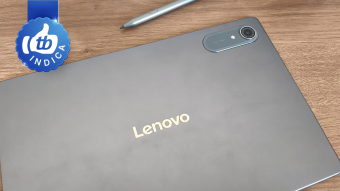
Lenovo offers tablets across various categories in 2026, ranging from basic models to high-performance and feature-rich devices for work. There are significant differences in battery capacity, display technology, and accessory configurations.
In this guide, Tecnoblog presents six of the best Lenovo tablets, comparing their main technical specifications and outlining the pros and cons of each model.
Idea Tab Pro Gen 2
The Idea Tab Pro Gen 2 is the brand's most advanced model. It is equipped with the Snapdragon 8s Gen 4 processor, which demonstrated high performance in multitasking, gaming, editing, and artificial intelligence feature tests. The model is available with up to 12 GB of RAM and 512 GB of internal storage, and it supports microSD cards up to 2 TB.
Another feature of the Idea Tab Pro Gen 2 is its screen. Although it uses LCD instead of AMOLED, it is 13 inches with a 3.5K resolution and a refresh rate of up to 144 Hz. This configuration ensures high image quality and smoothness for studying, watching movies, and gaming.
For work tasks, Lenovo provides a complete set including a stylus, a keyboard with a touchpad, and a magnetic case at no extra cost. The battery is rated for up to a day and a half of use. The factory operating system is Android 16, with a projected update to Android 18.
Lenovo Idea Tab Pro
The first generation Lenovo Idea Tab Pro boasts high performance thanks to the MediaTek Dimensity 8300 processor, support for up to 12 GB of RAM, and 256 GB of internal storage. Its display is smaller than the newest model (12.7 inches) but features high resolution and a refresh rate of up to 144 Hz, making it ideal for media consumption, multitasking, and gaming. Additionally, it is equipped with JBL technology with Dolby Atmos speakers, although the keyboard is not included—only the case and stylus.
Thanks to its hardware, the Idea Tab Pro surpasses basic Lenovo models, especially in terms of battery life, with a 10,200 mAh battery.
Lenovo Idea Tab Plus
The Lenovo Idea Tab Plus occupies an intermediate position in the brand's current lineup. The main focus is on a large screen, long battery life, and features geared towards studying, productivity, and entertainment. The tablet uses the MediaTek Dimensity 6400 processor in configurations with 8 GB of RAM and 256 GB of storage. This performance is sufficient for watching videos, video calls, streaming, and multitasking, although it lags behind the computational capabilities of the Idea Tab Pro Gen 2 in editing and gaming tasks.
The 12.1-inch screen has a 2.5K resolution and a refresh rate of up to 90 Hz, but the smoothness is lower than that of the professional model. The device is compatible with a stylus and keyboard, but only the Lenovo Pen is included in the package.
Lenovo Idea Tab
The Lenovo Idea Tab represents the simplest version of the line. It is equipped with the MediaTek Dimensity 6300 processor, up to 8 GB of RAM, and 128 GB of storage, which can be expanded via microSD. The screen is 11 inches with the same 90 Hz refresh rate, but the maximum brightness of 500 nits was found to be limited during reading and navigation according to tests conducted.
Similar to the Pro Gen 2 version, Lenovo supplies a full productivity kit: a case, a keyboard (without a touchpad), and a stylus (battery-operated). The 7,040 mAh battery provides all-day autonomy but only supports 8 hours of continuous video streaming.
Lenovo Tab
The Lenovo Tab serves as the entry point into the manufacturer's tablets and is designed for basic tasks such as entertainment and internet browsing, as it uses the MediaTek Helio G85 processor. The model is sold with 4 GB of RAM and 64 GB of internal storage (expandable via microSD). The 10.1-inch screen has a WUXGA resolution and brightness up to 400 nits. Unlike the Idea Tab, the panel operates at a 60 Hz refresh rate, making the visual experience simpler but sufficient for watching movies, navigating, and accessing social media.
The Lenovo Tab is equipped with dual speakers with Dolby Atmos, and its battery holds 5,100 mAh, which is less than other models in this review.
Lenovo Tab K11
The Lenovo Tab K11 is a mid-range tablet focused on productivity, studying, entertainment, and mobility, as it supports 4G connectivity. Its MediaTek Helio G88 processor combined with 4 GB of RAM is suitable for multitasking, document editing, and some light gaming, although it is not a gaming tablet. The IPS screen is 11 inches, with a WUXGA resolution and a 90 Hz refresh rate, providing greater smoothness than the Lenovo Tab. Brightness reaches 400 nits, which may make viewing difficult in bright conditions, and the 7,040 mAh battery offers good capacity and fast charging up to 20W.
The hardware of this device does not directly compete with the Idea Tab Pro Gen 2 or Idea Tab, but the 90 Hz screen, four speakers, battery, and stylus support make it a balanced option for studying.
The choice between models primarily depends on the intended use case. Among Lenovo tablets, there are significant differences in processors, displays, memory, and connectivity:
- Idea Tab Pro Gen 2 is the best choice for gaming, thanks to the Snapdragon 8s Gen 4 with Adreno 825 GPU and the ability to have up to 12 GB of RAM for maximum raw performance in heavy games. Its 13-inch screen offers 3.5K resolution and up to 144 Hz for smoother animation.
- Idea Tab is oriented towards reading and note-taking. Its high-resolution 11-inch screen, along with software features and stylus support, expands capabilities for document work and studying. It is a more suitable alternative to basic models for those who spend a lot of time reading.
- The Lenovo Idea Tab is also useful for studying and work because it comes with accessories such as a keyboard and stylus included and free. While the Tab K11 might be more interesting to those who require mobile connectivity, as it is the 4G LTE version in the Brazilian market.
Nevertheless, before making a decision, it is worth comparing the prices of these tablets with competitor offers in similar price segments. Lenovo offers options in different categories and price ranges, but the cheapest models may disappoint in terms of performance.
Samsung tablets stand out with features to enhance productivity, greater durability, and connectivity, while Apple's iPad maintains an advantage in performance and ecosystem integration, albeit at a higher cost.
The Lenovo Tab M10 is an outdated model that should only be considered if it can be found at a significantly lower price. Depending on the generation, it uses processors like Snapdragon 429/450 or Unisoc T610, has a 10.1-inch screen, and limited hardware by modern standards. Furthermore, software support for the main M10 generations has already been discontinued, which is an argument against purchasing it.