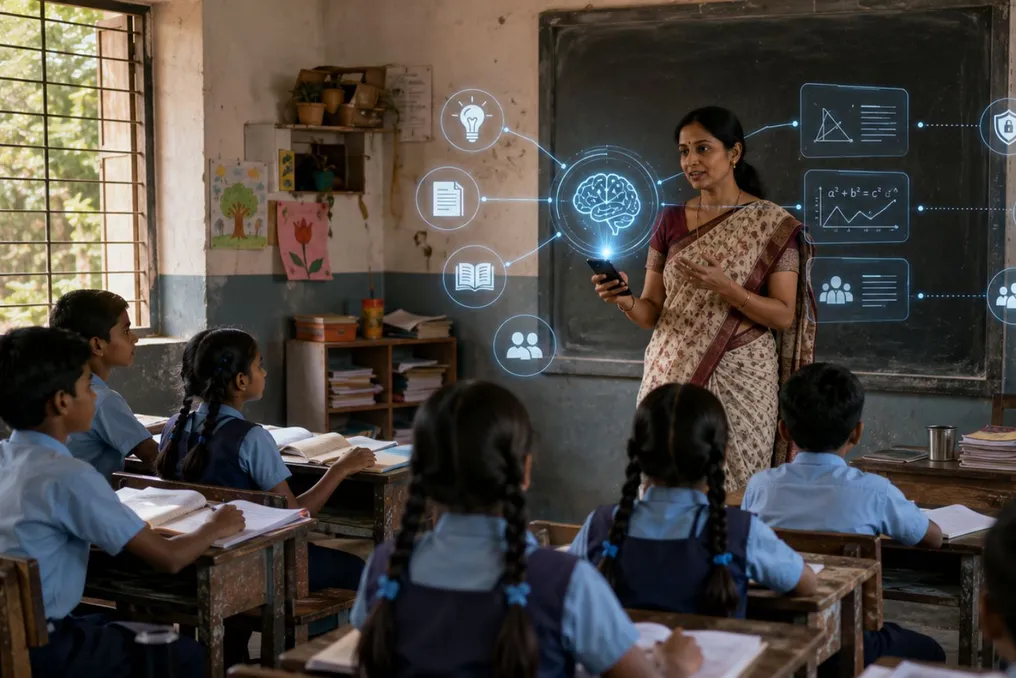
The implementation of artificial intelligence (AI) is taking place in Indian classrooms, but a new survey indicates that the people responsible for leading this transition may be ahead of the system supporting them. A national survey conducted among 797 government school teachers found that 72% view AI as a positive development, while 26% already use the technology regularly.
The study's results suggest that resistance may not be the most significant hurdle in adopting AI in public schools. Instead, teachers require more guidance and institutional support for the responsible use of this technology.
The report, titled 'AI Readiness of India’s Government Schools Teachers,' was published by JanAI, part of the Head Held High Foundation, on September 1st. It covers teachers from the states of Uttar Pradesh, Karnataka, Jharkhand, and Maharashtra. This comes several months before India begins introducing an AI and computational thinking curriculum for classes 3 through 12 in the 2026–27 academic year.
The research focused exclusively on government school teachers, avoiding combining them with private school teachers to obtain a broader national average.
For many educators, mastering AI does not begin with new infrastructure. Teachers already access AI through personal mobile phones, even in schools lacking computer labs. The report describes this as advancing adoption ahead of infrastructure expectations.
The technology is predominantly used as an aid for teaching. Most frequently, teachers apply AI to simplify complex concepts, generate examples and assignments, and prepare worksheets and assessments. Grading and administrative documentation are among the least common applications.
Furthermore, there is little evidence that teachers perceive AI as a threat to their jobs. Concerns about AI replacing teachers were almost entirely absent in both structured and open responses. A more significant gap exists between positive attitudes and regular usage.
Despite 72% of teachers being positive about AI, only 26% use it consistently. For JanAI, this means teachers do not necessarily need convincing about the technology; they need a supported pathway from experimentation to responsible and regular use.
This becomes even more critical for students. Among teachers who noted that AI makes them personally more effective, 86% expressed concern that students might become overly dependent on it. Among all surveyed teachers, 64% shared this anxiety. AI can help an educator explain a difficult topic or create learning material, but unlimited student use could negatively impact independent thinking.
The survey also revealed a serious privacy issue. More than half of the teachers using AI tools reported having entered a student's name, grades, or photo into an AI tool at some point. The report found that individual confidence in protecting student privacy does not always lead to safer behavior.
Instead, institutional support appears more crucial. School policies, government policies, training, and having a designated contact person for issues can collectively influence the responsible use of AI. This shifts the question from whether teachers are ready for AI to whether the system around them is ready to support that readiness.
JanAI plans to build upon these findings by identifying, training, and organizing a community of 50,000 rural government school teachers as AI change agents over the next 12–18 months. This program will be implemented by state, reflecting the report's conclusion that Uttar Pradesh, Karnataka, Jharkhand, and Maharashtra require different intervention measures. Teachers will act as local support points for colleagues adopting AI and help encourage structured discussions on responsible use.
The survey will also continue: JanAI intends to track the same group of teachers, expand coverage to more states, and publish updated results quarterly as India implements its AI and computational thinking curriculum. The initial report delivers an encouraging yet important message to India: government school teachers are not waiting to be presented with AI; they are already experimenting with it. Now, the system around them must catch up.