The Federal Senate approved Redata, which establishes the Special Tax Regime for Data Center Services. According to Luis Tossi, Vice President of the Brazilian Data Center Association, the most relevant aspect is not just the legislative approval, but the effect it will trigger in the sector.
Tossi commented in an interview with Olhar Digital that nearly 14 months passed from the announcement to the approval, a period during which there was a major backlog of projects in Brazil. This occurred because investors were waiting for the approval of this project to guarantee the necessary security for the large investments.
He added that only in the last two months, when the market began to question the viability of Redata, some projects were released, but only to maintain the natural growth of existing cloud services. With the approval now, the business landscape is changing significantly.
With Redata sanctioned, Tossi states that all international investors seeking locations with renewable energy and energy availability will return to focusing on Brazil. Although Brazil already holds more than half of the Latin American data center market, the high investment cost in the country represented a hurdle for attracting larger projects, especially those focused on training artificial intelligence models.
The executive explained that Redata reduces the tax burden on AI servers, allowing Brazil to enter the international competition, competing not only with its Latin American neighbors but also on the global stage. He highlighted that the previous investment cost was excessively high, which kept the country marginalized in this market.
Tossi emphasized that approximately 60% of cloud services used in Brazil are hosted outside the national territory. There is an expectation that Redata will help bring this data back to Brazil and attract a large volume of data centers dedicated to artificial intelligence training.
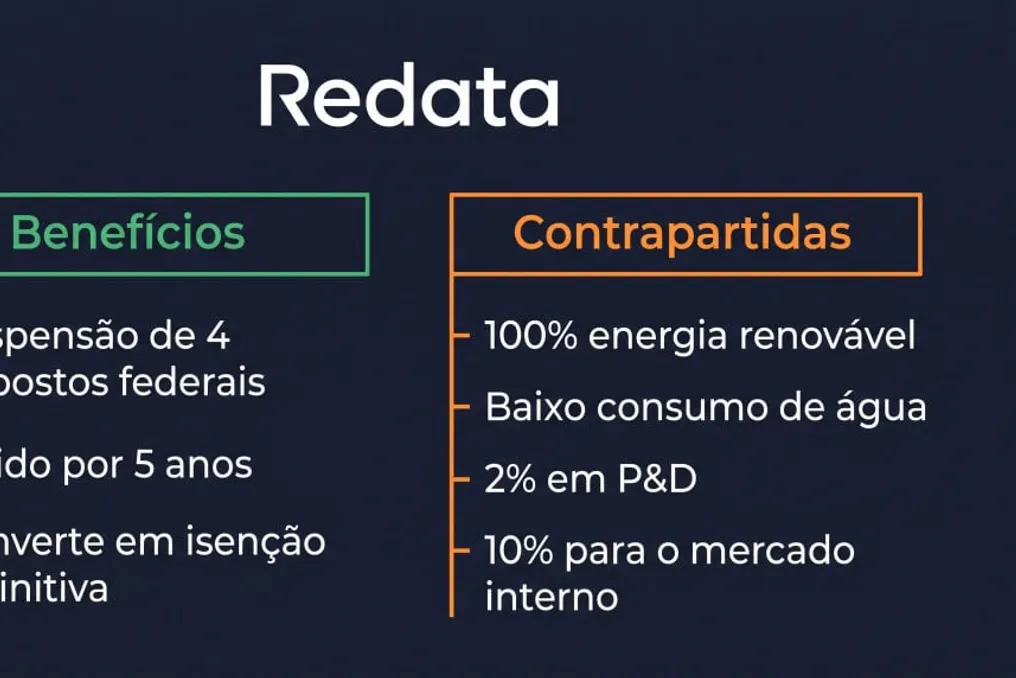
In practice, accredited companies will have tax suspension—including Import Tax, PIS/Cofins, PIS/Cofins-Importation, and IPI—for a period of five years when acquiring equipment. After fulfilling the stipulated obligations, this suspension turns into permanent exemption. The government estimates a fiscal waiver of R$ 5.2 billion in 2026, dropping to R$ 1 billion annually in the two subsequent years.
The main requirements imposed on beneficiary companies include the use of renewable or low-emission energy sources, the implementation of water efficiency in equipment cooling, a 2% investment in research and development (with 40% mandatory in the North, Northeast, and Central-West regions), and the allocation of at least 10% of computational capacity for the domestic Brazilian market.
Besides the issue of data location, Tossi pointed out two direct effects: the reduction in the cost of cloud services, which are currently among the most expensive globally, and the creation of jobs. A 50-megawatt IT data center generates between 3,000 and 6,000 jobs during construction and provides 3 to 5 direct jobs per megawatt during operation, adding 6 to 9 indirect jobs.
Brasscom classified the approval as a 'definitive step to ensure Brazil's prominence in the 21st-century global economy.' However, the approval was not unanimous; one day before the vote, the Coalition for Rights on the Net published a manifesto of opposition, as reported by Olhar Digital. The main argument raised was that the government 'inverted the order of things' by granting billions in tax exemptions before establishing clear guidelines on where and how such facilities could be built in Brazil.
Critical warnings included the high consumption of water and energy resources by data centers, the claim that installing servers on Brazilian soil does not result in technology or profit transfer to the country, the approval under emergency regime without public hearings, and the specific case of the TikTok data center in Caucaia, Ceará, which faces legal challenges due to impacts on water supply and the lack of prior consultation with the indigenous Anacé people.