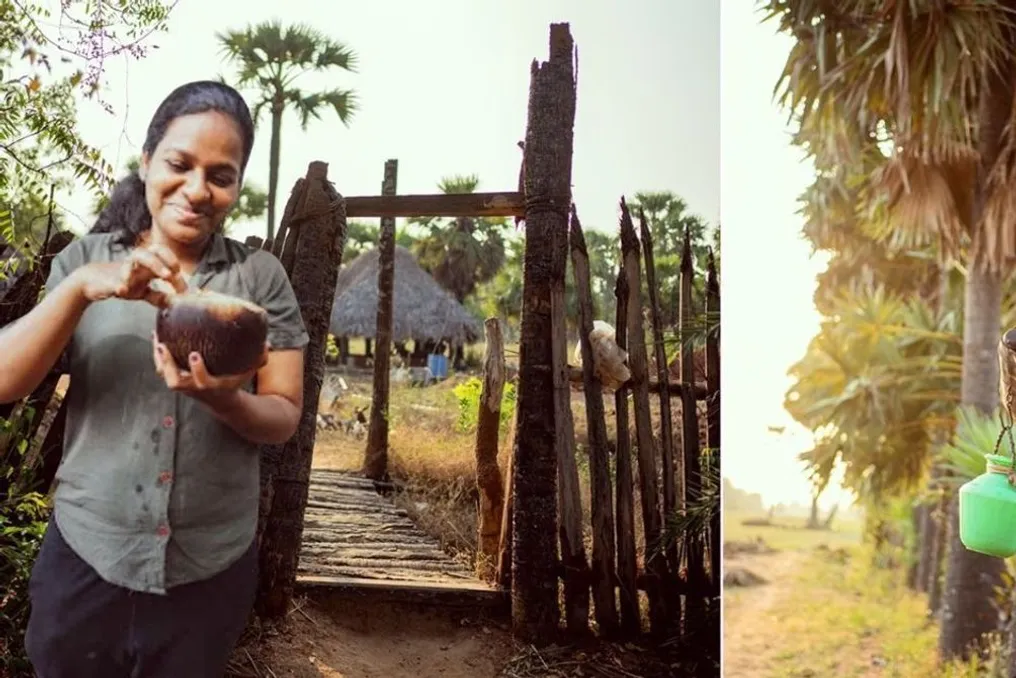
In the dry areas of South Tamil Nadu, as the sun rises, silhouettes appear against the backdrop of rows of tall palms. Some carry ropes wrapped around their shoulders, others carry sickles and woven baskets.
For many generations, these harvesters climbed palm trees before dawn to gather sap, collect fruits, and harvest leaves, which were then used to make everything from sugarcane and handicrafts to sweets and roofing materials. Today, many of them have reached seventy years of age.
This is a concern for Dr. Preethi Hari Babu. She is a 30-year-old tourism researcher and assistant professor from Chennai whose doctoral dissertation focused on how the state tree of Tamil Nadu could be revived through tourism and community involvement. She notes: 'The tree cannot be protected without community support. That is the charm of the palm—the community and the tree survive together.'
Dr. Preethi shares her experience: 'I conducted three tours. Each tour involved about twenty to thirty people. Most of them were unaware of the community and their livelihoods. They were amazed upon learning about it, purchased products, and even kept contacts for future orders.'
A Journey That Began in the Classroom
For Preethi, immersion into the world of the palm did not begin in forests or on farms, but in classrooms. After earning a bachelor's degree at Ethiraj College and subsequently pursuing an MBA in tourism, she began working in the tourism sector, believing that every place possesses unique characteristics that shape its identity.
While working with a nature conservation NGO in 2019, she joined a route dedicated to palm landscapes. This changed her perspective. She says: 'When I understood the advantages of this tree and saw how communities were trying to revive it, I realized there was much more to explore.'
This idea stayed with her even after completing the route. Ultimately, while pursuing her PhD in Tourism at Mizoram University, which she completed in 2025, she made the palm tree the center of her research—not just as a species, but as an ecosystem connecting livelihoods, ecology, culture, and identity.
More Than Just a Tree
Palm trees grow throughout Tamil Nadu along roadsides, fields, and coastal landscapes. However, according to Preethi, reducing them merely to a landscape misses their true significance. Large communities depend directly on this tree for income.
She explains: 'There are edible and inedible products. There are handicrafts, exports, product collectors, and women producing sugarcane. This creates jobs at many levels.'
Women's groups produce palm sugar and handicrafts. Harvesters collect sap and fruits. Artisans weave leaves into baskets and utilitarian items. Entrepreneurs prepare jams, sauces, and sweets from palm fruits. Furthermore, the tree serves an ecological function: it helps reduce soil erosion, aids in water retention, and provides habitat for numerous species. These ecological functions become critically important, especially in coastal and arid landscapes. As she notes: 'It is beneficial not only for people. Many species also survive thanks to these landscapes.'
Where Livelihoods Climb Trees
During fieldwork in Kanyakumari, Tuticorin, and Villupuram, Preethi spent time with harvester communities whose relationship with the palm spans generations. She emphasizes: 'There are huge harvester communities, almost like fishing communities. Their identity and livelihoods are deeply connected to this tree.'
One such harvester is 32-year-old Anth Brito, whose family has worked with palm trees for generations. He says: 'My grandfather was a harvester, and my father also worked in this profession. After studying, I found a job elsewhere, but I didn't find satisfaction there. Here, I am physically healthy, I am with my family, and I like this work.'
His family remains closely involved in the palm economy. While Anth climbs trees to collect sap and fruits, his parents prepare food products from palm produce. Together, they also manage two shops where handicrafts and food derived from the tree are sold.
However, what struck Preethi most was how inconspicuous many of these value chains remain. Many know about palm fruits, but few know about the sheer variety of products available. From nerya-based drinks to jams, sauces, jellies, adhirasama, and paniyaram—communities continue to create products that rarely attract mainstream attention.
For harvesters like Anth, the work remains seasonal but can provide a decent income. Between April and October, he collects enough sap to produce about two to three kilograms of karapatti (sugarcane) per day, earning about 1000 rupees daily during the season. He reports: 'In a day, I climb over 10 trees. During the COVID pandemic, I climbed nearly 20 trees a day.'
To change the perception of palm products, Preethi began organizing palm routes and community events. One such event was a fruit festival organized jointly with local communities and held at the Madras Social Work School, where artisans and producers from Villupuram showcased dishes made from palm produce. She notes: 'About 150 people came and tasted the food. Many had never tried these products before.'
The Moment That Changed Perspective
One experience continues to stay with her. As part of an extended study, Preethi spent 15 days on remote Indonesian islands, studying how local communities interact with similar palm ecosystems. Instead of feeling distant, it felt familiar.
She says: 'I was proud that this potential already existed in Tamil Nadu.' The communities there used palms for food, crafts, and even musical instruments. 'Then I realized that this tree connects communities across Asia. Community involvement follows the tree.'
Rote and Sabu are remote islands in Indonesia. They preserve the palm, known locally as lontar, in every possible way. 'More than preservation, I can say they coexist with the tree. Sasando is a traditional stringed musical instrument native to Rote Island, made from lontar. It is considered a symbol of identity, culture, heritage, and pride. Its influence is visible everywhere on the island, from heritage monuments to modern decorations inspired by its shape. There is even a building shaped like a Sasando that serves as the official residence of the Governor of East Nusa Tenggara in Kupang.'
Sabu Island is mainly covered with grasslands and lontar palms. Most people depend on the tree for their existence. They create intricate handicrafts, such as baskets and bags, while preserving their traditional foods. In the village of Namata on Sabu, there are houses with conical lontar roofs where visitors can observe animistic and ancestral worship practices. Visitors can also learn about weaving and watch harvesters collect sap from the trees, locally called tuak. This area is underdeveloped in terms of infrastructure, amenities, and sanitation, but it is surprisingly well-supported and organized.
Benefits are distributed directly among the community and supported by the government. For Preethi, this serves as one of the strongest examples of community-based tourism.
How Tourism Can Help Revive Community Livelihoods
For Preethi, tourism ultimately means empowering communities by supporting their livelihoods. She argues: 'Community-based tourism can create additional economic opportunities by helping communities showcase their culture and knowledge systems.'
Visitors can experience both the edible and inedible world of the palm ecosystem—taste fresh palm products and traditional dishes, and learn how leaves are turned into handicrafts, utilitarian items, and decorative elements using skills passed down through generations.
In her view, the benefits extend far beyond tourist income. Women who already play a central role in producing palm sugar, food, and handicrafts can earn direct income from visitors without relying on intermediaries. They can set prices for their products independently, run their own businesses, and continue living and working in their villages instead of migrating in search of work.
Preethi notes: 'Tourists are not just visitors; they become consumers who understand the labor, effort, and knowledge behind these products through direct experience.'
This experience also fosters a deeper understanding of the communities whose livelihoods depend on the palm and the ecosystem that supports them. Unlike typical tourist experiences, palm communities possess generations of ecological knowledge that is nowhere else found. They know the birds and insects inhabiting the trees, understand seasonal cycles, and recognize changes in flowering and fruiting cycles that only arise from living near the landscape for decades.
'They can share these experiences in stories, making the journey more memorable while sharing traditional ecological knowledge related to the tree,' says Preethi. In her vision, tourism becomes a platform not only for preservation but also for collaboration. Artisans from Tamil Nadu can exchange ideas with communities using palms in other parts of the world through peer-learning platforms, helping to revive traditional practices and encourage innovation in products and design.
She also envisions special celebrations placing the tree at the center of public attention. 'Why not hold an exclusive Global Palm Day?' she asks. 'The tree deserves recognition for all that it supports.'
Greater visibility, in her opinion, can also stimulate more research and development in palm products, handicrafts, and sustainable livelihoods. The result, according to Preethi, is not just economic development, but social development that supports inclusive growth, a circular economy, and sustainable, locally owned tourism models. She argues that tourism can strengthen the bond between harvesters and the trees they depend on, creating value through cultural experience, palm-based products, and ecotourism. As communities start earning more from the living tree, they have a stronger reason to preserve palm landscapes, protect traditional harvesting skills, and safeguard the biodiversity surrounding them.
The Tree Crossing Borders of Faith
She was also struck by how the palm quietly crosses religious boundaries. Muslim families use palm leaves to decorate weddings. Christian households use them to decorate homes. In Hindu traditions, sweets wrapped in palm leaves remain part of festivals like Karthigai Deepam. She concludes: 'It connects people in ways we don't always notice.'
The Problem No One Talks About
Despite all the advantages, the future of the palm remains uncertain. The biggest problem is not the tree itself, but the people. 'Most harvesters today are around 70 years old,' says Preethi. The younger generation is increasingly avoiding harvester work due to safety concerns, low wages, and changing aspirations.
As harvesters disappear, traditional knowledge risks disappearing with them. 'You cannot separate conservation from communities,' she insists. 'If we want the tree to survive, the people connected to it also need support.'
Her answer lies in tourism. Not mass tourism, but experiences based on local knowledge—routes, festivals, gastronomic tours, and community-led storytelling that create livelihoods and revive interest in traditional systems. Because for Preethi, saving the palm is not just protecting the tree; it is protecting everything that grows with it—livelihoods, culture, memory, and the communities that for generations looked up at these tall silhouettes and saw not just trees, but survival.