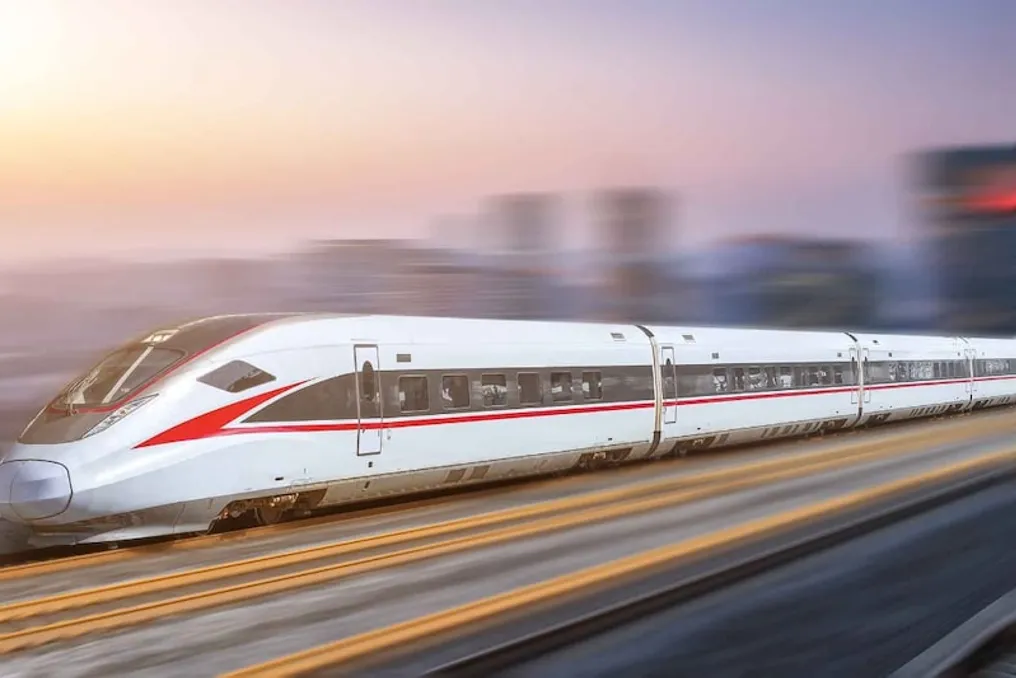
Indian Railways is actively working on creating the country's first high-speed train capable of reaching speeds of up to 280 km/h. The company Integral Coach Factory (ICF) from Chennai has signed a contract worth 866.87 crore rupees with BEML Limited. Under this agreement, a prototype of two high-speed trains will be developed.
The first prototype is planned to be ready by March 2027, after which the Research Development Standard Organization (RDSO) will begin testing it. If this schedule is met, the first service on the Mumbai-Ahmedabad high-speed rail corridor is expected to start by August 2027.
Two sets of trains will be created under this project, each consisting of eight coaches. The design of these trains provides for a speed of 280 km/h, and they will be able to travel faster than 250 km/h. These trains will feature fully air-conditioned passenger coaches, as well as amenities such as onboard infotainment and reclining and swivel seats. Special attention is paid to the needs of passengers with disabilities.
BEML has prepared a dedicated complex for high-speed railways named 'Aditya' in Bangalore for the production of these trains. These sets have been given the code name B-28. The train is designed taking into account India's climatic conditions. Creating a high-speed train for India is a complex task because many trains in Japan and Europe are designed for cooler climates, whereas in India, one must contend with intense heat, dust, and diverse weather conditions. Currently, the railways are working on using stainless steel for these sets.
Furthermore, for trains designed for speeds exceeding 300 km/h, the option of using aluminum sets is being considered. Transport Minister Ashwini Vaishnaw previously stated that India is working on developing next-generation trains capable of reaching speeds of 350 km/h.
Creating a 280 km/h train differs significantly from manufacturing standard LHB type coaches. The main challenge lies in maintaining stability and comfort at such high speeds. For this, the train's structure must be light yet strong. The coaches and suspension must be designed so that passengers do not feel jolts even at high speeds. The train design must also minimize air pressure. Additionally, high-power systems, advanced braking systems, control software, and crash safety technologies compliant with high-speed requirements must be developed.
The Mumbai-Ahmedabad high-speed rail project began in 2017 and is the first high-speed railway line in the country. Although the total cost of the project has increased, work on many of its sections is now progressing at an accelerated pace. Currently, the first operational runs are expected to take place on the Surat-Bilimora section. This means that passengers traveling on the Mumbai-Ahmedabad route will receive the service of a high-speed train with modern amenities.
The government also plans to expand the high-speed rail network to other regions of the country. Seven new high-speed rail corridors have been announced within the current budget. These include the Mumbai-Pune, Pune-Hyderabad, Hyderabad-Bengaluru, Hyderabad-Chennai, Chennai-Bengaluru, Delhi-Varanasi, and Varanasi-Siliguri corridors. It is projected that travel time on these proposed routes will be significantly reduced. For example, the distance between Mumbai and Pune should be covered in approximately 48 minutes, between Pune and Hyderabad in about 1 hour and 55 minutes, and between Delhi and Varanasi in approximately 3 hours and 50 minutes.
The main focus is currently on whether the first domestic high-speed train prototype will be ready by March 2027. After that, testing by RDSO will become critically important. During the tests, various aspects will be checked, including speed, safety, braking, stability, and passenger comfort. If the prototype and testing proceed on schedule, the path to launching high-speed service on the Surat-Bilimora section of the Mumbai-Ahmedabad corridor by August 2027 may be opened. Furthermore, this will give a powerful impetus to the plan for developing India's own high-speed trains and the future development of 350 km/h trains.