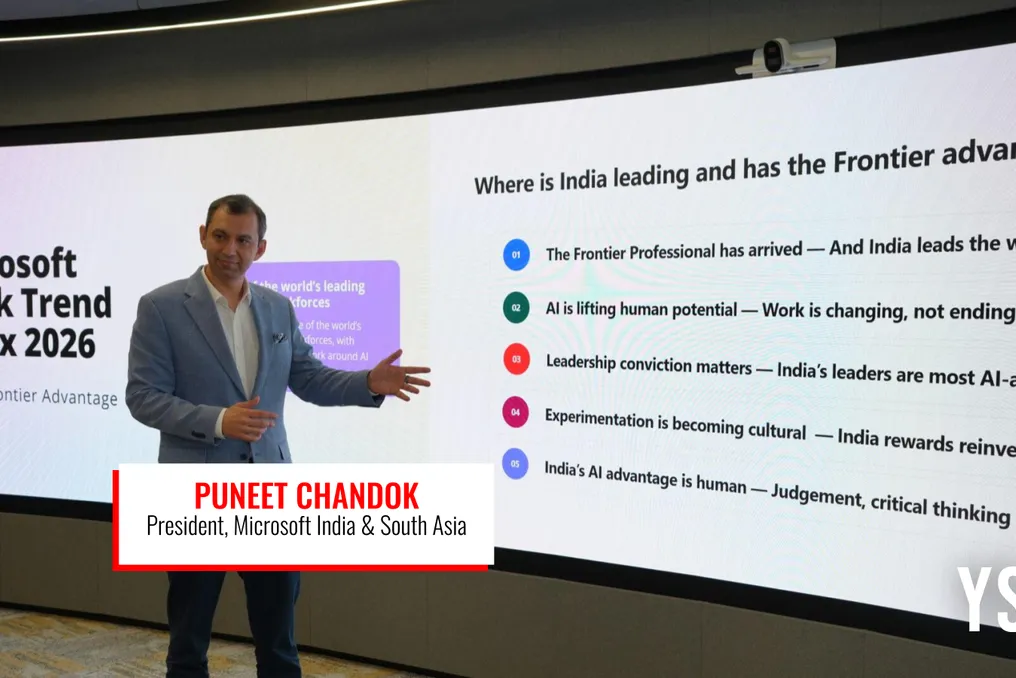
According to the Microsoft 2026 Work Trend Index, which focuses on the state of artificial intelligence in the workplace, India has become a global leader in workforce transformation.
New research from Microsoft, presented in Bengaluru on Thursday, demonstrates that specialists in Indian offices are moving beyond performing basic AI tasks to managing complex automated workflows. This transformation is changing daily employee activities, shifting them from routine work to high-level supervision.
Nearly a third of Indian specialists surveyed qualify as 'frontier professionals.' These professionals actively develop and control multi-stage systems using AI agents, balancing automation with strong human judgment.
The study covered 20,000 AI users across 10 markets and shows that India possesses one of the world's largest frontier workforces. Instead of letting technology replace them, these professionals are directing it to unlock new opportunities.
In India, 32% of AI users are frontier professionals, double the global average of 16% and the highest among the markets studied. Furthermore, almost 8 out of 10 Indian users claim that AI tools enable them to perform work that was impossible 12 months ago, compared to nearly 6 out of 10 globally; this figure reaches 85% among frontier professionals.
Puneet Chandok, President of Microsoft in India and South Asia, noted: 'One in three Indian AI users works with agents on multi-stage, real-world tasks. Globally, this is one in six. This is not lagging behind; this is leadership.'
This represents a huge leap from 2025, when business leaders merely expressed intentions to create human and agent teams on a large scale. Now, this aspiration has materialized, giving rise to new types of high-value work.
Despite the rapid adoption of highly automated systems, the results show that Indian workers refuse to delegate final responsibility. The study emphasizes that as automation becomes more complex, human judgment becomes more valuable, not less.
Indian AI users lead the world in prioritizing quality control of automated outputs. Nearly two-thirds consider evaluating AI-generated work a critical skill, compared to half globally. Moreover, 59% of Indian specialists place high importance on critical thinking, significantly higher than the global average of 46%.
Crucially, almost 9 out of 10 respondents in India state that they retain full responsibility for thinking, viewing system-generated material only as a starting point.
More than 4 out of 10 Indian workers feel that their company leadership has a clear and unified plan for using AI, nearly double the global average.
Managers are actively involved in AI adoption: both frontline managers (91%) and non-frontline managers (81%) use this technology. Frontline managers redesign team workflows to incorporate AI agents and automation. Meanwhile, non-frontline managers mainly adhere to traditional management methods and adopt/support AI, but with less intensity than frontline managers.
All of this is supported by a corporate culture that encourages rethinking. One in four Indian organizations rewards employees for rethinking workflows without immediate commercial returns, compared to only one in eight globally.
Scaling in large, complex operations is the ultimate test of AI implementation. In India, major IT companies are demonstrating how to transition from small-scale pilot projects to full enterprise transformation. In less than six months, Infosys, TCS, Wipro, and LTIMindtree jointly licensed over 4 lakh seats of Microsoft 365 Copilot, a generative assistant integrated into daily work applications.
Infosys is expanding its Copilot adoption to over 1 lakh employees, achieving a monthly active usage rate of 91% in delivery, engineering, and corporate departments. This figure reflects the proportion of licensed users who regularly interact with the tool, proving that it has become an indispensable work tool.
Speaking at an event in Bengaluru, Balakrishna D. R., Vice President of Execution and Head of Global AI Services and Industry Verticals at Infosys, noted: 'Building a frontier enterprise requires more than just technology. Organizations that achieve sustainable value from AI are those that combine leadership alignment, workforce readiness, management, and intelligence embedded in all business processes.'
AI deployments are bringing measurable productivity gains in Indian enterprises. At TCS, nearly 9 out of 10 licensed employees use this technology daily. TCS reports a productivity increase of 20–25% in research and content creation, as well as a reduction in process cycle time by 25–35%, which is the total time spent completing a business process.
Monthly active usage at Wipro exceeds 95%, saving an average of 250,000 full equivalent days per quarter, where each day represents one employee's workday. The company has also democratized agent creation, allowing employees to build over 29,000 custom user agents, alongside 60 enterprise-level solutions. Wipro and Persistent Systems have launched large-scale training programs to ensure all their personnel are fully prepared for AI adoption.