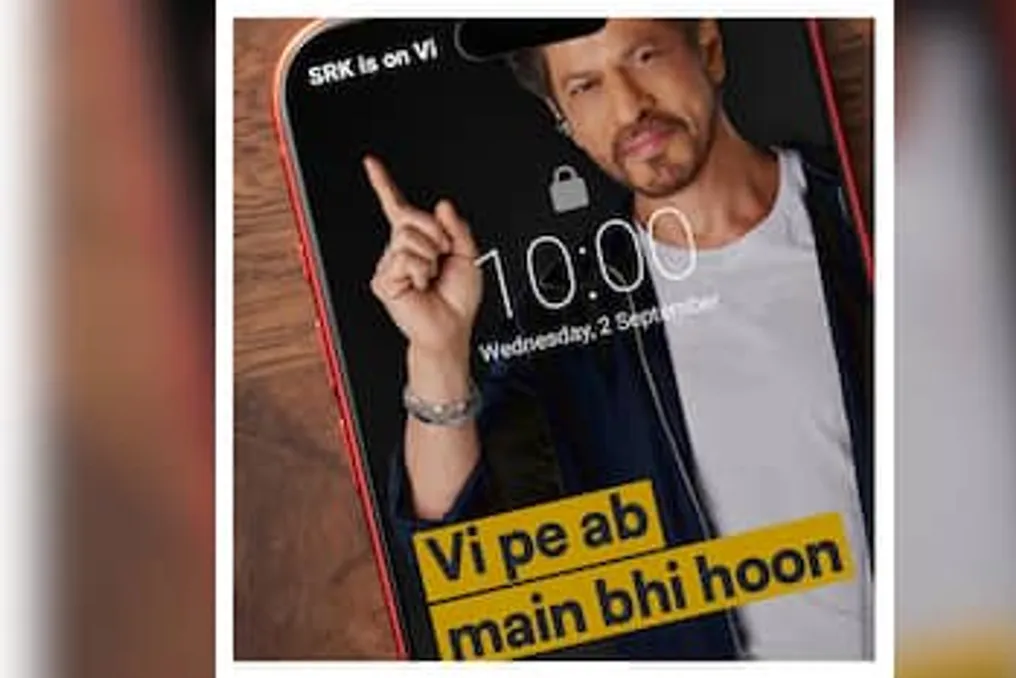
Vodafone Idea (Vi) has engaged Shah Rukh Khan for rebranding efforts, aiming to overcome years of financial difficulties, debt, and the loss of millions of subscribers. On September 1st, the company launched its new campaign titled 'Vi badal raha hai... tayaar rahiye,' featuring the Bollywood star as the brand face.
The rebranding extends beyond just a new advertising campaign; Vi has also changed its logo: the yellow two-dimensional dot was moved from below the letter 'i' to above it, adopting a three-dimensional, spherical design. The company asserts that the new identity is intended to convey 'optimism, energy, and opportunities' it sees in the future, while simultaneously signaling broader changes in its business and network.
Reasons for Choosing Shah Rukh Khan
For Vi, which has faced challenges in recent years, Khan's stability as a star brand makes him a potentially strong choice. According to the Kroll India Celebrity Brand Valuation 2025 report, Khan maintained his status as India's most valuable celebrity brand, with a brand value of $177.9 million. This figure was achieved despite the release of his latest film, Rajkumar Hirani's 'Dunki,' in December 2023. Furthermore, his brand value increased by approximately 22 percent in 2025, while the aggregate value of India's top 25 celebrity brands decreased by 3.7 percent.
Ashish Bhasin, founder of The Bhasin Consulting Group and former CEO of Dentsu Asia Pacific, noted that for a brand trying to recover or change its positioning, it is crucial that the celebrity's personality aligns with the brand's character and positioning. He believes that SRK and Vi have a 'good fit in this regard.'
Khan also possesses an unusual background in the telecommunications sector. Kimline Dsuza, Executive Creative Director at Hashtag Orange, pointed out that 'records show Khan has been the face of all three major competitors in India's telecom industry: Airtel in 2006, Jio upon its launch in 2015, and now Vi. No other Indian star has been entrusted by three direct competitors in the same industry to promote their brand. This is simply proof of his unique commercial appeal.'
Hyundai: The Most Striking Example of SRK's Help in Building Recognition
Over decades, Khan has advertised brands across the automotive, telecommunications, technology, and lifestyle industries. However, his collaboration with Hyundai, which began in 1998, stands out. At the time, Hyundai was an unknown Korean newcomer in the Indian auto market, which was dominated by Maruti Suzuki. Khan, whose popularity was rapidly growing, became the face of the Santro model.
The results were impressive. The Santro was launched on September 1, 1998, and within six months, by March 1999, Hyundai became the second-largest car manufacturer in India. By June 2000, the Santro had exceeded cumulative sales of 100,000 units and eventually sold over 1.3 million units in India. Nevertheless, Khan's star power was only part of this story. Key factors contributing to the sales growth included the distinctive 'Tall Boy' design of the Santro, pricing and positioning, localization for Indian conditions, expansion of the distribution network, and after-sales service. Khan helped make Hyundai familiar and accessible, but the product and business had to justify these promises.
This distinction is particularly relevant for Vi. Hyundai used Khan to familiarize consumers with something unfamiliar. Vi, conversely, is banking on him to convince consumers to reconsider something very familiar. Its task is not to introduce a new brand to India, but to persuade consumers that an established brand has undergone changes.
Dubai Tourism: The Scale of SRK's Reach
While Hyundai demonstrates Khan's ability to make the unfamiliar familiar, his long-term partnership with Dubai Tourism illustrates something else—the immense scale of his influence. Dubai Tourism engaged Khan for its #BeMyGuest campaign in 2016, leveraging his global popularity and long association with the city to attract international attention. In its initial phase, the campaign garnered around 45 million views and 65 million social media interactions, with subsequent editions reportedly exceeding 100 million views worldwide. The campaign also received several international awards.
These figures underscore Khan's capacity to deliver a brand message beyond traditional advertising audiences, reaching consumers across different geographical regions and demographics, including the Indian diaspora. Dsuza commented: 'SRK is one of the few celebrities in India who is genuinely connected to both urban millennials and the family audience from smaller towns, not just premium users in cities. More subtly, he also brings a sense of stability. A brand under scrutiny due to its financial health benefits immensely from association with a star whose own image is built on longevity and resilience, rather than a single viral moment.'
Celebrity power can boost awareness, but the business must still deliver results.
Khan's association with Dish TV serves as a clear example of how star power can help a brand expand its reach. Through comprehensive campaigns involving him across television, print, and digital media, the DTH platform quickly grew into one of the largest providers in India. According to ETBrandEquity, Arun Kumar Kapoor, then CEO of Dish TV, named Khan in 2016 as someone who helped the platform become part of Indian households through the entertainment narrative of the campaign.
Khan's collaboration with the edtech company Byju's also helped the brand gain mass pan-Indian recognition after he became its face in 2017. In May 2025, Byju Raveendran stated that the collaboration with Khan, alongside Lionel Messi, helped create massive public awareness about online learning applications. However, subsequent financial and operational issues at Byju's also highlighted the limitations of star endorsement. Visibility and trust based on stars cannot permanently compensate for weaknesses in the core business model.
Bhasin concluded: 'The brands previously associated with SRK undoubtedly benefited. However, celebrity endorsement can only take a brand so far. Ultimately, the brand must stand on its own feet.'
What Are the Next Steps for Vi?
Six years after Vodafone and Idea merged into Vi, the company is asking consumers to look at it again. Thus, the issue is not awareness, as consumers already know Vodafone, Idea, and Vi. The company needs former customers to reassess its network quality, existing customers to believe in network improvements, and the market to recognize a business striving to exit years of subscriber losses and financial strain.
This is where the new campaign 'Vi badal raha hai... tayaar rahiye' becomes important. Essentially, it asks consumers to update their mental perception of the company. Dsuza commented: 'Essentially, Vi is buying a share of his attention, guaranteed breakthrough from Khan's campaign in a saturated category where Jio and Airtel already dominate the general conversation. If the association helps shift even a few percentage points in consideration and recall among wavering subscribers, it will pay off. The real ROI will be shown not as 'brand equity transferred,' but in subscriber growth trends and churn reduction over the next 12–18 months.'
The government provided structural support and relief to Vodafone Idea while it battled its financial problems. Now, Khan can help make Vi's transformation attempt more visible. Bhasin concluded: 'For Vi, attracting someone like Shah Rukh Khan can be a catalyst, but the company will need a strong foundational strategy to turn this visibility into meaningful and sustainable impact.'