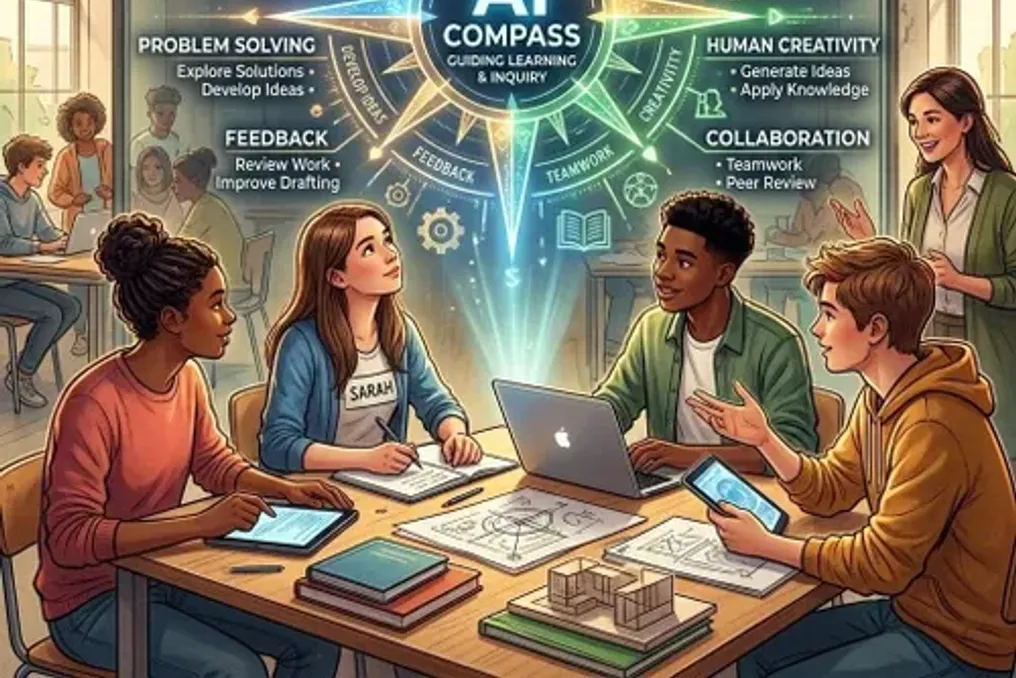
The 'AI Compass' concept is a method that allows students to apply artificial intelligence while maintaining clear expectations regarding the learning process. According to the World Economic Forum's report 'Future of Jobs 2025,' seven out of ten employers consider analytical thinking a key skill, and 57% of employers recognize creative thinking as necessary, while 51% identify technological literacy as a core skill. Young people will need to be confident in using technology, but this must be done with judgment, creativity, and independence.
The OECD report 'Digital Education 2026' emphasizes that generative AI can support learning if guided by sound pedagogical principles. However, if students use it merely to complete tasks for them, it may improve the final product without ensuring genuine material assimilation. Thus, a convincing answer is not always proof of understanding.
Artificial intelligence is already integrated into the processes of searching, writing, editing, coding, and creativity for many students. The question is no longer whether AI should be present in education—it should be. The main question is how educational institutions ensure that AI supports the learning process rather than replacing the students' own cognitive activity.
At Koa Academy, the solution to this problem is not unlimited AI use nor a complete ban. Instead, the 'AI Compass' system was developed—an internal set of teaching guidelines and methodologies that provides a common language for the responsible use of AI among students, parents, and teachers.
The Compass system is integrated into assignments, tasks, and assessments, making the expected use of AI explicit for every activity. It defines four modes of operation: Independent, Researcher, Collaborator, and Producer.
Tasks of the 'Independent' type require students to complete work without AI assistance. 'Researcher' type tasks allow AI to help in exploring ideas or clarifying complex concepts, while the final work remains the student's own. In 'Collaborator' mode, AI is used to receive feedback and refine, for example, to check text grammar, debug code, or test an argument. And 'Producer' type tasks prompt students to use AI to create a final product, requiring them to know how to set tasks, guide, select, and edit the resulting output.
Mark Anderson, co-founder of Koa Academy, notes: 'AI Compass is not a blanket permission to use AI nor a total ban. It gives students clear guidance for each task: should they work independently, use AI to study a concept, collaborate with it to improve existing work, or intentionally use it to create a final product?'
This level of detail is the foundation of the approach. A vague instruction about the possibility of using AI does not explain what meaningful and ethical application looks like. Similarly, a complete ban does not prepare students to make informed decisions about the technology they will encounter in higher education, at work, and in daily life.
For instance, an assignment might state: 'Collaborator: Before submitting the final work, use Gemini to suggest where the paragraph structure and grammatical structure can be improved.' Such an instruction defines the permissible role of AI while maintaining student accountability for the work.
The implementation of Compass was carried out through teacher training, parent involvement, and special sessions for students. Responsible AI use is a skill that must be practiced repeatedly across various subjects and contexts.
Schools and universities rightly worry about plagiarism and academic integrity, and clear rules are necessary. However, rules and detection tools alone are insufficient to prepare young people for an AI-driven world.
In South Africa, a shift in this discussion is already taking place. The University of Cape Town discontinued the use of Turnitin's AI detection assessment in October 2025, citing concerns about its reliability and fairness. Their approach instead focuses more on the learning process, including oral exams, observation of group work, and students' critical reflection on AI usage.
When AI can generate coherent text, solve template problems, and provide plausible answers in seconds, the finished product becomes a less reliable testament to learning. The deeper question is not just, 'Did the student use AI?', but also: 'What should the student have thought through, explained, challenged, or applied to complete this task?'
Anderson argues: 'A polished final answer is not always proof of learning. We need to focus more on how students approach the task, what decisions they make, what questions they ask, and whether they can explain and apply what they have learned.'
At Koa Academy, instructors assess learning as it happens, not just upon final submission. This places great importance on the process behind the result: the reasoning, the decisions made, the information and tools used, and the student's ability to defend and apply their knowledge.
The system also deliberately develops critical thinking, communication skills, ethical judgment, curiosity, collaboration, problem-solving, and leadership. These qualities are not supplementary elements of academic education; they are formed by how students learn, participate, apply knowledge, and work with others.
Anderson explains: 'AI makes these skills even more important. When creating an answer becomes easier, the real differentiator becomes the young person's ability to evaluate that answer, improve it, apply it, and use it responsibly.'
AI Compass recognizes that AI can be a powerful tool for research, feedback, practice, and creativity, while safeguarding the thinking and demonstrated understanding that give learning meaning. Koa Academy's goal is not to prepare students for a world without AI, but for a world where they can use it confidently, critically, and ethically, while retaining ownership of their thoughts, learning, and ideas.