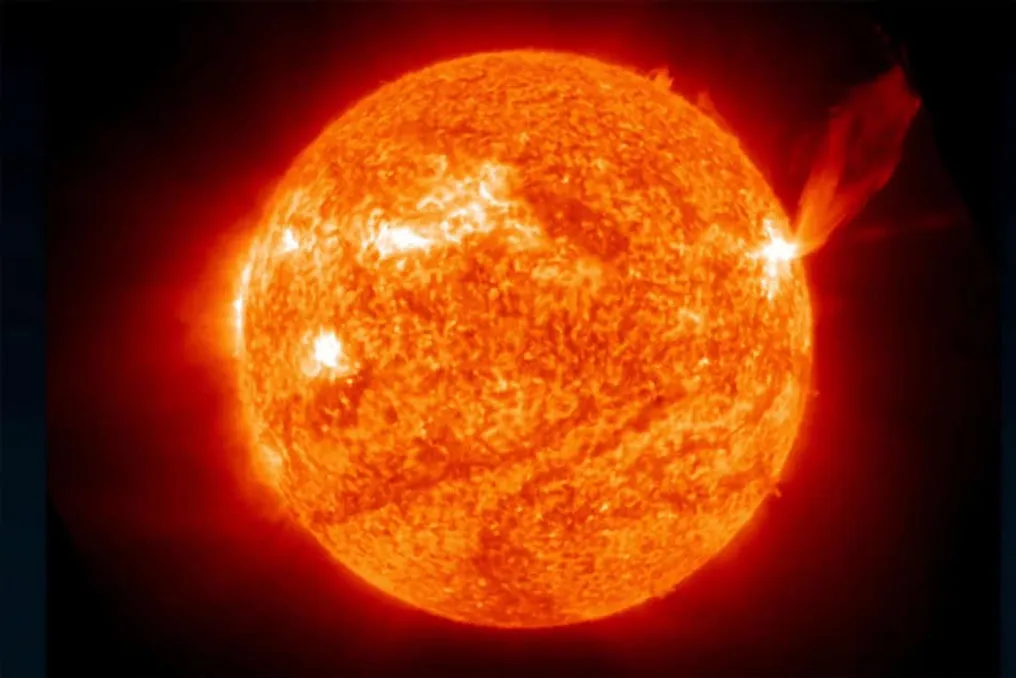
It is generally accepted that the Sun has a direct influence on all bodies in the Solar System. However, NASA research has shown that this influence on Earth is even more complex: past events of the star may have shaped the planet's climate.
One such study is the work of the SHIELD center, which stands for Solar Wind with Hydrogen Ion Charge Exchange and Large-Scale Dynamics. This research tracks the trajectory of the heliosphere—a massive magnetic bubble surrounding the entire Solar System—as it influenced the planet's climate during its journey through the galaxy.
Another study examines how the Sun, when young and less luminous than it is now, could have stimulated greenhouse gases and thereby warmed the Earth. Throughout its history, the planet has experienced constant periods of warming and cooling. Ice ages, when the average temperature on the planet dropped sharply, are an example of this recurring alternation over millions of years.
To explain these fluctuations, scientists traditionally focused on Earth's internal factors, studying greenhouse gases, orbital changes, and other internal processes. Nevertheless, new findings indicate that solar climatic influence plays an important role in these explanations.
Just as every planet has an atmosphere, the Solar System possesses a heliosphere that acts as a 'solar atmosphere.' This magnetic bubble is based on continuous solar winds carrying charged particles that spread throughout all corners of the system.
Just as the planet orbits the Sun, our Solar System (along with the heliosphere) moves around the center of the Milky Way. Over the 4.6 billion years of the Sun's existence, the heliosphere passed through various regions of the galaxy. The SHIELD study, published in the Annual Review of Astronomy and Astrophysics, reconstructs this trajectory and concludes that the different environments the heliosphere passed through shaped Earth's climate.
The study, led by Merav Ofer, a lead researcher at the SHIELD project at Boston University, showed that during this journey through the Milky Way, the Solar System crossed three massive clouds of dust and gas over the last millions of years. These 'icy clouds' exerted pressure on the heliosphere, shrinking it to the point where Earth's atmosphere was exposed to interstellar dust, temporarily losing the Sun's protection.
These events, occurring approximately 2–3 million, 6–7 million, and 13–14 million years ago, explain ancient Earth climate patterns. Simulations revealed that upon colliding with these interstellar clouds, Earth's atmosphere experienced an increase in water vapor and a change in the dynamics of the upper atmospheric layers, which consequently affected the surface.
Thus, giant icy dust clouds exerted such pressure on the Solar System that they directly influenced Earth's climate, possibly triggering ice ages. This aligns with geological samples: elements found in interstellar dust are discovered in deep sediments, Antarctic snow, and lunar samples precisely during these periods.
The SHIELD center is one of several NASA research centers focused on the heliosphere. It is part of DRIVE—an acronym standing for Diversify, Realize, Integrate, Undertake, and Educate—a complex of scientific centers dedicated to Heliophysics. SHIELD brings together specialists from various fields of knowledge to create a virtual model of the heliosphere. The goal of this 'digital twin' is to show how the 'Solar System's atmosphere' interacts with its environment.
In Greenbelt, United States, scientist Vladimir Irapetian from NASA's Goddard Space Flight Center studied another mystery of the past relationship between the Sun and Earth. The question was: how could the early Sun, which was 30% dimmer than today's, maintain a climate on Earth favorable for life?
This was the situation of the Sun 3 billion years ago. With such a configuration, it was expected that the planet would be completely covered in ice, but this was not the case. Geological evidence shows that liquid water existed long before this, as well as life itself. This mystery is known as the paradox of the young and weak Sun.
Young stars, like the Sun in our galaxy, might hold the answers to this paradox. According to data from the Kepler space telescope (which is now retired), these young stars tend to undergo more massive solar flares, releasing high-energy particles in all directions daily.
Thanks to this, Irapetian concluded that if the young Sun behaved like its modern counterparts, these particles could have reached early Earth and caused chemical reactions that provided the planet with warmth.
Details of the Early Sun Simulation Experiment
Irapetian's team modeled the atmosphere of early Earth in a sealed chamber, mixing molecular nitrogen, ammonia, carbon dioxide, and carbon monoxide. They then simulated solar flare particles by bombarding the mixture with protons. The result was the formation of nitrogen oxide, a greenhouse gas 300 times more potent than carbon dioxide.
Nitrogen oxide could have helped early Earth retain a small amount of heat coming from the Sun. However, the intense ultraviolet radiation from the young star broke down some of it, splitting it into oxygen and nitrogen. Nevertheless, even if only 10% of the nitrogen oxide remained, it could still keep part of the planet warm at a level of 5 degrees Celsius, preventing water from freezing. Moreover, maintaining this temperature range could have enhanced prebiotic synthesis, as temperatures close to the freezing point of water are more effective for forming complex amino acid chains—a process necessary for the origin of life.