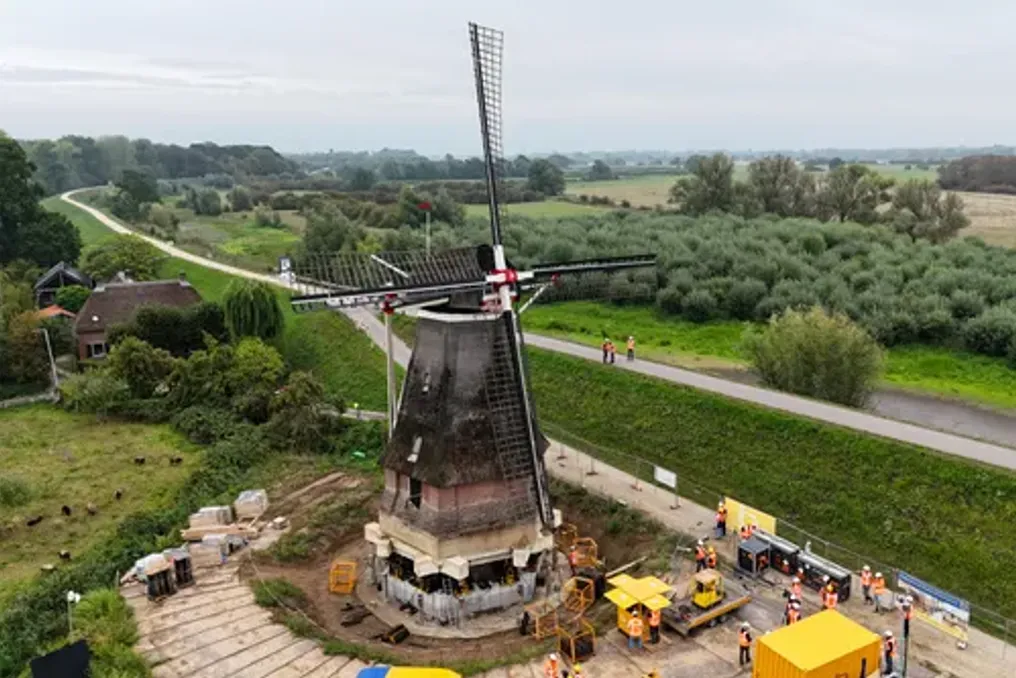
Workers participated last week in the raising of a 250-year-old windmill in Waardenburg. This lift was necessary because the dike heightening, caused by flood risks associated with global warming, prevented proper wind capture, which is an inherent right of windmills in the Netherlands.
Koen van der Kroon, who managed the operation from the dike, noted that the mill 'has a right to the wind.' This rare hexagonal mill, which still grinds grain, has been located on the banks of the Waal in the Rhine delta for 250 years and is a monument listed in the Dutch heritage register.
However, the construction of a new dike for flood protection blocked the wind's access to the mill, jeopardizing its continued operation. The solution was to use hydraulic jacks to raise the mill by 80 centimeters, with the process proceeding very slowly—only 10 centimeters per hour.
Project manager van der Kroon explained that residents living behind the dike are primarily concerned with safety due to the frequently high water levels in the Waal. He emphasized that to ensure safety in this area, the dike must be raised, and consequently, so must the mill.
This situation is becoming increasingly common in the Netherlands due to climate change, as one-third of the country's territory lies below sea level. As water levels rise and flooding becomes more frequent, authorities are forced to reinforce the country's complex dike system, leading to unintended consequences for windmills.
Van der Kroon, aged 44, stated that the dike raising 'seriously affects iconic monuments,' but they are ensuring the continuation of these majestic mills that make the Netherlands famous.
This lift is the second such event, following a similar operation conducted in the 1990s. The fact that the mill needs to be raised even higher demonstrates the difficulties faced by Dutch authorities in balancing population flood protection with the preservation of national heritage.
Project manager van der Kroon reported that old foundations were first moved, then jacks were installed beneath them to allow the mill to be lifted by approximately 10 centimeters per hour. Next, new supports will be installed on which the mill will stand, followed by careful backfilling of the space with soil.
Once the mill is stable on the new base, it should have enough wind to turn its sails, thereby continuing the centuries-old tradition in the Dutch countryside. Marcel de Kroon, representing the company that owns the mill, called it 'an engineering feat that we do not perform every day, and we are proud of the team's collective efforts.' He added that it is very rewarding to strive to preserve this mill in its historical context.