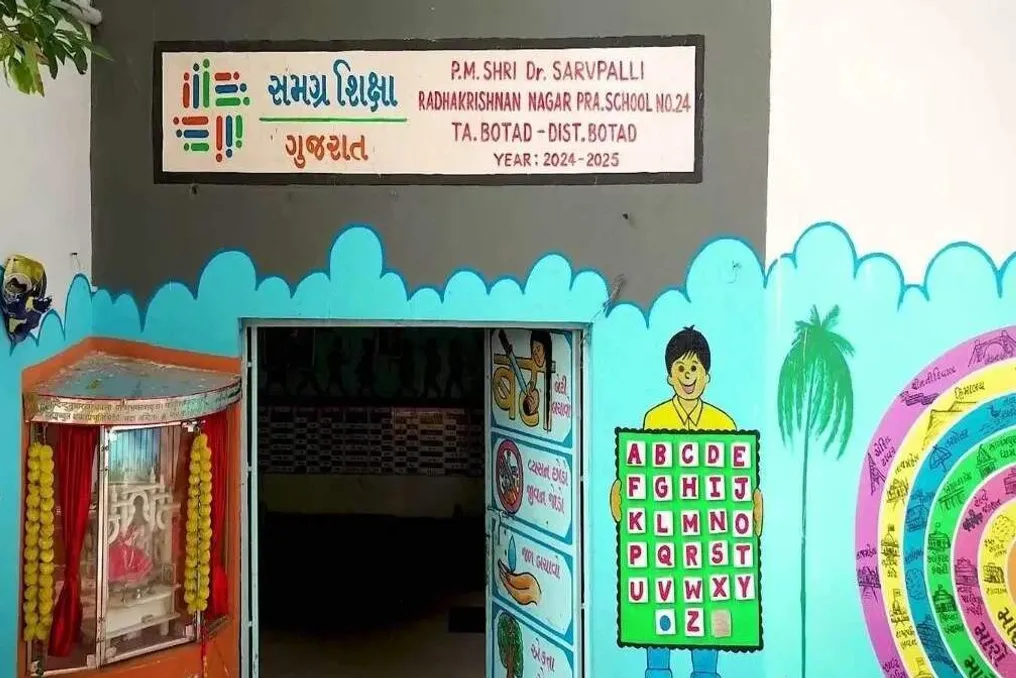
Education issues have once again become central to political discussions and major strategic debates. The opposition, gaining confidence after its victory in the NEET protest, intends to increase pressure by exposing the dilapidated state of school infrastructure across various states, starting with Rajasthan. Local reports from the publication TOI also revealed serious deficiencies in government schools throughout the state.
Particularly alarming is the fact that many government schools in Kota, known as India's educational hub, are in a dilapidated condition. A broader investigation conducted by TOI reporters nationwide showed that Rajasthan is not an exception. In Bihar, one classroom housed four grades, while two others were occupied by livestock. In Uttarakhand, leaking roofs forced students to use buckets and umbrellas as learning aids. In Madhya Pradesh, TOI found that schools faced both teacher shortages and unsafe buildings. Kerala, however, presented a notable exception to this general picture.
National statistical data is of significant interest. In Rajasthan, during the 2025-26 period, 7,200 schools with a single teacher were registered, yet only 36.4% of schools had ramped handrails, and 26.3% had toilets adapted for Children with Special Needs (CwSN).
From Livestock and Buckets to National Figures
Most information about Indian schools comes from the UDISE+ system, which is an annual administrative database similar to a census, covering schools of all management types. Schools provide details on their students, teachers, and infrastructure, including attendance, staff strength, availability of toilets, electricity, ramps, computers, and internet access. This data is integrated into the national statistics of the Ministry of Education, Union.
Nearly One Hundred Thousand Fewer Government Schools, But Paper Accessibility Improves
In 2015-16, 1,104,796 government schools operated in India. Ten years later, according to UDISE+ data, this number was 1,005,245, representing a difference of 99,551 schools or 9%. However, it should be noted that a school excluded from UDISE+ records might reflect closure, merger, rationalization, reclassification, or other administrative changes.
Fewer Government Schools by Nearly 100 Thousand Over 10 Years
Government schools are losing students despite systemic improvements. Over two years, from 2023-24 to 2025-26, the total number of students in government schools decreased from 12.75 crore to 11.89 crore, signifying a loss of nearly 85.9 lakh students, or a decline of 6.7%. During the same period, enrollment in unsubsidized private schools rose from 9.00 crore to 9.89 crore, increasing by approximately 88.3 lakh, or 9.8%. This reduction is noticeable over a decade: the average enrollment in a government school fell from about 132 students in 2014-15 to 120 in 2024-25, a decrease of approximately 9%; the latest UDISE+ data shows that the average number of students in 2025-26 was around 118.
Structural Changes
More Teachers Nationally, But Gaps Remain Locally
In India, there were 9.696 million teachers working in 2020-21, rising to 10.273 million in 2025-26, marking an increase of almost 5.77 million teachers over five years. The number of schools with a single teacher decreased from 110,971 in 2023-24 to 100,843 in 2025-26, and the number of children studying in such schools dropped even more sharply—from 39.94 million to 29.12 million. Thus, nearly 11 million fewer children are now studying in these schools.
Reduction in Single-Teacher Schools
A positive development is the declining dropout rate. In many states, girls are being encouraged to continue their education. Concurrently, the Gross Enrolment Ratio (GER) in higher secondary education increased from 56.2% in 2023-24 to 61.7% in 2025-26, and the secondary level dropout rate fell from 14.1% to 9.5% over the same period. National statistics here also conceal vast disparities. For instance, Kerala reported maintaining secondary level retention at 99.1% in 2025-26.
Lower Dropout Rates
Increased Digital Access, But TOI Finds a Different Reality in the Classroom
In line with the government's 'Digital India' initiative, digital infrastructure has expanded rapidly. In 2020-21, 24.5% of schools reported having internet access; by 2025-26, this figure reached 67.4%. Computer availability increased from 41.3% to 69.9%. The approved budget for ICT labs, smart classrooms, and other digital projects grew from 381.1 crore rupees in 2018-19 to 3,221.1 crore rupees in 2025-26.
Toilets on Paper, TOI Uncovers Functional Gaps On the Ground
India is approaching universal provision of toilet facilities in schools, at least on paper. UDISE+ reports the presence of female toilets in 98.5% of girls' and co-educational schools in 2025-26. However, existence and functionality are different matters.
The Basic Access Gap Remains
In 2020-21, 24.5% of schools had internet access, and 41.3% had computers. About 48.3% had ramped handrails, and 25.3% had toilets for children with special needs. By 2025-26, internet accessibility reached 67.4%, and computer availability reached 69.9%. Ramped handrails accounted for 58.2%, while toilets suitable for CwSN stood at only 40.1%. Nevertheless, national data alone does not explain why families make certain decisions. Some of these decreases may also reflect cleaner data and, ironically, even a lack of proper data loading, as noted by the Minister of Education of Bengal.