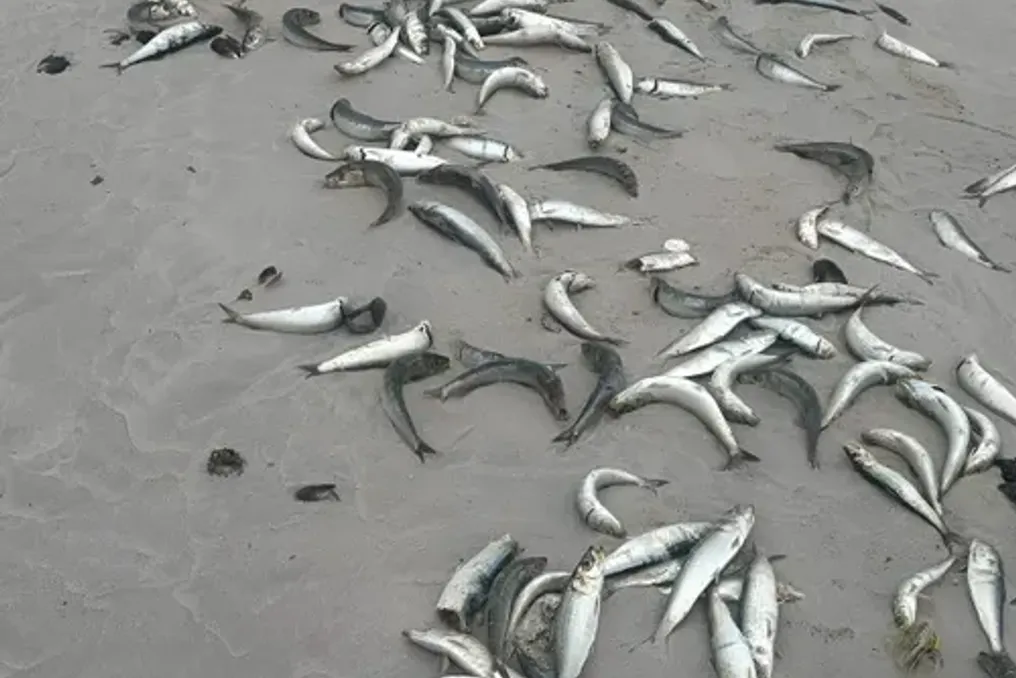
Thousands of dead sardines washed ashore on the coast of Gqeberha in South Africa last week, prompting authorities to launch a new investigation. By dawn, large stretches of the Gqeberha coastline were covered with the silvery fish.
Residents of Hobie and Pollock beaches observed waves bringing increasing amounts of fish onto the sand, intensifying fears that a virus linked to devastating mass sardine die-offs abroad might be the cause.
The local conservation group Algoa Bay Conservation described the sight as 'devastating.' This led to a surge of calls to marine scientists' offices.
Nadine Stride, a zoology professor at Nelson Mandela University, reported receiving numerous inquiries. She specified that sardines and pilchards predominated among the caught fish and emphasized that the true scale of mortality could be significantly higher than what was found on the shore, as some fish might remain on the seabed.
This mass die-off occurred just weeks after a similar fish mortality event along the West Cape coast of South Africa, located hundreds of kilometers from Gqeberha.
The increase in die-offs raised concerns that the Pacific Herpesvirus (PHV)—a disease that decimated sardine populations in Australia and New Zealand in the 1990s—could be spreading in South African waters.
The Department of Forestry, Fisheries and the Environment (DFFE) stated on Sunday that the probability of a link between the events in Gqeberha and the West Cape is considered high, although confirmation is still required. The department noted that PHV remains the primary cause of fish deaths in the West Cape, but other factors, including environmental causes, will also be investigated.
DFFE reported that the virus was first detected in South African waters in July after sardines collected near Saldanha Bay, Cape Canyon, Elands Bay, and Gansbaai tested positive. Genetic sequencing showed over 99% similarity to the strain associated with the outbreak in Australia.
Stride stated that this is unprecedented in South African history. PHV material was found in both dead and seemingly healthy sardines collected near Saldanha Bay, with the highest viral levels recorded in the deceased fish.
However, DFFE representative Zolile Nkayi clarified that this detection alone does not prove that PHV caused the deaths. Scientists are studying whether the virus is the primary cause or if it infects fish already weakened by environmental stress.
Sardine populations in South Africa are already low, and low-oxygen waters and harmful algal blooms can make them more susceptible to disease. State tests found no traces of paralytic shellfish toxin and only low levels of other marine toxins, which reduces the likelihood that algal poisoning was the main cause.
The investigation is expanding following reports of sardine die-offs along the Namibian coast. Although PHV poses no known risk to human health, the broader consequences of the outbreak are already being felt. At the Koeberg nuclear power station near Cape Town, dead sardines clogged the cooling water intake basin, forcing the national energy company to reduce power generation from one of its two units.
Scientists and conservation groups fear the repercussions may extend far beyond the fishing industry. Craig Smith, Senior Technical Specialist for WWF South Africa, reported that the organization is collaborating with government and industry representatives to respond to the outbreak. He expressed deep concern, noting that the virus destroyed 70 percent of stocks in Australia, and worries this could be the first wave, with the possibility of a more lethal second wave.
Sardines occupy a critical niche in the marine food web, serving as food for dolphins, seals, seabirds, and endangered African penguins. Stride stressed that the consequences are 'immense,' given the large number of fish lost, which could impact the environment.
In Algoa Bay, home to one of the world's most important colonies of African penguins, nature defenders believe that the loss of sardines could increase pressure on penguins, who are already struggling to find enough food. Chemical ecologist Ronelle Friend from Algoa Bay Conservation stated that due to uncontrolled fishing, penguins are already competing for food, and now, with this viral sardine die-off, the situation will worsen.
Fishing communities are also watching with apprehension. A veteran fisherman from Durban, Bonnie Adams, noted that the sardine run this year has been quieter than usual. He added, 'Now, with this virus, we don't know what to expect. We are truly concerned.'
An intergovernmental task force is coordinating monitoring, testing, disposal of dead fish, and impact assessment on sardine stocks. The Small Pelagic Scientific Working Group is expected to meet this week to discuss the need for additional management measures. However, the scale of mortality remains uncertain, and a clearer picture may emerge later this year during the annual hydroacoustic survey of sardine stocks conducted by DFFE.