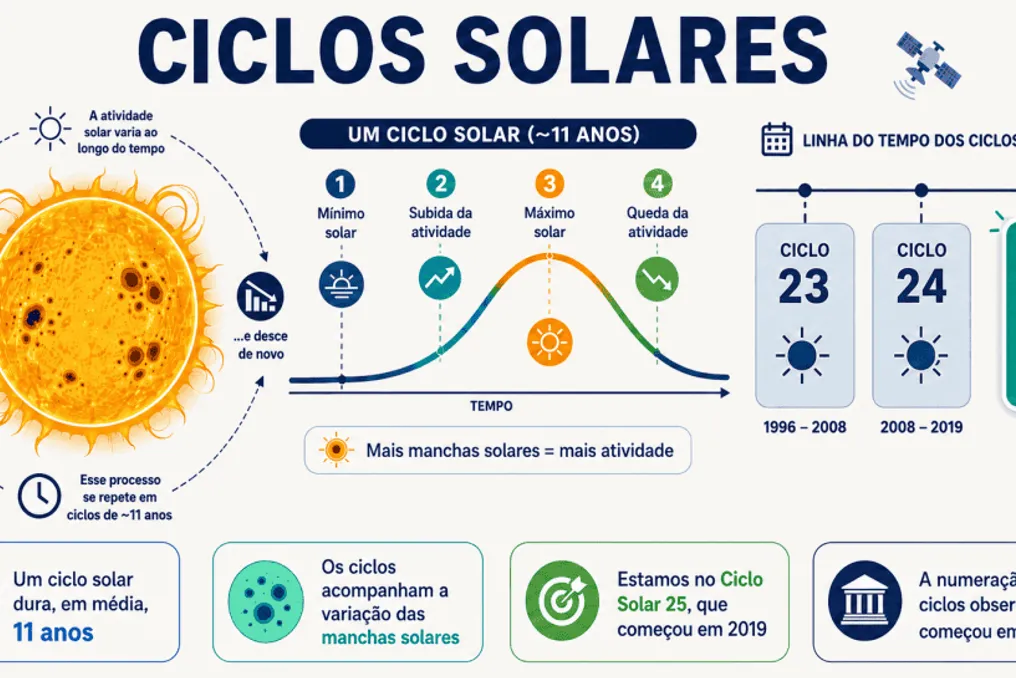
There is a hypothesis that the Sun may 'forget' its past. This idea was put forward as a result of research conducted by the University of Oulu in Finland. Scientists analyzed about 180 years of geomagnetic records and discovered an interesting pattern related to solar activity cycles.
The analysis used the aa index, which serves as an indicator of the intensity of disturbances in the Earth's magnetic field and began to be recorded in 1844. According to the data obtained, after the completion of an odd-numbered solar cycle, the characteristics of this period cease to help as effectively in predicting the strength of the next cycle.
This discovery is related to the so-called Gnevyshev–Ohl rule, proposed in 1948. This rule states that solar cycles occur in pairs, and usually the odd cycle in each pair demonstrates higher activity than the subsequent even cycle.
This behavior has been observed in most records over the last 180 years. The most recent exception occurred between cycles 22 and 23. The current pair, consisting of cycles 24 and 25, corresponds to the expected pattern, with cycle 25 showing greater activity than the previous one.
Researchers' Comments
Physicist Adriana Valio, a full professor at Mackenzie Presbyterian University and a researcher at the Mackenzie Center for Radio Astronomy and Astrophysics (CRAAM), confirmed in an interview with Olhar Digital that correlations between even and preceding odd cycles are systematically weak and insignificant. At the same time, correlations between odd and preceding even cycles are strong and statistically reliable.
According to the researcher, who did not participate in the new study, this asymmetry, noted when using different methods for obtaining variables, is not merely a sample fluctuation but represents a physical characteristic of our star's magnetic behavior.
She noted: 'It is likely what is expected from the Gnevyshev–Ohl rule and the theory of solar dynamo, according to which the toroidal field of one cycle (generating spots) originates from the polar field accumulated in the previous cycle within the 22-year Hale cycle. In other words, the 'forgetting' of the odd cycle's information when predicting the next even cycle reflects the structure of the dynamo itself (related even-odd pairs), rather than a sampling limitation.'
The study suggests that the end of an odd solar cycle represents a kind of reset point. After it, data related to past activity cease to provide relevant information about the intensity of the next cycle. Simply put, the Sun apparently does not retain useful long-term 'memory.'
This finding may complicate predictions about solar behavior. Solar Cycle 26 is expected to begin around 2030, but if the hypothesis is correct, scientists will only be able to estimate its intensity when it actually begins, but with greater uncertainty than was observed when predicting odd cycles.
Nevertheless, the fact that the 'bridge' with the previous odd cycle is broken does not mean that scientists will lose analytical tools. Adriana explained that other indicators can overcome this deficiency of direct correlation, such as observing the duration of past cycles of the same parity (analyzing the activity two cycles ago instead of one), monitoring geomagnetic activity registered at the very beginning of the new period, and using independent models focused on predicting the next solar spot cycle. The physicist added: 'By combining these clues, it is still possible to estimate the intensity of Cycle 26—just with less accuracy than if we were predicting an odd cycle.'
The activity of the new cycle will become known with greater accuracy as new solar spots and geomagnetic activity events appear. These signals will allow researchers to track the Sun's behavior and improve forecasts over time.
To reach this conclusion, the researchers applied the Gleissberg filter. This method is used to 'clean up' individual fluctuations in geomagnetic data over almost 180 years and identify the true trend of solar activity over decades.
It was this correction that allowed them to confirm the Sun's 'memory loss': the link between the intensity of one cycle and the next sharply drops after the completion of an odd cycle. Thus, as Cycle 25 approaches its end, the Sun will pass through this reset point. To predict the strength of Cycle 26 with greater accuracy, scientists will be unable to rely on the recent past and will have to monitor the appearance of the first solar spots of the new period in real-time.