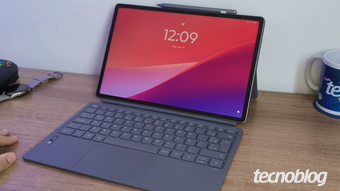
The Lenovo Idea Tab Pro Gen 2 is presented as a tablet aimed at professionals, focusing on offering a complete ecosystem for those who prioritize high performance and productivity. This model is equipped with the Snapdragon chip, features a 3.5K resolution screen, and a 144 Hz refresh rate.
Launched in May 2026, the device was priced at R$ 3,699 at the time of this analysis publication. The author tested the model over the last month to detail its strengths and weaknesses.
Tecnoblog, an independent journalistic outlet since 2005, provided the Idea Tab Pro Gen 2 on loan for testing, committing to return it afterward. The outlet's analyses are not promotional in nature.
The package that comes with the Idea Tab is comprehensive, including a 20W charger, a USB-A to USB-C cable, a microSD card key, and manuals. A major differentiator is the inclusion of a magnetic cover, a keyboard with a touchpad, and a rechargeable pen, along with an extra tip for the pen.
This Pro version represents a significant improvement over the basic model, which has a keyboard but lacks a touch-sensitive area and uses a battery-powered pen. The Idea Tab Pro's design maintains the look of the simple model: a body entirely made of brushed gray aluminum with the brand logo in embossed mirror finish. The notable structural change is in the rear camera module, which now features a rounded shape.
Compared to the first generation of the Pro version, this model is lighter and thinner, despite having a larger screen. It measures only 6.2 mm thick, compared to 6.9 mm for the 2025 model. However, the author observed that despite its features, the tablet is still considered heavy, making it tiring to hold with one hand for long periods.
Lenovo kept the volume, power buttons, and microphones on the sides of the Lenovo Idea Tab Pro Gen 2. Like the speakers, located at the top and bottom, the USB-C port and the microSD slot are also located there. The tablet also includes a magnet to hold the pen when not in use.
One point of caution is that Lenovo eliminated the P2 jack for wired headphones, and there was no advancement in water and dust resistance certification. The model retains the IP52 certification, which only protects against splashes of water and dust, which is considered limited for a second generation of a professional model.
The screen is highlighted as one of the main attributes of the Idea Tab Pro 2. The LCD panel has evolved considerably from the base model, now featuring 13 inches and a refresh rate of up to 144 Hz. This improvement provides excellent fluidity in both navigation and gaming.
The resolution was also raised to 3.5K, using a 19:10 aspect ratio, which offers a comfortable workspace for multitasking and productivity. In practice, the display shows vibrant colors, especially when playing compatible 4K content, ensuring good detail. However, there are limitations: while suitable for movies and work in well-lit indoor environments, the typical brightness of 600 nits still presents difficulties under direct sunlight.
Although the contrast does not reach the absolute black of AMOLED panels, it is considered sufficient for daily multimedia consumption. It is important to note that Lenovo does not specify whether the screen glass has any official resistance certification, suggesting caution in daily use.
Lenovo introduced audio power in the Pro version, something absent in the standard model. The four speakers demonstrate better balance in reproduction, without the metallic sound of the previous model, and offer consistent bass. The sound system features JBL technology and Dolby Atmos support, elevating the overall sound quality.
As is usual in the tablet segment, photography is not the main focus of the Idea Tab Pro 2. The camera setup maintains the configuration of the first generation of the professional line but improves upon the base model. On the back, there is a 13 MP autofocus sensor with flash. The 8 MP front camera is functional for work or study calls, provided there is adequate front lighting, such as a ring light; otherwise, the quality drops drastically in dark environments.
In terms of video recording, the device shoots in Full HD at 30 fps with the front camera and impresses by recording in 4K at 30 fps with the rear camera. However, the practical experience is limited by the absence of optical image stabilization (OIS) and optical zoom, resulting in instability and loss of quality when filming in motion.
When positioned statically, the camera setup is satisfactory, confirming that the tablet's focus is far from photography.
While the base model might struggle with heavy tasks, the Pro version transforms this scenario. A model with 12 GB of RAM and 256 GB of internal storage, expandable via microSD, was tested. The major highlight is the 4th generation Snapdragon 8s processor, accompanied by the Adreno 825 GPU. This represents a robust evolution compared to the MediaTek Dimensity 8300 of the first Pro generation and a significant leap over the Dimensity 6300 of the traditional Idea Tab.
This power translates into extremely fluid operation, without crashes. The tablet performed well in intensive multitasking, when operating in PC mode, in video editing with CapCut, and when using artificial intelligence features, such as Gemini and native Lenovo tools.
For gaming, the difference is clear: while the standard model was not recommended, the Pro offers a new perspective. In tests with Fortnite, the tablet maintained a stable frame rate with graphics set to maximum, even allowing the use of an Xbox controller via USB cable.
Technical superiority was also validated in synthetic tests. In Geekbench 6, the Idea Tab Pro 2 achieved 2,043 points in single-core and 6,254 points in multi-core, placing it among the mid-to-premium leaders.
The professional tablet comes from the factory with Android 16 and the brand's customized interface, compatible with Google's AI features, such as Circle to Search. Unlike the standard model, the processing power of the Idea Tab Pro Gen 2 resolved performance issues, allowing AI usage without interruptions, whether in research, photo correction, or video editing.
Biometrics and the use of the pen for writing or drawing worked well. However, the most surprising aspect was the use of the touchpad in PC Mode, where the author used the tablet as a secondary computer for days without major problems. Many gestures used on the author's Dell laptop work on the Lenovo touchpad, making it a viable alternative for those looking to replace a PC with a tablet.
According to Lenovo, the Idea Tab Pro will receive Android updates up to version 18 and security patches until 2030. This support is inferior to that offered by Samsung, which should be considered by those seeking longevity.
The Lenovo Idea Tab Pro Gen 2 has a 10,200 mAh battery, using the same 2-cell lithium-ion component as the first Pro generation. Although the capacity is the same as the predecessor, the autonomy is a notable evolution compared to the standard Idea Tab. In continuous use tests with the Pro Gen 2, the tablet remained powered on for 14 hours and 40 minutes during video streaming.
In a mixed daily use scenario (work, social media, and entertainment), the device can last a day and a half without needing a recharge. The charging time, however, requires more patience. Although it supports charging up to 45W, the adapter included in the box is only 20W, taking 2 hours and 26 minutes to charge from 0% to 100%.
Regarding connectivity, the Lenovo tablet has limitations, as it does not support mobile data (4G or 5G) or NFC, even being the professional version. This implies that the user will need to keep their phone with them for contactless payments and rely on a Wi-Fi network for internet access.
The device features Wi-Fi 7, Bluetooth 6.0, and a high-speed USB-C 3.0 port with DisplayPort support, allowing connection to an external monitor. However, the model only allows mirroring the screen to the external monitor, not extending it, which is a disadvantage compared to Samsung's DeX Mode.
In summary, the Idea Tab Pro 2 offers a high-definition and high-refresh-rate screen, robust performance for heavy tasks, and a battery that sustains daily routines. The complete kit, including a keyboard with a touchpad, magnetic cover, and rechargeable pen, adds value to the cost-benefit ratio.
Despite this, reaching the R$ 3,700 price range, it competes directly with more accessible Android competitors, such as the Galaxy Tab S10 FE+. The Samsung model stands out by including the S Pen, having IP68 water and dust resistance certification, supporting Samsung DeX, and offering a longer software update period, even though it has a lower raw performance processor than the Lenovo tablet. For these reasons, the Idea Tab Pro 2 becomes a more attractive option if found in the R$ 3,000 range.