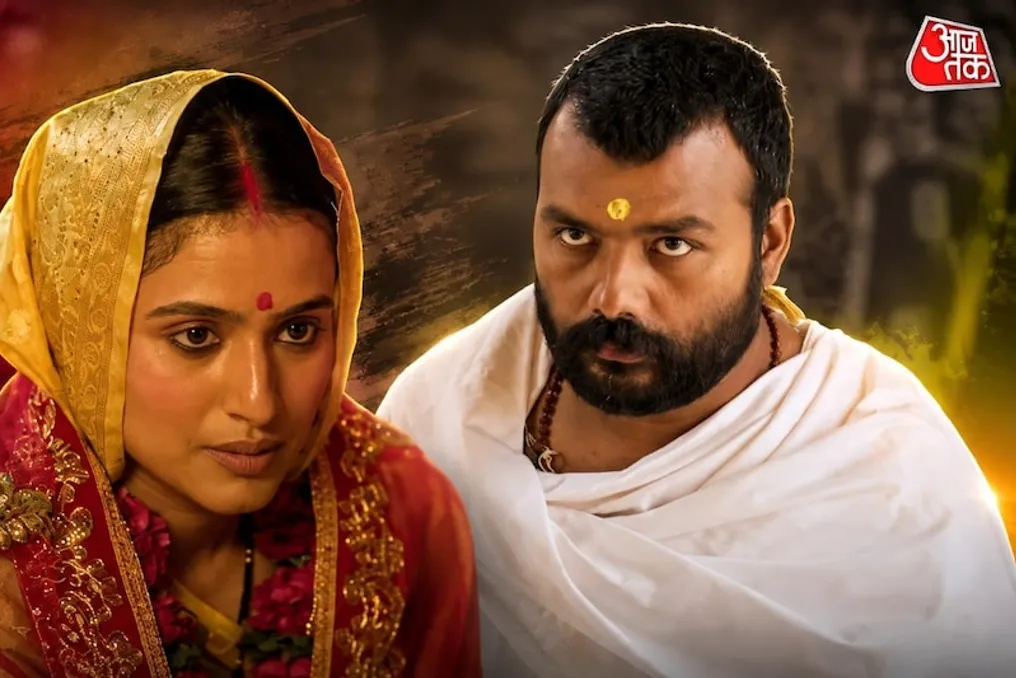
The film 'Hanuman ANSH' presents the love story of Nima Karoli Baba and his wife Rambeti, demonstrating that in a relationship, it is not necessary to be physically present, but rather to understand and respect the other person's feelings. This work showcases a small but profound episode from the life of Nima Karoli Baba that remains long in the memory of viewers.
The film illuminates the marital life of Nima Karoli Baba. Lakshmi Narayan, who was absorbed in the meditations of Sita-Rama from the age of 12, did not find happiness in marriage. He turned away from worldly temptations and spent his life in a cave-hut, later becoming known as Nima Karoli Baba.
However, the plot takes a turn when years later his father forces him to return home. In reality, he was already married to Rambeti, who had been living in the parental home all this time. Lakshmi Narayan had almost forgotten about this, and his father decided on the wedding. It is here that a very touching and soulful scene begins, accompanied by the song 'When Parvati insisted, and Saptarishi came to calm her down...'.
Baba acts as the groom and brings provisions for the house. It would seem that his family life will now gain stability. But the film reveals another facet: although Nima Karoli Baba takes on the responsibilities of the head of the family, he keeps Rambeti away from the spousal love and happiness that a woman naturally expects. Days pass, and Rambeti remains silent.
Eventually, Rambeti's patience breaks. When Baba announces that he will go to the village of Nima Karoli to meet his followers, Rambeti asks her long-standing question: 'Am I not beautiful? Is there something wrong with me?' Baba smiles and only replies 'no'. However, Rambeti's complaints do not cease. Then Baba takes several mustard seeds, places them on his tongue, and shows his wife his open mouth. What happens next deeply moves Rambeti. The mustard seed seems to sprout and turn into a flower, and Rambeti understands that her husband is not an ordinary man, but a divine figure.
After this, she does not stop him. She gathers a blanket, a pitcher, and a cloak for his journey. Perhaps the most beautiful moment of this story occurs at the end. As Baba prepares to leave, Rambeti hesitantly asks for just one thing: 'Please continue to wear your beard, it suits you so well.' Baba accepts this small request with a smile and goes to the barber to shave.
This short episode of the film, according to the author, demonstrates a very calm and beautiful form of love. There is no stubbornness in seeking love, no criticism, no cold questions and answers, no fuss or selfishness. Rambeti asked for her share of love, but it was done selflessly, within her right. But when she understood her husband's path and his true nature, she did not try to hold him back, but respected his desire.
From the perspective of worldly life, the story of Nima Karoli Baba and Rambeti may seem incomplete. The woman did not receive her husband's support, and their marriage did not become what is usually expected of a marriage. However, love is not just a physical connection; it is also a feeling. Perhaps this is where the story reaches its most beautiful goal. Rambeti had love for her husband, and Baba had respect for his wife, and sometimes these two things are enough to make a relationship complete.
The author notes that this fragment deeply touched him because he concluded that love is not always about keeping someone close. Sometimes accepting another person's path and respecting their small wish makes love complete. Although materially this story may seem incomplete, internally it rivals any famous love story in the world.
It is also reported that a second part of the film will be released soon, which may lead to a further revelation of the relationship between Rambeti and Nima Karoli Baba. According to information, Baba and Rambeti had three children—two sons and one daughter—and later Rambeti's wife began living with them, which may open a new emotional chapter in this story.