A classroom might seem like an ordinary place: rows of desks, hurried notes, a board covered in half-erased equations, and a teacher trying to explain the same thing to forty students in different ways. However, sometimes a teacher's words remain in memory forever.
It could be someone who notices that a quiet child has something important to say, tells a struggling student not to chase grades, or simply believes in a young person before they believe in themselves.
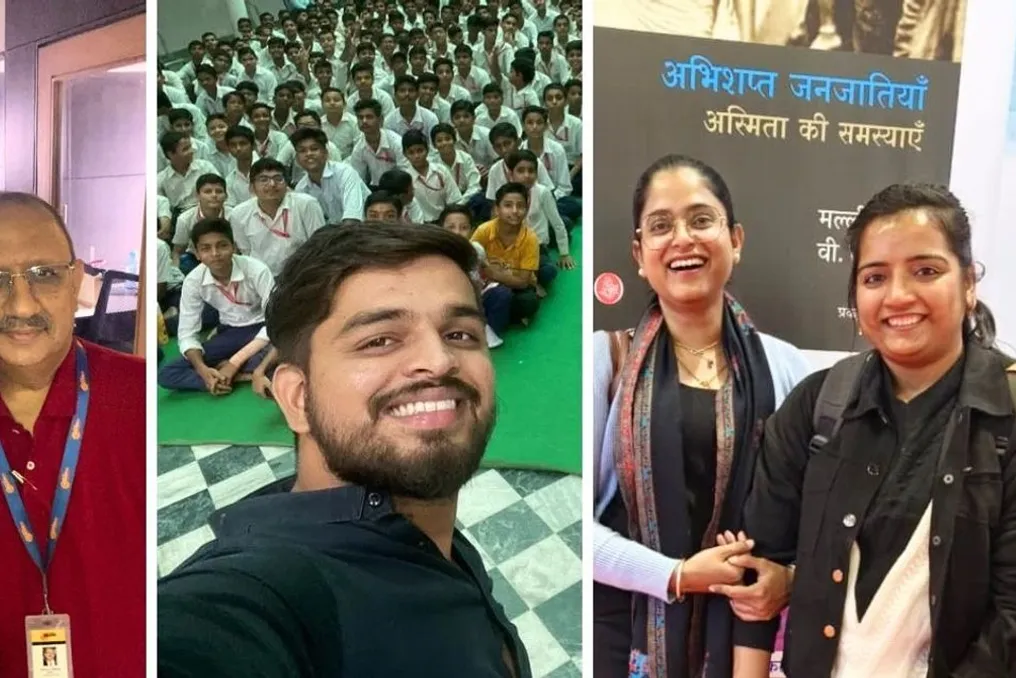
In honor of Teacher's Day, we asked our innovators about the teachers who changed their lives. For Manav Soni, who left a stable legal career to found an NGO, the lesson came from a teacher he never met in a classroom. For Vaibhav Rathore, founder of Revamp India, it was teachers who taught him to love learning and put him on stage when he was afraid. And for Richa Jain, who started teaching on YouTube with just her smartphone and now reaches about 90,000 NET and JRF aspirants through free Hindi lessons, it was her Hindi teacher who taught her to believe in herself.
Today, all three are creating change in ways they might not have imagined as students. But their life journeys carry the lessons of the teachers who shaped them.
Lessons That Remain
Manav Soni, a law graduate from Calcutta, initially wanted to become a Supreme Court advocate and possibly a judge. His plan involved an internship at a law firm in Calcutta, followed by moving to Delhi to build a legal career. However, a conversation in 2018 changed his direction.
This conversation took place with Jenny Tangri, a radio station DJ whose shows Manav regularly listened to. Tangri told him: 'Life is never easy. It becomes easy when you make it yourself. You must follow your passion, do what you love, and love what you do.' Manav considers Tangri a 'life teacher' who saw what others missed.
Manav recalls: 'He saw this passion in me, the desire to do something for society.' He also notes that Tangri believed in him, saying that even if he didn't work in the corporate sector, engaging in social work, he could become a very significant person in life.
In January 2020, Manav met Tangri and shared his growing desire to help needy people. Tangri advised him: 'Don't chase big things in life. Chase what will truly bring you many blessings, because sometimes blessings should be more important than money in your life.'
Another moment gave Manav the confidence to act on this advice. When he was working with an NGO, Tangri recommended he take on a client under a CSR program. Manav was nervous about working with such a large company. In the evening before the meeting, Tangri called him around 11 PM and helped him prepare—what to present, how to speak, and how to demonstrate his ability to handle the responsibility. The meeting went well, and soon Manav began planting trees and engaging in community initiatives.
'For him, it was a small gesture. But for me, it changed my life,' he says. Later, when Manav left his high-paying legal job for social impact, he reached out to Tangri again. He cried and asked, 'Sir, what am I doing with my life?' Tangri listened to him, then gave him a piece of paper and asked him to write down what he truly wanted. Manav wrote: 'I want to follow my dreams. I want to follow my passion, but I don't have someone to support me.'
Tangri's answer was simple: 'Regardless of who is around or not, I will support you.'
Today, Manav leads the Funsmart Knowledge Solution Foundation, which has planted over 4,000 trees, collected 12 tons of plastic waste, and influenced hundreds of thousands of people. However, when asked what he thinks Tangri would be most proud of, Manav does not mention the numbers. 'The person I have become,' he says. The connection continues: Manav calls him every Friday to share the week's good news. When his story appeared in Dainik Bhaskar, Tangri ordered a copy from another city and placed it in his office. For Manav, this may be the greatest gift a teacher can give—not a lesson to memorize, but the confidence in what you are capable of becoming.
For Vaibhav Rathore, some of his earliest lessons came from the classroom, but not always from textbooks. His history teacher, Reshu Tiwari, changed his view on learning. He says: 'I stopped chasing ranks and exams thanks to her lessons. I felt like I could understand so many things in class.'
She taught history through stories, bringing events like the Battle of Panipat and the Indus Valley Civilization to life. His math teacher, Vipul Sir, gave him another important lesson: confidence in public speaking. In the 9th grade, Vipul Sir asked Vaibhav to recite a quote at the school assembly. He was terrified. The teacher simply asked, 'What is the worst that could happen?' Vaibhav went on stage to read: 'Do not look for mistakes, look for solutions.' He recited it nervously incorrectly and finished: 'Thank you and have a nice day.' It wasn't his best speech, but it was a start. By the 11th grade, he was the captain of the sports team and conducted assemblies himself. He laughs: 'I said the quote wrong, but after that, my life went in the right direction.'
'Reshu Ma'am also taught me to be proud of my work, regardless of recognition. 'Whatever work you do, you must do it with complete dedication, regardless of the result,' asserts Vaibhav. Today, this philosophy shapes his work with schoolchildren through the Revamp India Foundation. Through initiatives like Faldaar, students have helped saplings achieve a 75% survival rate by developing a personal connection with the saplings they plant.'
His teachers also influenced how he interacts with children. He recalls visiting their homes during Holi as a child. Today, when children surround him after seminars for photos and autographs or write him messages with questions, he feels the same connection. 'I feel like I did something right,' he says. During a seven-day program in 11 districts on pre-exam stress reduction, one session lasted over four hours because the children kept asking questions. Many still write to him. For Vaibhav, listening to children is part of what makes a good teacher, alongside a genuine love for the work and hard work for the students.'
Richa Jain describes herself as an ordinary student. Academic performance was never her main passion; like many students, she just wanted to get good grades and move on. This experience, she says, helps her understand her students today.
The teacher who changed her self-perception was Dr. Sakshi Singh, her Hindi teacher. 'She didn't just teach me the subject; she taught me to recognize my potential and trust my own abilities,' says Richa. Their relationship extended beyond the classroom. Richa could share personal and family problems with her, seeing her as both a teacher and an older sister.
During exam preparation, poor results could sometimes upset Richa. Dr. Singh advised her not to compare herself to others. Instead, she should focus on what she learned that day and whether she was better than the day before. She also assured Richa that she would pass the exam in the end. This advice stayed with her. Even today, when facing setbacks, she asks herself: 'Am I a little better today than yesterday?'
During the COVID-19 pandemic, Richa had time for reflection. After passing the NET/JRF exam while studying, she realized that her preparation and knowledge could help other students needing guidance. She started sharing her knowledge online, using only her smartphone at first. What began as an attempt to ease students' preparation turned into a community of about 90,000 NET and JRF aspirants through her free Hindi lessons. This experience also shaped her view of what a teacher should be. 'The role of a teacher should be to empower the student so they can ultimately make their own decisions,' she says. For Richa, teaching is not about creating dependence on the teacher, but helping in achieving self-sufficiency. She hopes Dr. Singh sees the same lesson in her work. If her teacher visited her class today, Richa said she would ask for honest feedback. 'I still want to learn from her.' And there is one thing she would like to tell her teacher: 'Madam, the student you taught to believe in herself—today I strive to instill that same belief in my students.'
Perhaps this is what distinguishes teachers from people standing at the front of the class. Their words can become an anchor. Their support can give someone the courage to take a risk. Their belief can stay with a student long after they leave the classroom.
For these innovators, the teachers who shaped them taught different lessons, but the impact was the same. Sometimes a teacher changes a student's life without knowing how far that single lesson will spread.