The use of intelligent applications previously required significant financial investment for companies, as creating even a basic chatbot or coding assistant incurred enormous inference bills. This situation posed serious difficulties for tech startups aiming to scale their platforms, since developers faced exorbitant costs for computing power just to keep systems operational.
However, this barrier is beginning to crumble. A significant shift is being observed: AI token prices reached a record low this week, effectively changing the rules of the entire technology ecosystem.
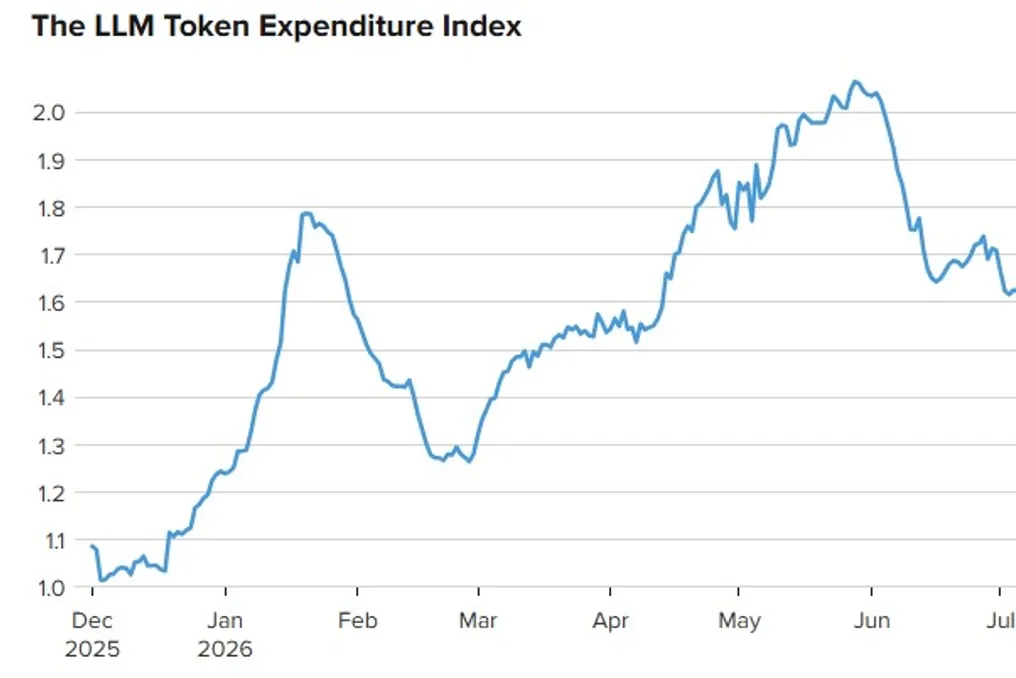
According to Silicon Data, the LLM token cost index dropped to 97 cents, representing an impressive 50% decrease compared to the early summer peak. The reason for this sharp decline is the intensifying competition in the AI market. Chinese developers have begun releasing highly efficient open-weight models that are significantly cheaper than Western tech giants.
Kimi K3 from Moonshot AI serves as an example. This model not only matched the quality of results for everyday coding and summarization tasks but also substantially reduced access fees. This flooded the market with incredibly cheap and capable alternatives.
As a result, businesses no longer had to pay a premium for simple data queries, and supply finally matched demand, perhaps even exceeding it. The consequence was a fierce and aggressive price war, forcing everyone to react.
OpenAI intensified the pressure at the end of July by aggressively lowering prices for two of its anticipated GPT-5.6 models. This move further lowered global token prices, setting a new floor for the industry. Other leading labs immediately reacted, and the entire industry began implementing dynamic pricing models where access costs decrease as API demand falls.
This is favorable for the developer community but poses a threat of margin compression for companies like Anthropic and OpenAI. These corporations still bear fixed, astronomical costs for building multi-billion dollar data centers, while the price they can set per unit of machine intelligence is constantly decreasing.
Raw computing power is no longer a reliable defensive barrier. If inexpensive open-source architectures can reliably handle 90% of enterprise tasks, having only a slightly smarter LLM will not save the business model. The fundamental technological gap is rapidly closing.
Therefore, these innovative companies are shifting the focus of their competitive battle. Instead of simply selling raw analytical intelligence, they are actively fighting for software ecosystems, deep penetration, and persistent long-term memory. Leading model developers quickly realize that robust context windows matter far more than a slight reduction in inference time.
For startups, the drop in inference cost makes deploying autonomous AI agents and complex corporate automation economically viable for the first time. However, traditional Wall Street investors may need to seriously reassess the situation. Tech giants like Nvidia and Microsoft have invested billions in advanced chips and extensive cloud infrastructure, expecting astronomical guaranteed profits.
But if strong token deflation continuously squeezes revenue metrics, these massive capital investments may take much longer to recoup. This is a paradoxical modern situation: digital intelligence is rapidly becoming infinitely abundant and extremely cheap. The main question now is how these multi-billion dollar corporations will survive the price collapse they helped create.