Results of admission to master's programs at state universities published in Uzbekistan for the 2026/2027 academic year
Read more
Podrobno.uz [uz]
podrobno.uz

Results of admission to master's programs at state universities published in Uzbekistan for the 2026/2027 academic year

The results of admission to master's programs at state higher education institutions in Uzbekistan for the 2026/2027 academic year are now available.

The Ministry of Higher Education, Science and Innovation reported that all applications submitted by citizens through the electronic system my.edu.uz or the Unified Portal of Interactive Government Services my.gov.uz have been reviewed.

Information on admission results can be found in the personal account on the my.edu.uz platform.

Furthermore, students were previously provided with clarifications regarding the procedure for applying for dormitory accommodation at state universities. This can be done remotely through the Unified Portal of Interactive Government Services or using the kontrakt.edu.uz system. The application process began on August 1st and will continue until the end of the current academic year.

Similar stories

Nearly one in six university graduates in Uzbekistan faces difficulties finding a job
Read more
podrobno.uz

Nearly one in six university graduates in Uzbekistan faces difficulties finding a job

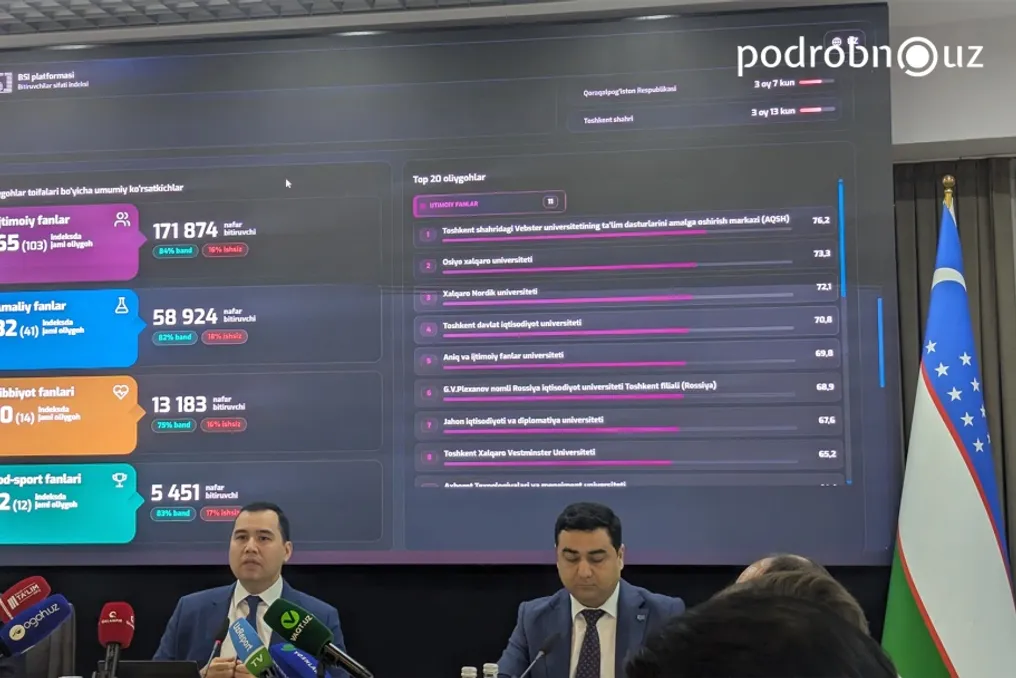
Although most higher education students in Uzbekistan find employment after graduation, about one in six graduates remain unemployed. This data was obtained from an analysis of the employment status of 249,432 graduates who completed the 2024/2025 academic year.

A correspondent from Podrobno.uz studied the results of the study titled 'Graduate Quality Index,' conducted by the National Agency for Education Quality Assurance. This analysis covered graduates from 170 different higher education institutions. On average, students required three months and five days to find their first job.

Differences in Employment Chances by Field of Study

Employment opportunities significantly depend on the specialty. The most favorable situation is observed among graduates in socio-humanitarian sciences, where 84% of specialists found employment. High rates were also noted in creative and sports fields (83%) and practical sciences (82%), while the percentage of employed graduates in medical sciences was 75%.

It should be noted that the statistics for the medical field require further verification, as the provided information states that 16% of graduates could not find a job, although the overall employment rate for this sector is 75%.

Job Search Duration and Employment Stability

The fastest job search period was recorded among graduates of private universities—they found jobs in an average of two months and ten days. In state universities, the average period was two months and twenty-nine days, and at branches of foreign universities—three months and twenty days.

Nevertheless, having a job does not guarantee long-term stability. Only 42.9% of all graduates managed to maintain permanent employment over the last six months. This figure was lower among graduates of state universities (42.1%), higher among private ones (46.7%), and highest among graduates of branches of foreign universities (49.8%).

Income and Rating Leaders

The average official salary of graduates is estimated at 4.9 million soms per month. In the capital, Tashkent, this figure is higher—6.6 million soms. The highest earnings were recorded at Inha University in Tashkent (12.6 million soms), Westminster International University of Tashkent (12.5 million soms), and the University of World Economy and Diplomacy (10.6 million soms).

According to the study results, the State Conservatory of Uzbekistan was recognized as the leader of the Graduate Quality Index, scoring 81.5 points. Second place was held by the Nukus Branch of the State Conservatory with a score of 79.6 points, and third place went to the Webster University Educational Programs Implementation Center in Tashkent, which received 76.3 points.

The index is calculated automatically using data from ten state information systems and takes into account parameters such as speed of job acquisition, employment stability, income level, and form of employment.

Number of foreign universities in Uzbekistan increased more than fourfold over ten years
Read more
podrobno.uz

Number of foreign universities in Uzbekistan increased more than fourfold over ten years

The number of foreign higher education institutions in Uzbekistan has significantly grown over the past decade. At the beginning of the previous academic year, 30 foreign universities were operating in the country, which is an increase of 4.3 times compared to the previous period.

According to information from the National Committee on Statistics, only two foreign higher education institutions operated in Uzbekistan in the 2005/2006 academic year. By the 2010/2011 academic year, their number had increased to six.

Subsequently, in the 2020/2021 academic year, the number of foreign universities reached a threefold increase, totaling 18 institutions. An additional 12 such organizations were added over the next five years.

As a result, over a period of two decades, the total number of foreign higher education institutions in Uzbekistan has increased fifteenfold. It was also previously mentioned that a branch of Liaoning Normal University of China was opened in Khiva, intended for training specialists in artificial intelligence and tourism.

Discussion in Uzbekistan on changing the scoring system for applicants with national certificates
Read more
podrobno.uz

Discussion in Uzbekistan on changing the scoring system for applicants with national certificates

Uzbekistan is considering a potential adjustment to the current methodology for assigning maximum scores to applicants who possess national certificates. This issue is currently under review in collaboration with the Agency for Assessment of Knowledge and Qualifications, according to Sardor Rajabov, the first deputy minister of higher education, science, and innovation.

Rajabov explained that the exams for obtaining a national certificate differ from standard entrance examinations: they include open-ended tasks, and results are calculated using the PISA model. In contrast, regular tests use closed questions, which creates a risk of randomly guessing answers.

It is noted that the number of applicants holding national certificates is increasing year by year. According to Rajabov's forecasts, their numbers may exceed those taking traditional entrance tests in the coming years.

Currently, holders of A+ and A level certificates receive full marks for the corresponding profile subject. For B+, B, C+, and C level certificates, scores are distributed proportionally to the achieved result. Furthermore, all certificate holders receive the maximum score for the mandatory subject, regardless of their level.

Despite the discussions, a final decision on modifying the existing system has not yet been made. Experts need to assess the validity of the current system and analyze its impact on the admission campaign. Any potential changes will be announced later.

Additionally, there was previous information that children of medical and pharmaceutical workers with at least fifteen years of experience in state institutions would receive compensation equivalent to thirty percent of the annual tuition fee at state universities, provided this amount does not exceed fifteen BRV.

Popular