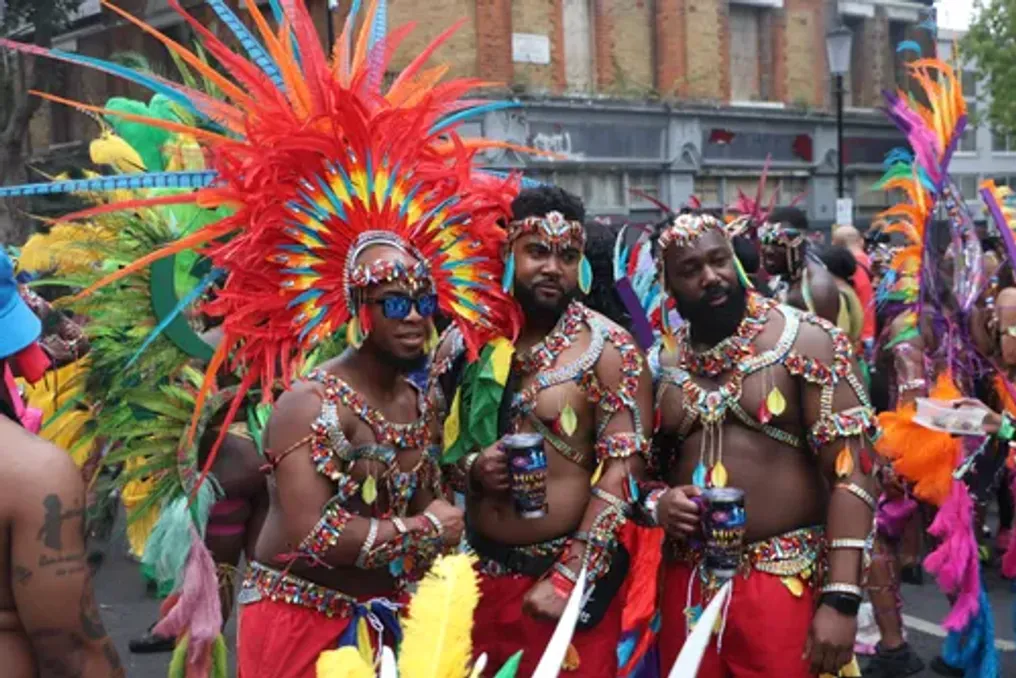
For Sarraunia Samuels, who was born in London, the annual Notting Hill Carnival signifies a feeling of freedom. She notes that since early childhood, she was surrounded by the carnival atmosphere as music trucks passed by her home.
The Notting Hill Carnival is an annual event in the Notting Hill area of London, originating from the first 'Caribbean Carnival' held at St Pancras Town Hall in 1959. The history of this event includes an indoor carnival organized by Claudia Jones in 1959, racial tension, and the street event in Notting Hill in 1966, organized by Ron Laslett.
Since then, it has become a two-day event held at the end of August, attracting up to two million people and generating an annual revenue of £396 million.
Sarraunia Samuels, whose mother is from Cape Town, participated in the parade that goes through Notting Hill—the area where Caribbean immigrants first settled in London. Each parade carries either a sound system or a live band playing Caribbean music. Men and women in bright costumes follow these parades, with some costumes representing different Caribbean countries and cultures.
Samuels views the carnival as a moment of 'liberation from oppression,' emphasizing that it is a time for self-expression and joy. She says that creativity, clothing, and makeup are part of her culture and DNA, and she feels comfortable in it.
Samuels has mixed heritage: her mother was classified as coloured during apartheid in South Africa, and her father is a white Englishman. She started participating in the carnival through her Caribbean friends. During her studies, she was mainly surrounded by girls from the Caribbean; her friends were from Jamaica and Trinidad, and her cousin introduced her to the carnival.
Preparing for the carnival involved decorating costumes. Samuels recalls that in childhood, they helped create costumes, and she strives to maintain this tradition of creativity.
Her mother, Moira Samuels, was born in Cape Town, where the annual Tweede Nuwe Jaar carnival also has roots in the theme of oppression, marking the day of celebration of New Year by slaves in colonial Cape. Samuels notes that her mother constantly fought for liberation and the right to visit certain areas where she was forbidden to go in her youth. When she arrived in London, she was warmly welcomed by the Caribbean community due to shared hardships.
Moira Samuels, who has lived in London since 1979, recounted how her aunt from South Africa took her to the first Notting Hill Carnival. She described it as an unparalleled feeling of liberation, distinct from any other carnival, because it is based on community.
Moira Samuels has lived in the area for 40 years, and she notes that residents living in the carnival zone receive visitors from outside who come for two days to socialize and have fun. Furthermore, Moira Samuels participated in the fight for justice for the victims of the Grenfell Tower fire near her home and in the Notting Hill carnival area. The Grenfell building fire occurred in 2017 and resulted in the deaths of 72 people and injuries to another 70.
At the current Notting Hill Carnival, a 72-second minute of silence was observed in memory of the 72 people who died in the fire.