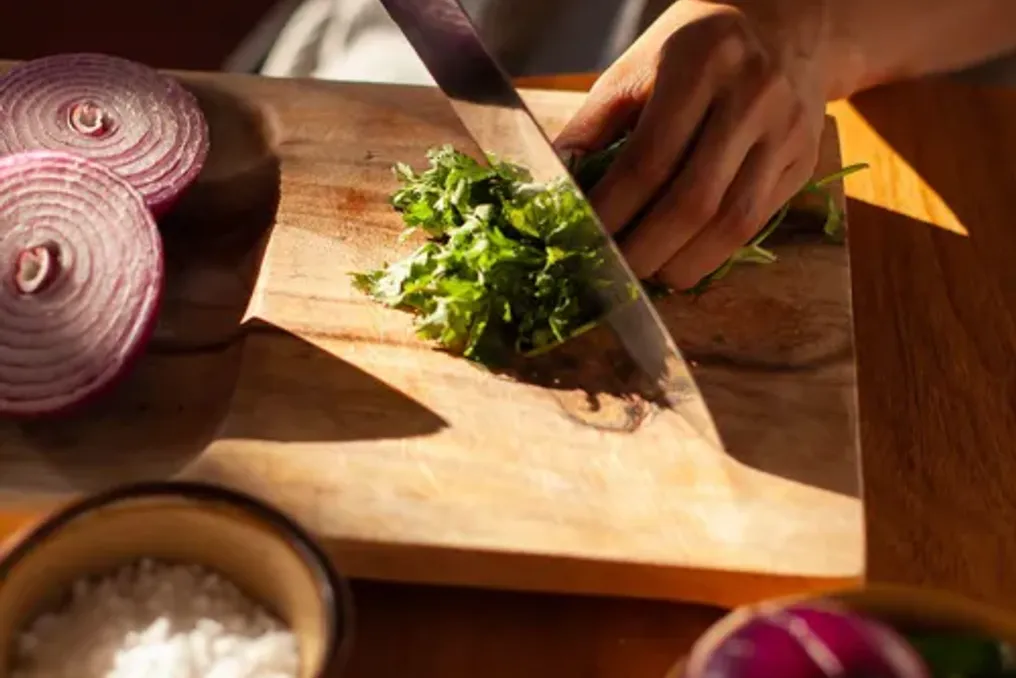
Although a large knife block might give the impression of a well-equipped kitchen, having a dozen different knives does not necessarily simplify the cooking process. Many people have likely opened a drawer or looked at a knife block and wondered when they last used some of them. Therefore, the purchase of kitchen knives should be aimed not at collecting every possible type, but at choosing a few versatile tools that suit your cooking style.
Three Types of Knives Worth Considering
There is no single list that suits every family, but three types of knives can serve as a useful starting point for many kitchens: a chef's knife, a paring knife, and a serrated knife. The important difference is that the serrated knife is useful not only for bread.
Chef's Knife
The chef's knife is generally the most versatile tool in the kitchen. It is suitable for many everyday food preparation tasks, which is why it is often chosen. It is especially useful when working with large ingredients and general preparation, making it a sensible choice when setting up a kitchen from scratch. The main principle here is versatility. Instead of buying several knives for slightly different tasks, one good multi-functional knife can cover a significant portion of daily preparation. The chef's knife is indispensable.
Paring Knife
The paring knife is a more compact option, useful when a larger knife would be cumbersome. It is ideal for small, precision tasks and can be very convenient when working with small produce. It is unlikely to replace a chef's knife, but that is not its primary purpose either. Its value lies in its small size and ease of handling for tasks where a large blade is not required. The paring knife comes in handy when something smaller than a chef's knife is needed.
Serrated Knife
Many perceive this knife solely as a bread knife, but its usefulness extends beyond that. The serrated blade is particularly suited for foods that need to be cut on the outside without exerting excessive pressure on the soft interior. This makes the serrated knife useful for bread, rolls, tomatoes, and some soft fruits, as well as for items like cakes, where a clean cut through a delicate center can be beneficial. Thus, if you are deciding whether a serrated knife deserves a place in your kitchen, you should think more broadly than just about bread. Toothed knives can be used for more than just slicing bread.
Why Quality Matters More Than Quantity
If you are going to spend money on kitchen knives, there is a strong argument to invest that budget in a few reliable pieces rather than buying the largest set you can afford. Tools you use frequently naturally wear out more than those sitting untouched in the back of a drawer. When assessing quality, pay attention to the overall construction and the feel of the knife in your hand. Comfort, balance, and a secure grip are important aspects for an item that will be used regularly. Maintenance also matters. A good knife still requires proper care, so consider whether you are willing to maintain it rather than viewing it as a disposable item. And remember that expensive does not always mean superior. The right knife is one that fits your kitchen, your cooking habits, and your budget. When choosing a knife, comfort, balance, and a secure grip are important factors to consider.
Buy According to How You Cook
A person who bakes regularly will have different priorities than someone who mainly cooks quick meals during the week. Similarly, someone who often cooks from scratch may have different needs than someone who relies on pre-made ingredients. This is why there is no magic number of knives that every family needs. Start with the tasks you actually perform. If you constantly feel that you lack a certain tool, that is a much stronger reason to buy it than if it is included in a 15-piece set.