This university created an artificial intelligence curriculum even before the release of ChatGPT. It now intends to share its experience with other schools.
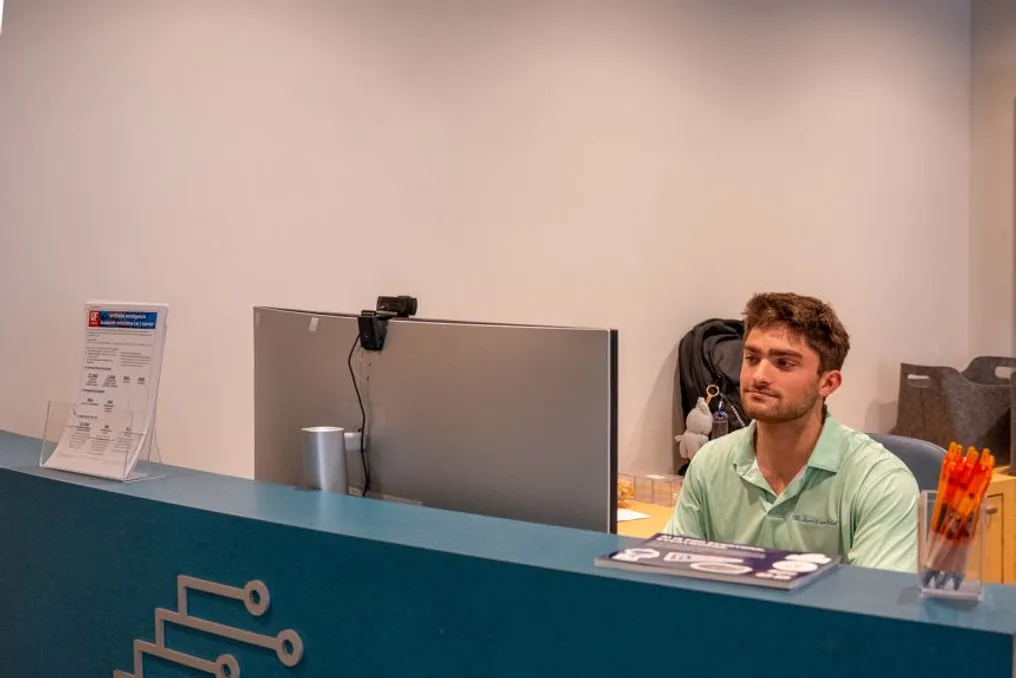
Ethan Pecora uses a team of 15 specialized AI agents to assist with his work, including calendar management and tasks related to the mental health application he is developing, as well as for his studies. Although his setup resembles a startup, Pecora is a senior at the University of Florida studying business and communications.
Pecora calls his system a 'second brain' but expressed dissatisfaction with the term, finding it 'a bit dystopian.'
The University of Florida has been integrating AI into its curriculum since 2022, predating the arrival of ChatGPT, largely thanks to investments from chip giant Nvidia. The university aims to teach students how to professionally apply this technology across all disciplines, not just technical ones.
Students have already used AI to train chatbots that assist with exams and to catalog dance movements to help dancers protect their intellectual property. The school currently offers over 200 AI courses, covering fundamentals and ethics, accessible to any student or faculty member regardless of their technical background. There are also AI certifications for specific fields such as hospitality and public health.
Joseph Glover, Vice President of the University of Florida, emphasized that it is incorrect and unhelpful to consider AI education something that should be restricted to the College of Computer Science or the College of Engineering. He noted that otherwise, using AI would require constant engineering presence.
There is a complex and polarizing debate surrounding the impact of AI on education and early careers. Students and faculty are facing a world where jobs may radically change due to rapidly evolving technology. These concerns are present at the University of Florida too; some students have opposed the technology despite the school's progressive approach to AI, and reports of AI-related academic misconduct are beginning to emerge.
One way to address these issues is by holding an international summit where the school hosts panel discussions on the role of AI in education and shares its model with other institutions. In 2026, nearly 500 people from 10 countries and 40 US states attended the conference.
Andrea Ramirez Salgado, a professor in the College of Engineering who participated in developing the university's AI curriculum, stated that 'AI will soon be like the internet. It's just technology.' However, she added that to drive and stimulate innovation, one must understand 'what is under the hood.'
The University of Florida gained an early advantage through close ties with Chris Malachowsky, co-founder of Nvidia, a $5 trillion company at the center of the AI boom. Malachowsky graduated from the university in 1980 and serves on the foundation board that supports the school through various investment and advocacy efforts.
As early as 2018, he informed the University of Florida Board of Trustees that the school should begin developing an AI strategy. Then, in 2019, a meeting between Malachowsky and Glover laid the groundwork for the program. Initially, the school wanted Malachowsky to invest in a new engineering program, but the Nvidia co-founder proposed a different idea: he asked the vice president what the school would do with an AI supercomputer—a high-performance computer often used for research.
Malachowsky told CNN: 'His answer, and I say this without hesitation, was: 'I don't know, I think I will teach AI across the curriculum.'' In addition to the supercomputer, named HiPerGator, the school hired 100 new faculty members to integrate AI across all 16 colleges. The total investment to launch the program amounted to $95 million from Nvidia, the University of Florida, and the state.
Employers are increasingly demanding AI experience. According to the National Association of Colleges and Employers report for Spring 2026, over a third of entry-level vacancies required AI skills, almost three times more than last year.
Even if academic institutions did not widely implement AI in their curricula, they had long been monitoring the technology. Carnegie Mellon University began offering an AI bachelor's degree in 2018, and the Milwaukee School of Engineering announced the creation of a new academic center to promote AI education in 2017.
Unlike the University of Florida, Kelvin Bentley, Director of Community Practice at the National Association of Higher Education Systems, noted that 'there are more institutions that are simply trying to teach their faculty 'What is AI?' and how to use it.'
Emma Mackie, an assistant professor in the Department of Geological Sciences at the University of Florida, was one of the faculty hired to accelerate these efforts. She and her students use AI and other tools to model landscapes by processing vast amounts of data and physical models. Last year, they mapped the topography beneath the ice sheets in Antarctica.
One of the challenges is keeping up with constantly evolving technologies. As she explained, a lab assignment prepared by Mackie became obsolete by the time of the class. She described it as a 'very unpleasant' moment when she stood in front of the class and her code didn't work.
Pecora also observed that not all courses are as beneficial as they could be. An AI course in business that he took in 2024 taught students to automate certain tasks by writing code, but he felt it was more like a short course in Python programming language than an application of AI.
AI can also change assessment methods. Mackie allows her students to freely use AI but now grades papers based on factors such as originality and 'maturity of ideas.' She notes that 'it's easier to get a 'C' for this assignment, but harder to get an 'A'. '
Initial concerns about AI in education mainly revolved around its potential for cheating. However, more existential anxieties later emerged, such as adequate student preparation and the technology's impact on career prospects.
Graduates from the University of Arizona and the University of Central Florida protested mentions of AI during commencement speeches last year. A May survey conducted by the educational news site Inside Higher Education among over 1000 students from 203 institutions showed that forty percent were worried that AI was diminishing their ability to think independently. Only 7% of students said they were 'fully ready' and 'genuinely excited' about the potential of AI.
Mackie believes that 'many students... feel very anxious about AI. They dislike what it is doing to their career prospects, and they have very little faith in the outcomes, which I think is great.'
Even at the University of Florida, there are concerns. One professor completely abandoned homework and began basing grades solely on in-class quizzes to prevent AI use, reported Tristan Robbins, a senior studying sports management, statistics, and economics at the University of Florida.
According to public data published this year by The Independent Florida Alligator, the number of reports of AI-related academic misconduct increased from zero in Fall 2021 to 66 by April 2025. A university representative stated that the university encourages responsible AI use, and students must 'strictly follow the instructions of their course instructor, academic advisor, or other academic supervisor' when using AI for educational purposes.
Furthermore, Salgado noted that students are concerned about AI's environmental impact and feel they have less sense of ownership over their work.
Malachowsky from Nvidia admitted that these issues are difficult to solve. However, he stated that rejecting this technology is a big mistake. 'I cannot promise that AI literacy and its widespread adoption is the answer,' he said. 'But I am firmly convinced that inaction, ignoring it, or trying to shove it back in a box is a death sentence. There is no positive outcome from that.'