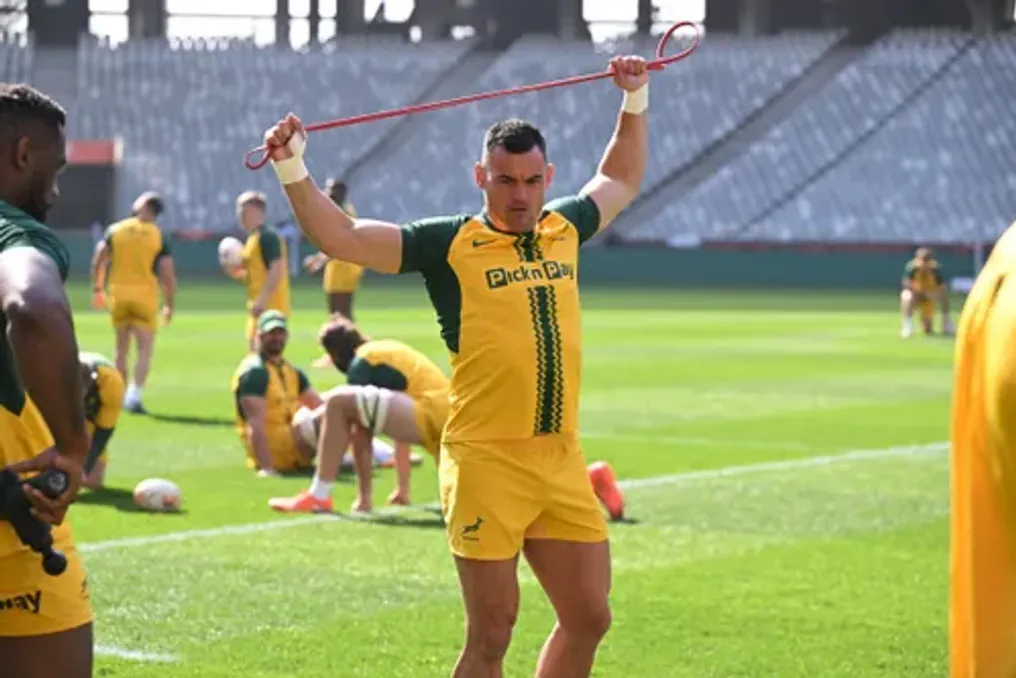
The ferocious rush defense of the Springboks, which has served as a cornerstone of their success for nearly a decade, is showing signs of weakness this season.
This defensive system, designed to stifle opposing playmakers, restrict width, and provoke mistakes, is known for its intense commitment. However, the Springboks have recently conceded an unusual number of tries, not only during the current high-stakes series against the All Blacks but also in their Nations Championship fixtures against England and Scotland.
The defensive frailties have manifested in several ways. Against Scotland, the Boks were repeatedly vulnerable to inside balls, as attackers capitalized on minor gaps created when defenders advanced too aggressively without securing their inner shoulder.
A similar vulnerability was observed when playing Ireland at home in 2024, where runners exploited weaknesses by attacking both sides of the ball carrier before executing a quick inside pass.
Противостояние величайших соперников регби
Against the All Blacks, the problems have surfaced on the wider parts of the field. A contributing factor involves positional inaccuracies within the rush structure, which were worsened by necessary backline adjustments during the first two Tests.
In the initial Test, injuries in the backline required central defensive linchpin Jesse Kriel to move to the wing, which immediately compromised the communication center at the outside centre position.
During the second Test in Cape Town, indecision regarding structure proved detrimental on the edges. Ethan Hooker, despite performing well overall, struggled with defensive shifts, being unsure whether to defend narrowly or hold wide, leaving him exposed as New Zealand utilized the outer channel.
The All Blacks have also demonstrated clever adaptations to circumvent South Africa's line speed. In Cape Town, New Zealand's attacks frequently originated from deeper positions before initiating their plays. By maintaining a deep stance, their playmakers gained valuable extra time, compelling the Bok rush to overcommit prematurely before distributing the ball through passing lanes into the open space near the outside shoulder.
Flyhalf Ruben Love has been instrumental in this strategy, supported by forwards who delivered superior ball through short passes from the backfield compared to their Springbok teammates. Love consistently appears behind the play after making an initial pass, acting as a reserve player who has significantly troubled the Boks in these wide areas.
Historically, the Springboks have relied on their exceptional scrambling ability to neutralize line breaks. However, the current All Blacks squad possesses such high quality that they have managed to inflict damage whenever given even a slight opportunity.
Acknowledging this danger, the Springboks implemented a significant tactical change in the second half at DHL Stadium. Instead of attacking from the outside-in to suppress the ball carrier, they switched to defending from the inside-out, prioritizing alignment, drift, and tracking to seal off the wide channels.
As the Springboks prepare for the third Test at FNB Stadium in Soweto, improving the precision of their rush defense is crucial, as it remains a powerful tool when executed correctly. The system depends entirely on players making astute choices to enter passing lanes without overextending, while simultaneously committing fully to intercepting both the opponent and the ball.
To regain their formidable reputation, the Boks must eradicate hesitation on the edges and reinstate the precise, suffocating discipline that once earned them world championship status.